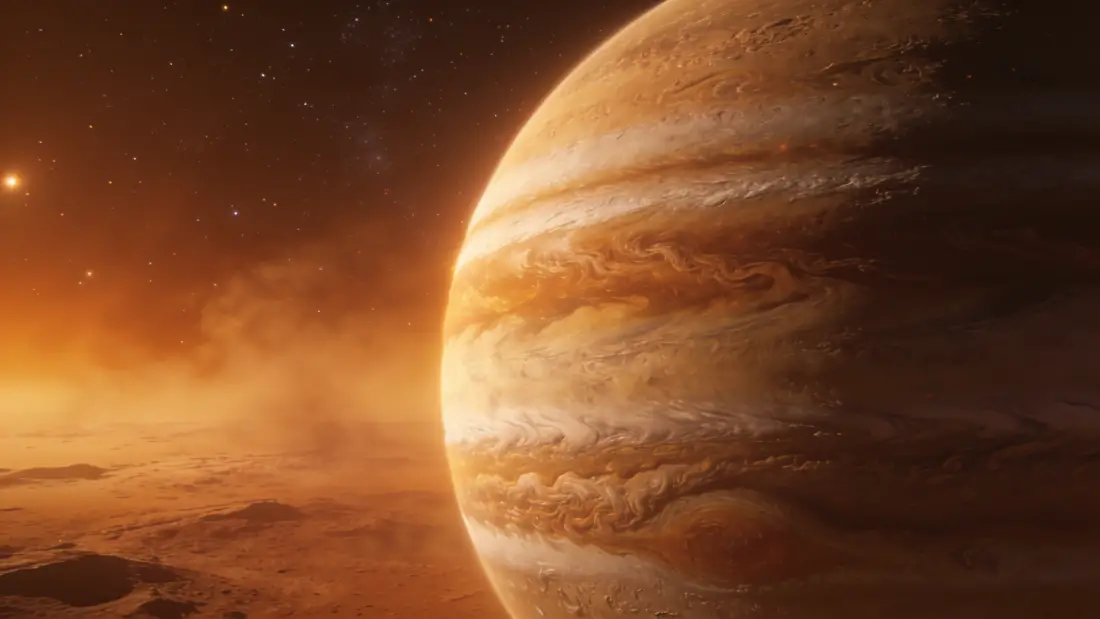
Kepler-1593 b: A World Where Water Might Be Possible

Kepler-1593 b: A World Where Water Might Be Possible

August 2, 2026

Kepler-1593 b: A World Where Water Might Be Possible

Kepler-1593 b is a faraway planet that sits in the zone around its star where liquid water might be possible. Scientists don't know yet if it has water or life, but its location makes it one of the more interesting worlds worth watching.

KEEP READING
Meet DMPP-6 b: A Newly Found Mini-Neptune

August 1, 2026

Meet DMPP-6 b: A Newly Found Mini-Neptune

DMPP-6 b is a newly confirmed planet 178 light-years away, and it completes an entire year in just 7.6 days! It belongs to a type of planet called a mini-Neptune — one of the most common kinds in the galaxy, but totally absent from our own solar system.

KEEP READING
How Far Away Is GJ 15 A b?

July 31, 2026

How Far Away Is GJ 15 A b?

GJ 15 A b is one of the closest exoplanets to Earth, sitting just 11.6 light-years away — but even at that short distance, it would take tens of thousands of years to reach it. Find out what this super-Earth is like and how scientists discovered it.

KEEP READING
TOI-5159 b: Getting to Know a Super-Earth

July 30, 2026

TOI-5159 b: Getting to Know a Super-Earth

TOI-5159 b is a super-Earth located 180 light-years away, and it is bigger than our planet but smaller than Neptune. Scientists are working to figure out what this mysterious in-between world is made of — and the clues are pretty surprising!

KEEP READING
Meet the TOI-1136 System: 6 Worlds Around One Star

July 29, 2026

Meet the TOI-1136 System: 6 Worlds Around One Star

About 276 light-years away, a star called TOI-1136 has six planets circling around it. One of them, TOI-1136 f, is almost four times wider than Earth — and scientists are using this crowded system to learn how planet families are built.

KEEP READING
How Did We Find DMPP-6 c?

July 28, 2026

How Did We Find DMPP-6 c?

Scientists can't photograph DMPP-6 c, but they still proved it exists — 178 light-years away! Find out how a tiny starlight wobble and a cool trick called the Doppler effect helped astronomers uncover this mysterious world bigger than Earth but smaller than Neptune.

KEEP READING
Could Kepler-991 b Be Friendly to Life?

July 27, 2026

Could Kepler-991 b Be Friendly to Life?

Kepler-991 b is a planet more than 1,200 light-years away that scientists discovered in 2016. It's bigger than Earth, orbits a calm orange star, and has a temperature that might not rule out life — but there's still a lot we don't know.

KEEP READING
TOI-1718 b: A New World Around TOI-1718

July 26, 2026

TOI-1718 b: A New World Around TOI-1718

TOI-1718 b is a scorching hot planet nearly four times wider than Earth, racing around its star in less than six days. It belongs to a type of world that doesn't exist in our solar system — and scientists are just beginning to uncover its secrets.

KEEP READING
How Long Would It Take to Reach Gl 725 A b?

July 25, 2026

How Long Would It Take to Reach Gl 725 A b?

Gl 725 A b is one of the closest exoplanets to Earth, but even at 11.5 light-years away, it would take our fastest spacecraft about 209,000 years to get there. Find out what that distance really means and what we know about this nearby world.

KEEP READING
HD 85426 c: Getting to Know a Mini-Neptune

July 24, 2026

HD 85426 c: Getting to Know a Mini-Neptune

HD 85426 c is a faraway world bigger than Earth but smaller than Neptune, and scientists have already figured out some surprising things about it. Find out what it might be made of, how hot it gets, and why this planet is such a great example of how space science works.

KEEP READING