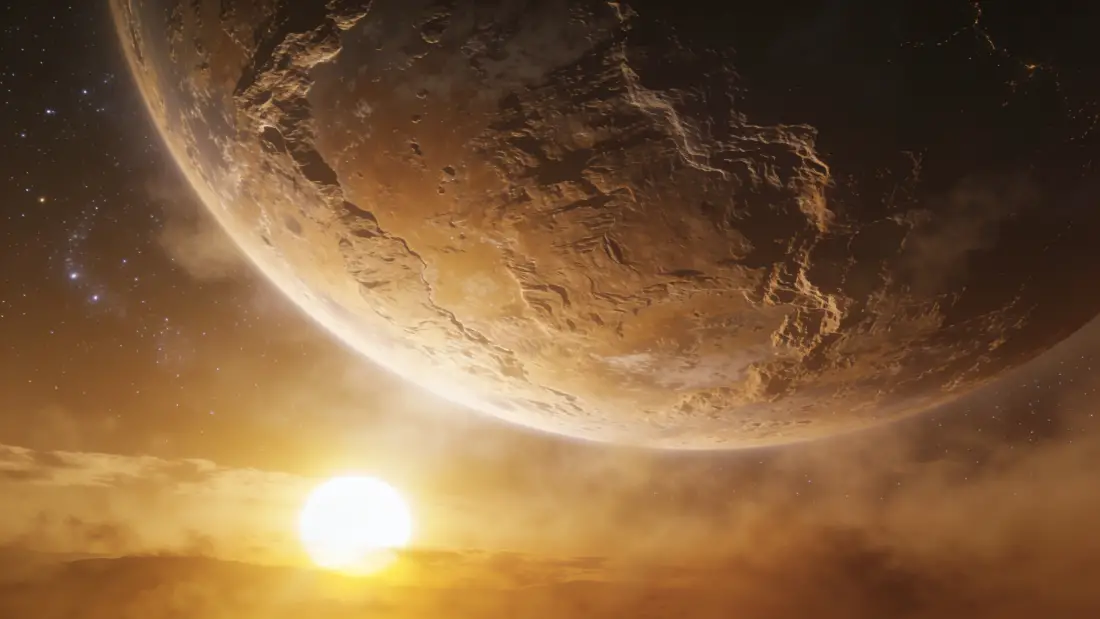
Hundreds of light-years away, a planet circles a star that looks a lot like our Sun. That planet is TOI-5788 c, and it was discovered in 2026. Finding it took careful science, patient watching, and two clever methods that let astronomers spot worlds they can never see directly.
A Quick Portrait of TOI-5788 c and Its Star
TOI-5788 c orbits a star called TOI-5788. That star sits about 318 light-years from Earth. A light-year is the distance light travels in one full year — roughly 9.5 trillion kilometres. So 318 light-years is an almost impossible distance by human standards, yet modern telescopes can still study the starlight that reaches us from there.
The star TOI-5788 has a surface temperature of 5,615 K (K stands for kelvin, a scientific unit for measuring heat). Our own Sun has a surface temperature of about 5,778 K, so TOI-5788 is only a little cooler. That makes it what astronomers call a Sun-like star, though scientists are still working out its exact size and mass.
There are at least two planets known in this system so far. TOI-5788 c is the second one found. The letter “c” just means it was the second planet confirmed around this star — the first was “b”.
The Transit Method: Catching a Planet’s Shadow
TOI-5788 c was discovered using the transit method. The word “transit” means one object crossing in front of another. When a planet passes between its star and us, it blocks a tiny slice of the star’s light. Astronomers watching that star see a very slight dip — a dimming — in the brightness of the starlight.
Here is how it works, step by step:
- A space telescope stares at a star and records its brightness thousands of times.
- Most of the time, the brightness stays steady.
- When a planet crosses in front of the star, the brightness dips by a small amount.
- The dip ends when the planet moves past.
- If the same dip repeats at regular intervals, scientists know a planet is orbiting.
The dip is often very small — sometimes less than one percent of the star’s total light. That is like someone dimming a very bright lamp by just a tiny flicker. Sensitive telescopes can catch even that. The size of the dip tells scientists how big the planet is compared to its star. A bigger planet blocks more light and causes a deeper dip.
For TOI-5788 c, that regular dip repeats every 16.2 Earth days. That is how long one full orbit — one year on this planet — takes. The transit method also gave scientists the planet’s radius: 2.27 times the radius of Earth. If you could hold Earth and TOI-5788 c side by side, TOI-5788 c would be noticeably larger, though not a giant.
If you’d like to see how this detection works in an interactive way, the planet-finding simulator on this site lets you try spotting transits yourself.
The Wobble Method: Listening to the Star Move
The transit method is great for measuring a planet’s size, but it does not tell you its mass. For that, astronomers often use a second technique called the radial velocity method — sometimes nicknamed the “wobble method”.
Here is the idea. We usually think of a planet orbiting a star, but the truth is slightly more interesting. Both the planet and the star pull on each other with gravity. A large enough planet actually makes its star wobble slightly as they orbit their shared centre of balance. The star does not sit perfectly still — it rocks back and forth, just a little.
Astronomers can measure this wobble by studying the starlight very carefully. When the star moves toward us, its light waves get slightly compressed, shifting toward the blue end of the colour spectrum. When it moves away, the waves stretch out toward the red end. This shift is called a Doppler shift — the same reason an ambulance siren sounds higher-pitched as it approaches and lower as it passes. By measuring how much the starlight shifts, and how often, scientists can work out the mass of the planet doing the pulling.
For TOI-5788 c, this method gave a mass of 6.4 times the mass of Earth. Combined with the radius from the transit method, scientists can also estimate how dense the planet is, which gives clues about what it might be made of.
What the Numbers Tell Us About TOI-5788 c
With a radius about 2.27 times Earth’s and a mass about 6.4 times Earth’s, TOI-5788 c sits in a category scientists sometimes call a super-Earth or perhaps a mini-Neptune. A super-Earth is a planet larger than Earth but smaller than the ice giants in our solar system, like Uranus or Neptune. The exact category depends on what is inside the planet — whether it has a thick gassy atmosphere or a rocky core — and scientists haven’t fully worked that out yet.
The estimated surface temperature of TOI-5788 c is about 667 K, or roughly 394 degrees Celsius. That is far hotter than any place where life as we know it could survive. For comparison, water boils at 100 degrees Celsius, so this planet sits well beyond any reasonable idea of a “habitable zone” — the range of distances from a star where liquid water could exist on a surface. TOI-5788 c orbits much too close to its star for that.
A World Unlike Anything Close to Home
Think about what a year means on TOI-5788 c. One full trip around its star takes just 16.2 Earth days. That means this planet completes more than 22 full orbits in the time it takes Earth to go around the Sun once. It moves fast because it is so close to its star. That closeness is also why it is so hot.
At 318 light-years away, no spacecraft we have today could ever reach it. Even travelling at the speed of light — which is impossible for any object with mass — the journey would take 318 years. TOI-5788 c is a world we can study only through its effect on starlight.
Questions Scientists Still Want to Answer
Even with what we know, there is a lot still to learn. Scientists haven’t measured the exact size or type of TOI-5788’s star in detail. We don’t know whether TOI-5788 c has an atmosphere, or what that atmosphere might contain. We don’t know the exact composition of the planet’s interior. Future telescopes may be able to study the starlight that passes through a planet’s atmosphere during a transit — if there is one — and use it to detect chemicals. That technique is called transmission spectroscopy, and it is one of the most exciting tools scientists hope to use more widely.
TOI-5788 c is a reminder of how much the universe holds. We found it not by pointing a camera at it, but by watching a distant star blink — very faintly, very briefly, and very regularly — and asking why.