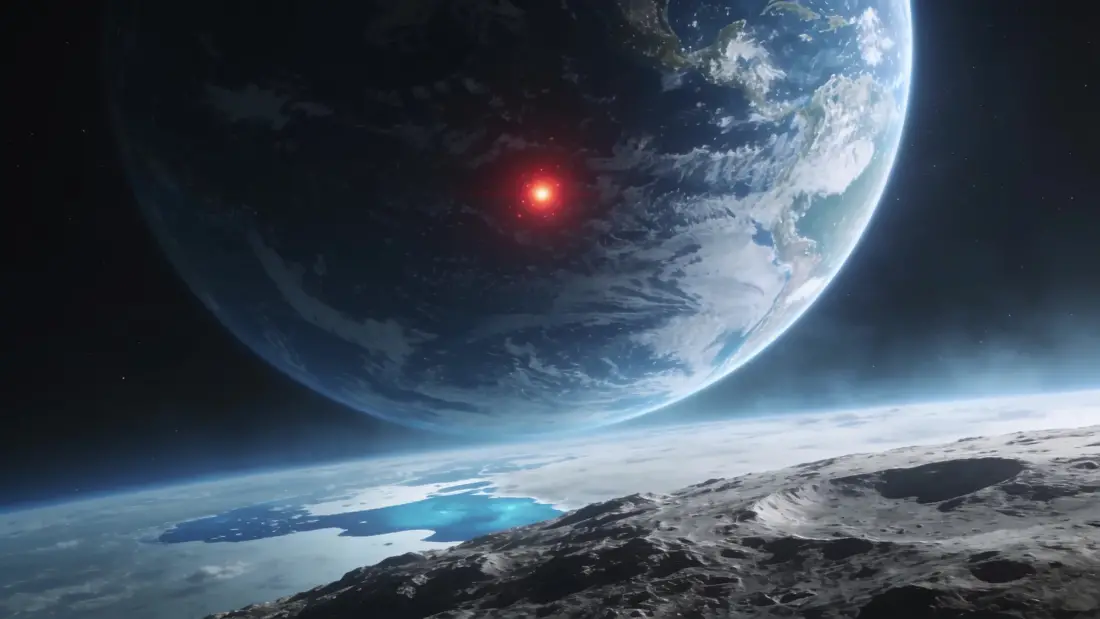
Just 12.5 light-years from Earth, Teegarden’s Star c is one of our closer neighbors in the galaxy. It orbits a small, dim star that you cannot see with your own eyes. Scientists discovered it in 2019, and even at this cosmic distance, there is a lot to learn about it.
A Small, Cool Star in Our Backyard
Before we meet the planet, it helps to understand the star it orbits. Teegarden’s Star is what astronomers call a red dwarf — a star much smaller and cooler than our Sun. Red dwarfs are the most common type of star in the Milky Way, but they are so faint that we usually need a telescope to see them.
Our Sun’s surface temperature is about 5,778 K. (K stands for Kelvin — it is a temperature scale scientists use, where 0 K is as cold as anything can possibly get.) Teegarden’s Star has a surface temperature of just 3,034 K. That makes it roughly half as hot as the Sun at its surface, and it gives off a deep orange-red glow.
Because it is so cool and faint, Teegarden’s Star puts out much less light and warmth than the Sun. Any planet that wants to stay reasonably warm has to orbit very close to it. That is exactly what Teegarden’s Star c does — though, as we will see, “close” does not mean “warm enough.”
Meet Teegarden’s Star c — Size, Mass, and Orbit
Teegarden’s Star c is a rocky world that looks a lot like Earth on paper. Its radius — that is, its width from the center to the surface — is 1.02 times Earth’s radius. Its mass is 1.05 times Earth’s mass. Those are remarkably close to our own planet’s values. In fact, scientists have rarely found a world that matches Earth’s size and mass so well.
But size and mass do not tell the whole story. This planet moves very fast around its star. One full orbit — what we would call a year on Teegarden’s Star c — takes only 11.4 Earth days. To put that in perspective, Mercury, the fastest planet in our own solar system, takes 88 days to orbit the Sun. Teegarden’s Star c laps its star more than seven times in the same period.
The reason for that quick orbit is simple: the planet is very close to its star. Orbiting a cooler star up close is the only way to receive enough energy to stay above the coldest possible temperatures. Even so, the numbers suggest this world is quite chilly.
How Cold Is This World?
Scientists estimate that the average surface temperature of Teegarden’s Star c is about 209 K, which works out to roughly -64 degrees Celsius. That is colder than the coldest recorded temperature on Earth’s surface, and colder than most places on our planet ever get.
For comparison, the average surface temperature of Mars is around -60 degrees Celsius — so this world is likely even a bit colder than the Red Planet. Scientists use the word equilibrium temperature to describe this kind of estimate. It is the temperature a planet would reach if it absorbed and released heat perfectly, with no atmosphere to trap warmth. If Teegarden’s Star c has a thick atmosphere, its actual surface temperature could be higher. But scientists haven’t measured its atmosphere yet, and we cannot say for sure whether it has one at all.
At these temperatures, liquid water on the surface seems unlikely — though scientists are careful not to rule anything out completely. The planet sits outside what researchers call the habitable zone, the region around a star where conditions could allow liquid water to exist on a surface. Teegarden’s Star c orbits a little too far from its star to comfortably sit in that zone.
How Scientists Found It

Teegarden’s Star c was discovered in 2019 using a method called radial velocity. Here is how it works. When a planet orbits a star, its gravity gives the star a tiny tug. That tug makes the star wobble very slightly — first toward us, then away from us, as the planet goes around. Scientists can detect that wobble by watching how the star’s light changes. When the star moves toward us, its light shifts slightly bluer. When it moves away, the light shifts slightly redder. By measuring those tiny shifts very carefully, scientists can work out that a planet must be there, and estimate its mass.
The radial velocity method is clever because it can work even when the planet never passes in front of its star. You can think of it as feeling the star dance without ever seeing its partner. The data from those careful measurements gave us the 2019 discovery of Teegarden’s Star c, along with its companion planet in the same system.
12.5 Light-Years Away — What Does That Really Mean?
A light-year is the distance light travels in one year. Light is the fastest thing in the universe, covering about 300,000 kilometers every second. In a full year, it travels roughly 9.46 trillion kilometers. Teegarden’s Star is 12.5 light-years away, which means light takes 12.5 years to make the journey from there to here.
Our fastest spacecraft ever launched, the Voyager probes, travel at roughly 17 kilometers per second. At that speed, reaching Teegarden’s Star would take about 220,000 years. Even a spacecraft traveling at one percent of the speed of light — far beyond anything we can build today — would need 1,250 years to arrive. Distance like this puts into perspective how far even our “nearby” stellar neighbors truly are. You can explore these kinds of numbers yourself with our distance and travel time tool.
Still, 12.5 light-years is close by galactic standards. The Milky Way is roughly 100,000 light-years across. On that scale, Teegarden’s Star is practically next door — which is part of why scientists find it so interesting to study.
A Three-Planet System
Teegarden’s Star c is not alone. Astronomers currently know of three planets orbiting Teegarden’s Star. The system’s architecture — the arrangement of its planets — is still being studied. Scientists haven’t published confirmed detailed measurements for all three planets yet, so we will not guess at numbers that aren’t verified. What we can say is that finding multiple planets around a red dwarf is common. Red dwarfs seem to collect planets readily, and many of the small stars nearest to us have turned out to host more than one world.
You can place Teegarden’s Star and its planets in context among nearby systems using our cosmic map, which shows just how populated our stellar neighborhood really is.
Teegarden’s Star c is a reminder that the universe is full of Earth-sized worlds in unexpected places. This one is cold, distant, and still largely mysterious — but it is right there in our cosmic backyard, waiting for better telescopes and future missions to tell us more.