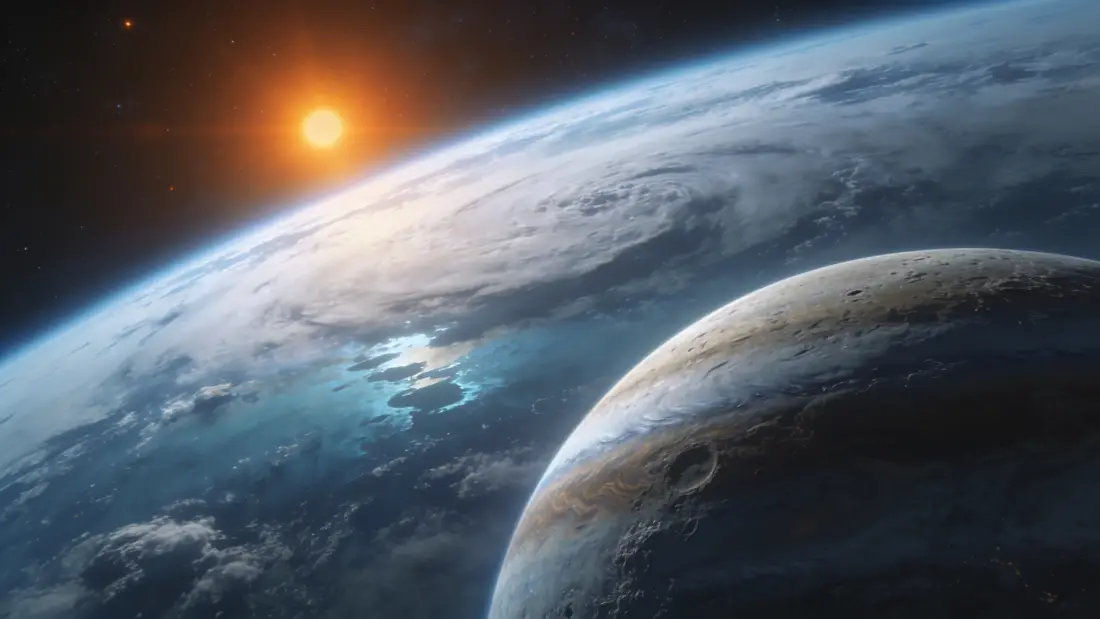
In 2020, astronomers spotted a world called Kepler-1661 b crossing the face of a distant star. It sits about 1,339 light-years away — a light-year is the distance light travels in one year, roughly 9.5 trillion kilometers — so we will not be visiting anytime soon. But we can still ask a quiet, fascinating question: could a world like this one be friendly to life?
Where in the Galaxy Is Kepler-1661 b?
Kepler-1661 b lives 1,339 light-years from Earth. To put that in some perspective, light moves faster than anything else in the universe, and even at that speed the journey from this planet to us would take over a thousand years. The planet orbits a star called Kepler-1661, which gets its name from the Kepler space telescope that found it.
Astronomers discovered Kepler-1661 b using the transit method. That means scientists watched for a tiny dip in the star’s brightness. When a planet passes in front of its star, it blocks a small fraction of the light. By measuring how much light disappears and how often, scientists can work out the planet’s size and how long its year is. In this case, one full orbit around its star takes 175 Earth days — a little under half an Earth year.
What Kind of Star Does It Orbit?
The star Kepler-1661 has a surface temperature of 5,100 K — that “K” stands for kelvin, a temperature scale scientists use. For comparison, our own Sun has a surface temperature of about 5,778 K. So Kepler-1661 is somewhat cooler and a little dimmer than the Sun. It is what astronomers call a K-type star, or sometimes an “orange dwarf.” These stars are smaller and cooler than the Sun, but they are still much larger and hotter than the smallest stars in the galaxy.
K-type stars are interesting to scientists who study life beyond Earth. They burn their fuel slowly and steadily, which means they can shine for a very long time — possibly long enough for life to develop on a nearby planet, if conditions are right. They also tend to be calmer than smaller, more active stars. That could matter a lot for any life trying to survive in their neighborhood.
Size, Mass, and What the Planet Might Be Like
Kepler-1661 b has a radius about 3.87 times that of Earth. Picture Earth as a tennis ball — this planet would be closer to a grapefruit. Its mass is about 17 times Earth’s mass. These two numbers together tell scientists something important about what the planet is probably made of.
When a planet is both significantly larger and much heavier than Earth, scientists often think it could be a sub-Neptune — a type of world that might have a thick envelope of gas, water, or ice surrounding a rocky or icy core. We do not have a planet exactly like this in our own solar system, so sub-Neptunes are a bit mysterious. Scientists are not certain what the interior looks like, whether there is a solid surface to stand on, or whether the outer layers are mostly gas or something more like a deep, slushy ocean under enormous pressure.
That uncertainty matters when we think about life. Life as we know it seems to need a surface, liquid water, and some chemical ingredients. A thick, crushing gas envelope might make those conditions hard to achieve. But scientists are honest about how much they still do not know about planets in this size range.
The Habitable Zone — and Whether This World Sits in It

The habitable zone is the band of distances around a star where conditions might allow liquid water to exist on a planet’s surface. Not too hot, not too cold — sometimes people call it the “Goldilocks zone.” Liquid water is important because, as far as we know, every living thing needs it. Being in the habitable zone does not mean a planet has water or life. It simply means the temperature range is not ruled out from the start.
Whether Kepler-1661 b truly sits inside its star’s habitable zone depends on the exact size and brightness of the star, and scientists measure these things carefully. The planet’s orbit of 175 days and its star’s temperature of 5,100 K together place it in a region that many researchers consider to be within or near the habitable zone. If you want to explore how habitable zones work for different kinds of stars, you can check out the Habitable Zone explorer on this site.
Still, being in the zone is just one piece of a very large puzzle. A planet’s atmosphere — the layer of gases around it — plays a huge role. A thick atmosphere can trap heat, making a planet warmer than its distance from the star would suggest. A thin one can let heat escape, leaving a planet frozen. We do not yet know what kind of atmosphere, if any, Kepler-1661 b has.
Temperature: A Clue With Caveats
Scientists estimate Kepler-1661 b has an average temperature of around 243 K, which works out to roughly -30 degrees Celsius. That is cold — similar to a very harsh winter at Earth’s poles. On Earth, that kind of temperature would freeze water solid. So at first glance, this might sound discouraging for life.
But there is more to the story. That estimated temperature is often called an equilibrium temperature. It assumes the planet has no atmosphere trapping extra heat. If Kepler-1661 b has a thick atmosphere with greenhouse gases — gases that hold warmth close to the surface, the way a blanket holds body heat — the actual surface temperature could be higher. Much higher, in some cases. Earth itself is warmer than its simple equilibrium temperature because of its own atmosphere. Scientists have not measured the atmosphere of Kepler-1661 b yet, so the true temperature at the surface, if there is a surface, remains unknown.
One Planet, One Star, Many Questions
So far, Kepler-1661 b is the only planet known in this system. That does not mean it is the only one — smaller or differently positioned planets can be very hard to detect, and astronomers may simply not have spotted others yet. One known planet just means one known planet.
Taken all together, Kepler-1661 b is a genuinely interesting world. It orbits a calm, long-lived star. It may sit in the region where liquid water is possible. But it is also quite large, probably not rocky in the way Earth is, and very cold by our best current estimate — unless an unknown atmosphere changes that. If you enjoy comparing worlds like this one, the Most Earth-Like Worlds list shows how it stacks up against other candidates. The honest answer is that we do not know enough yet to say whether this world could support life. That is not a disappointment — it is an invitation. Every new telescope and every careful measurement brings us a little closer to knowing.