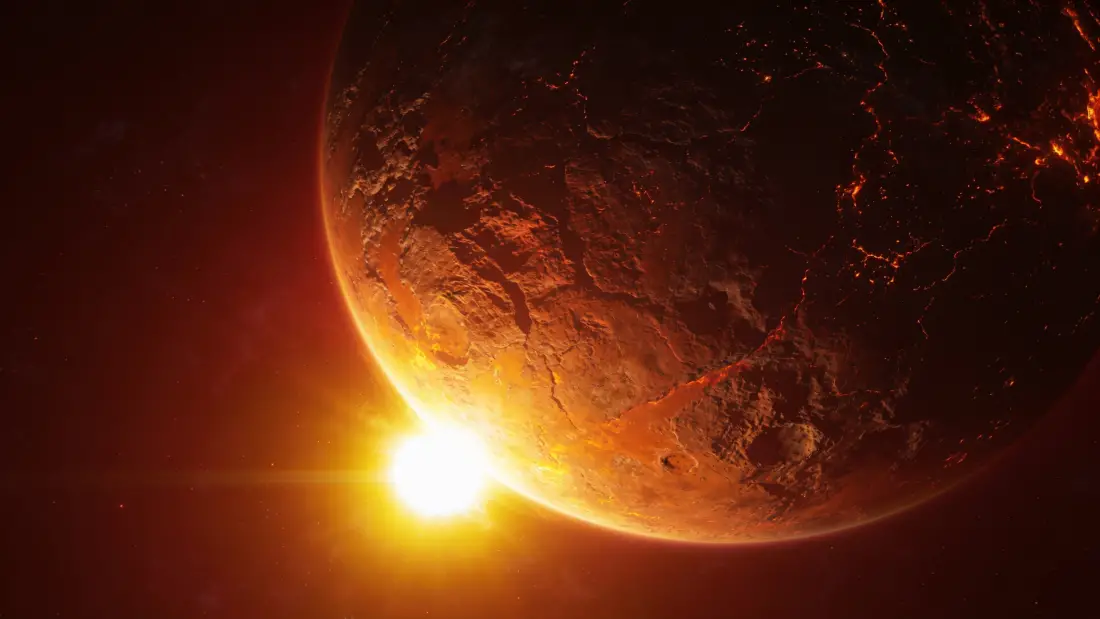
About 211 light-years away — a light-year is the distance light travels in one whole year — a star called HD 108236 quietly holds five planets in its gravity. That makes it one of the more richly populated planetary systems we have found beyond our own. Studying all five worlds together helps scientists understand how solar systems are built.
A Star with Five Worlds
HD 108236 is a star in the southern constellation Centaurus. It is fairly similar to our Sun, though its surface runs a little cooler. Scientists measure star surfaces in kelvins — a temperature scale that starts at absolute zero, the coldest anything can be. The surface of HD 108236 sits at about 5,660 K. Our Sun’s surface is around 5,778 K, so these two stars are neighbors in temperature terms.
Around this star, at least five planets travel in tight, fast orbits. All five were found using a space telescope, and all five were confirmed by 2020 or shortly after. Having five planets in one system gives astronomers a rare chance to compare worlds that all formed from the same cloud of gas and dust, long ago.
Meet HD 108236 b
The planet called HD 108236 b is the innermost of the five, meaning it orbits closest to the star. One year on HD 108236 b — the time it takes to complete one orbit — lasts only 3.8 Earth days. That is an extremely short year. On Earth, 3.8 days is barely enough time to get through a school week.
HD 108236 b is larger than Earth but smaller than the giant planets in our Solar System. Its radius — the distance from its center to its surface — is about 1.62 times Earth’s radius. Its mass, meaning how much material it contains, is about 3.24 times Earth’s mass. Planets in this size and mass range are sometimes called super-Earths, which just means rocky-ish worlds noticeably bigger than our own. Scientists think HD 108236 b is probably rocky, though they are not completely certain.
Because HD 108236 b sits so close to its star and completes an orbit in under four days, it receives an enormous amount of heat and light. Scientists estimate its likely temperature at around 1,099 K, which is roughly 826 degrees Celsius. At that temperature, metals like lead and zinc would be liquid. Any atmosphere on HD 108236 b would be under extreme stress, and scientists do not think this planet is a good place to search for life as we know it.
The Other Four Planets
Beyond HD 108236 b, four more planets orbit the same star. They were all found in the same discovery campaign, though their full details took time to confirm. Scientists haven’t published the same level of measured detail — such as confirmed masses — for all four outer planets. What we do know is that they also orbit relatively close to their star compared to, say, Earth’s distance from the Sun.
The outer planets in the HD 108236 system appear to span a range of sizes. Some seem to be in the super-Earth range, while at least one may be larger, closer to what scientists call a sub-Neptune — a planet smaller than Neptune but bigger than Earth, probably wrapped in a thick layer of gas or water. Because these worlds orbit farther out than HD 108236 b, they receive less heat from the star. That does not automatically make them comfortable — it depends on many things, including whether they have an atmosphere and what that atmosphere is made of.
Scientists haven’t measured whether any of the five planets sit in what is called the habitable zone — the range of distances from a star where liquid water could, in theory, exist on a planet’s surface. That question is still being studied. No confirmed liquid water or signs of life have been found in this system.
How Astronomers Found Them
All five planets in the HD 108236 system were found using the transit method. Here is how that works. When a planet passes in front of its star from our point of view, it blocks a tiny fraction of the star’s light. A telescope watching the star sees the light dip a little, then return to normal. By measuring how deep the dip is and how often it repeats, scientists can figure out the planet’s size and how long its orbit takes.
The transit method works best for planets that orbit close to their stars, because those planets cross in front of the star more often. That is partly why the HD 108236 planets were detectable — they orbit quickly, so each one produces regular, repeated dips in starlight. The discovery was reported in 2020, and astronomers have continued studying the system since then to pin down details like mass, which requires a different technique called radial velocity — measuring tiny wobbles in the star caused by the gravitational pull of each planet.
How This System Compares to Our Solar System
One of the first things scientists notice about HD 108236 is how tightly packed its planets are. In our Solar System, Mercury — our closest planet to the Sun — takes about 88 days to complete one orbit. HD 108236 b does its orbit in just 3.8 days. Even the outer planets in the HD 108236 system likely orbit closer to their star than Mercury orbits ours.
This kind of tightly arranged system turns out to be surprisingly common in the galaxy. Many of the planetary systems found by space telescopes contain several planets all crammed into a space smaller than Mercury’s orbit. Our own Solar System, with its widely spaced planets and large outer giants, may actually be a little unusual compared to what we see out there. That is a humbling thought worth sitting with.
You can explore this and other systems in our system explorer, where each planet’s orbit is mapped out visually.
What Scientists Hope to Learn
The HD 108236 system is interesting partly because of how many planets it has and partly because those planets seem to vary in size. Comparing them — their sizes, their distances from the star, and eventually their atmospheres — could help scientists understand how planets grow and change over time.
Future telescopes may be able to study the atmospheres of some of these worlds, especially the larger ones. If light from the star passes through a planet’s atmosphere during a transit, it leaves chemical fingerprints that scientists can read. This technique has already been used on a handful of exoplanets — planets outside our Solar System — and researchers hope to apply it to more systems like HD 108236 in the years ahead.
For now, HD 108236 stands as a good example of something astronomers are learning again and again: stars rarely travel alone. Most seem to carry families of worlds, each one shaped by the same raw materials but turned out differently. Getting to know those families, one system at a time, is how we slowly build a picture of the universe we live in.