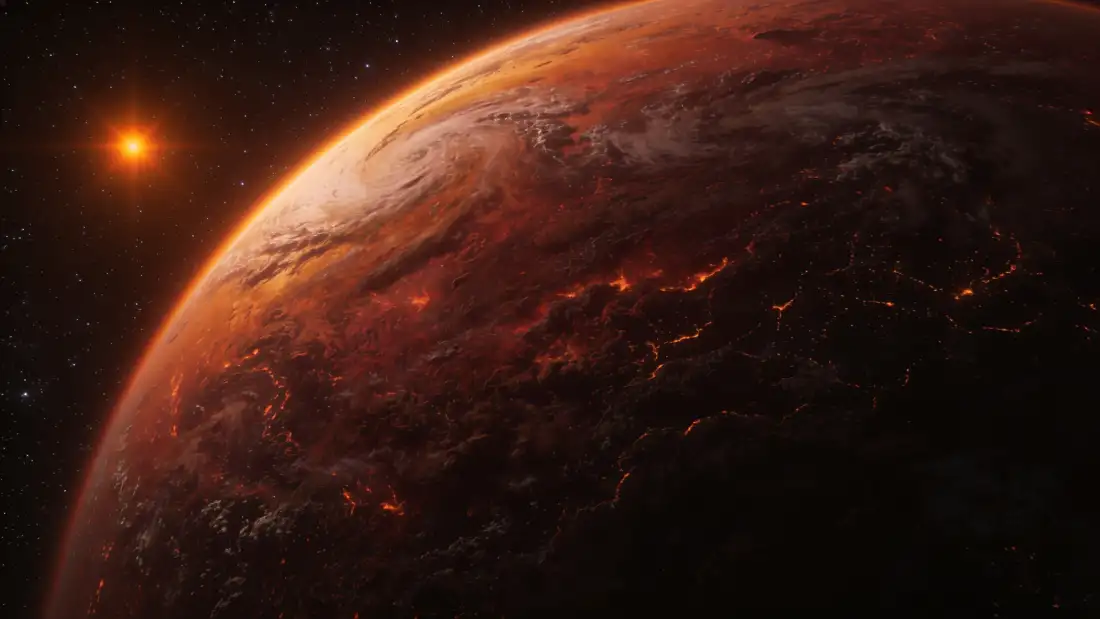
In 2026, astronomers added a new name to the long list of worlds beyond our solar system. That world is TOI-929 b, and it sits 373 light-years from Earth. A light-year is the distance light travels in one year — about 9.5 trillion kilometers — so this planet is very far away. Even so, scientists have already learned a surprising amount about it.
Where in the Sky Is TOI-929 b?
TOI-929 b is 373 light-years away from us. To put that in perspective, if you could somehow travel at the speed of light, it would still take 373 years to reach it. No spacecraft we have today could get there in any reasonable human lifetime. This planet was spotted not by traveling there, but by watching its star very carefully from here on Earth. You can explore other distant worlds like this one in the Atlas.
The star TOI-929 b orbits is called TOI-929. The name “TOI” stands for TESS Object of Interest. It tells us the star was flagged by the TESS space telescope as a place worth looking at more closely.
What Kind of Star Does TOI-929 b Orbit?
Every planet needs a star, and TOI-929 b’s star is cooler than our own Sun. Scientists measure a star’s surface temperature in Kelvin — a unit that starts at absolute zero, the coldest anything can possibly be. Our Sun has a surface temperature of around 5,778 K. TOI-929 has a surface temperature of 4,457 K, which is noticeably cooler.
Stars with temperatures in this range are called K-type stars, sometimes nicknamed orange dwarfs. They are smaller and dimmer than the Sun, but they burn steadily for a very long time. Scientists think K-type stars could be good places to look for planets, because they are calm and do not blast out as much harmful radiation as some hotter or more active stars do.
So far, TOI-929 b is the only planet confirmed around TOI-929. There may be other worlds hiding there that we haven’t detected yet, but as of now, scientists have only confirmed one.
How Big and Heavy Is TOI-929 b?
TOI-929 b is a planet with a radius — that is, the distance from its center to its surface — of 2.69 times Earth’s radius. That makes it noticeably larger than our planet, though not enormous by exoplanet standards. An exoplanet is simply any planet that orbits a star other than our Sun.
Its mass, meaning how much matter it contains, is about 7.7 times Earth’s mass. Knowing both the size and the mass of a planet is very useful. Scientists can use those two numbers to figure out the planet’s density — how tightly packed its material is. A planet that is large but not very heavy might be made mostly of gas or water. One that is smaller but very heavy might be mostly rock or metal.
For TOI-929 b, the numbers suggest it falls into a category scientists call a sub-Neptune or possibly a super-Earth, right at the border between the two. These are planets bigger than Earth but smaller than Neptune. Scientists think that worlds in this size range might have thick atmospheres, or layers of water or ice deep inside, but exactly what TOI-929 b is made of is something researchers are still working to understand.
A Very Short, Very Hot Year

One of the most striking things about TOI-929 b is how fast it travels around its star. It completes one full orbit — one year on that planet — in just 5.83 Earth days. That means while you are spending a week at school, TOI-929 b has already gone all the way around its sun.
To orbit so quickly, the planet must be very close to its star. And being that close has a big consequence: heat. Scientists estimate the likely temperature on TOI-929 b is around 774 K, which is about 501 degrees Celsius. That is far hotter than any oven, and hot enough to melt many metals. No one expects this world to be comfortable for life as we know it. It sits nowhere near the habitable zone — the range of distances from a star where liquid water could possibly exist on a planet’s surface.
How Scientists Found TOI-929 b
TOI-929 b was discovered using the transit method. This technique works by watching a star’s brightness over time. When a planet passes in front of its star, it blocks a tiny bit of starlight. From Earth, we see the star dim very slightly. By measuring how much it dims and how often it happens, scientists can figure out the planet’s size and how long its orbit takes.
The transit method has now revealed hundreds of planets, and you can trace how that list has grown over the years on the Discovery Timeline. TOI-929 b joined that list in 2026, confirmed by careful follow-up observations after the initial signal was spotted.
What This World Might Be Like Inside
Scientists haven’t measured everything about TOI-929 b yet. Some details, like what its atmosphere is made of, are still unknown. But based on its size and mass together, researchers can make educated guesses. A planet of this density might have a rocky core surrounded by a thick envelope of gas or volatile materials — substances that turn to gas at relatively low temperatures, like water vapor or ammonia.
TOI-929 b is a reminder that the universe holds an enormous variety of worlds. Some are gentle and temperate. Others, like this one, are scorching and strange. Each one helps scientists build a clearer picture of how planets form and what shapes they can take. TOI-929 b may not be somewhere anyone would want to visit, but it has a quiet story to tell about how diverse planetary systems can be.