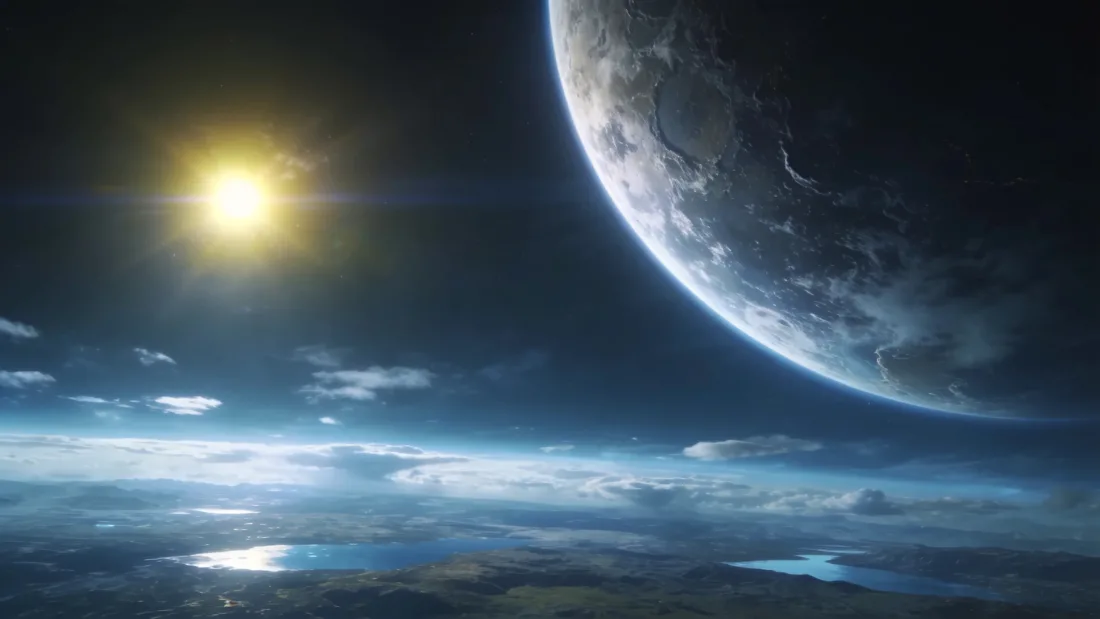
Far out in space, 864 light-years from Earth, a large planet moves slowly around a star called WASP-47. That planet is WASP-47 c, and it sits in a spot that scientists find genuinely interesting. Its estimated temperature puts it right around the range where liquid water could exist — though whether it actually does is a much harder question to answer.
A Busy Solar System Far From Home
When we say WASP-47 c is 864 light-years away, that number is hard to picture. A light-year is the distance light travels in one year, moving at about 300,000 kilometers every second. Even so, 864 of those is an enormous gulf. No spacecraft we have today could reach it in any human lifetime. Everything we know about this world comes from careful study of the light its star sends our way.
The star WASP-47 has a surface temperature of 5,565 K. That stands for Kelvin — a way scientists measure temperature starting from the coldest anything can be. To give you a sense of scale, our own Sun’s surface runs around 5,778 K. So WASP-47 is a little cooler than the Sun, but not by much. It is a fairly ordinary yellow star, similar in many ways to the one that warms our own planet.
How Scientists Found WASP-47 c
WASP-47 c was discovered in 2015 using something called the radial velocity method. Here is how it works. When a planet orbits a star, the planet’s gravity gives the star a tiny tug. That tug makes the star wobble, very slightly, back and forth. When the star wobbles toward us, its light shifts to slightly shorter wavelengths — toward the blue end. When it wobbles away, the light shifts toward the red end. Scientists measure these tiny shifts carefully, and the pattern tells them a planet is there.
The radial velocity method is good at finding massive planets, because heavier planets create a stronger tug. As you will see in a moment, WASP-47 c is very massive indeed, which made it easier to detect this way. The method tells us a planet’s mass and orbit quite well, but it does not directly tell us the planet’s size or what it looks like on the surface.
A Giant World in a Long, Slow Orbit
WASP-47 c is 447 times more massive than Earth. That is a truly enormous world. For comparison, our solar system’s biggest planet, Jupiter, is about 318 times Earth’s mass. So WASP-47 c is even heavier than Jupiter by a wide margin. Scientists sometimes call planets in this size range super-Jupiters or massive giant planets.
Because of its huge mass, scientists think WASP-47 c is most likely a gas giant — a planet made mainly of thick gases rather than solid rock, similar to Jupiter or Saturn in our own solar system. We do not have a measured radius for WASP-47 c yet, so scientists haven’t been able to pin down exactly how large it is across.
This world takes 590 Earth days to complete one orbit around WASP-47. That means a year on WASP-47 c lasts about one and a half of our years. Its orbit is slower and wider than Earth’s, which is one reason its temperature estimate sits where it does.
What the Habitable Zone Actually Means

The habitable zone is the band of space around a star where conditions might allow liquid water to exist on a planet’s surface. It is sometimes called the “Goldilocks zone” — not too hot, not too cold. If a planet is too close to its star, water boils away. Too far, and it freezes solid. The habitable zone is the range in between.
It is very important to understand what “habitable zone” does not mean. It does not mean a planet has water. It does not mean a planet has life. It only means the distance from the star is right for liquid water to be possible, given the right conditions. A planet’s atmosphere, its composition, its geology — all of these things matter too. You can explore how the zone works for different stars using our habitable zone explorer.
Could WASP-47 c Support Liquid Water?
WASP-47 c has an estimated temperature of 247 K, which is about -26 degrees Celsius. That is below the freezing point of water at normal pressure — colder than a winter night in many places on Earth. At first glance, that sounds too cold for liquid water.
But scientists are careful here. That temperature is an estimate based on the planet’s distance from its star and how much energy the star puts out. It does not account for an atmosphere. On Earth, our atmosphere traps heat and keeps the surface warmer than it would otherwise be — this is called the greenhouse effect. A planet with a thick atmosphere could be considerably warmer at its surface than the basic estimate suggests.
On the other hand, WASP-47 c is almost certainly a gas giant. Gas giants like Jupiter do not have solid surfaces where liquid water could pool. If there is any water in such a world, it would likely exist deep inside the planet, under crushing pressure, in forms that are very different from the water we know. Scientists think the chances of surface liquid water — the kind that might support life as we know it — are low for a world like this. Still, the temperature range puts it in an interesting spot, and science rarely says never.
A Crowded Neighborhood of Four Planets
WASP-47 c does not travel alone. Scientists have found four planets in the WASP-47 system so far. This makes it a multi-planet system, which is quite common in the galaxy from what we have learned. The other planets in this system include a well-known hot Jupiter — a giant planet orbiting very close to the star — making WASP-47 one of the more unusual and well-studied systems we know of. The way these planets interact gravitationally helps scientists refine their understanding of each world’s orbit and mass.
If you are curious about how WASP-47 c compares to other worlds that might be interesting for life, our most Earth-like worlds list gives a sense of the range of planets scientists are watching closely.
What Comes Next for This Distant World
There is still a great deal we do not know about WASP-47 c. Scientists have not yet measured its radius, so its exact size is uncertain. We do not know what its atmosphere is like, or whether it has moons. Modern telescopes are getting better at studying distant planetary systems, and future observations may fill in some of these gaps. For now, WASP-47 c is a reminder of how strange and varied planets can be — and of how much careful, patient work it takes to understand even one world 864 light-years away.