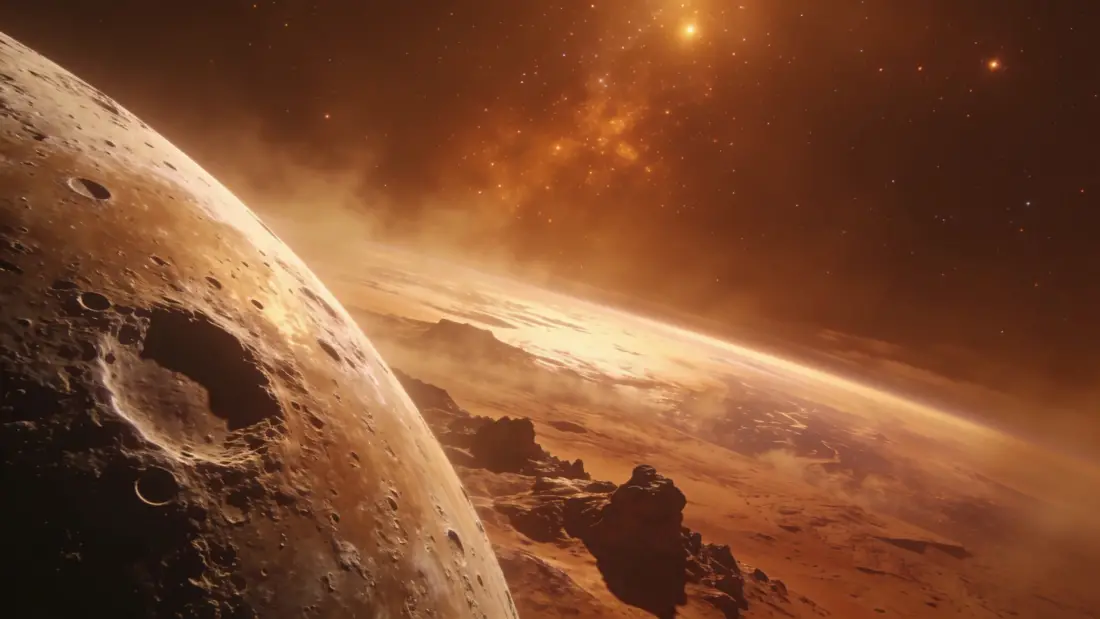
About 42 light-years away, a star called HD 40307 is surrounded by at least five planets. That makes it one of the more crowded planetary families we know of in our corner of the galaxy. One member of that family, HD 40307 d, gives scientists a useful window into what these worlds are really like.
A Star Not Too Different from Our Sun
HD 40307 is an orange dwarf star. An orange dwarf is a star that is a little cooler and a little smaller than our Sun. Scientists measure star temperatures in a unit called Kelvin (K). The surface of HD 40307 reaches about 4,956 K. Our Sun, by comparison, is around 5,778 K, so HD 40307 runs noticeably cooler.
That difference in temperature matters a great deal for any planets nearby. A cooler star gives off less energy. That means the zone where liquid water could exist — scientists call it the habitable zone — sits closer in toward the star than it does in our own Solar System.
HD 40307 sits about 42.2 light-years from Earth. A light-year is the distance light travels in one year — roughly 9.5 trillion kilometers. On a cosmic scale, 42.2 light-years is quite close to us. Even so, no spacecraft we have today could reach it in any reasonable human lifetime.
How Scientists Found These Worlds
The five planets around HD 40307 were found using a technique called the radial velocity method. Here is how it works. When a planet orbits a star, its gravity gives the star a tiny tug. That tug makes the star wobble very slightly toward and then away from Earth. Scientists can detect that wobble by watching how the star’s light shifts. When the star moves toward us, its light looks slightly bluer. When it moves away, the light looks slightly redder. By measuring those shifts carefully, scientists can figure out that a planet must be there — even though they cannot see it directly.
The radial velocity method is especially good at detecting planets that are fairly massive and orbit close to their star, because those planets cause a stronger tug. All five planets around HD 40307 were confirmed this way, with the discoveries announced in 2009.
Meet HD 40307 d
Of the five known planets in this system, HD 40307 d is one of the more closely studied. Scientists have measured its mass at about 1,775 times the mass of Earth. That is very large — far more massive than even the biggest planets in our Solar System. Jupiter, our own giant, is about 318 times Earth’s mass, so HD 40307 d is in a different league entirely.
A planet that massive is almost certainly not a rocky world like Earth. Scientists think planets at this scale are likely to be gas-rich or made mostly of very dense materials, though exactly what lies beneath is still an open question. The radial velocity method tells us mass, but it cannot tell us a planet’s size or what its surface — if it even has one — looks like.
HD 40307 d completes one full orbit around its star every 20.4 Earth days. That is a very short year. In our Solar System, Mercury — our fastest planet — takes about 88 days to go around the Sun. So HD 40307 d moves much more quickly, meaning it sits quite close to its host star.
Being that close to the star comes with consequences. Scientists estimate the likely temperature of HD 40307 d at around 541 K, which works out to about 268 degrees Celsius. That is well above the boiling point of water. Conditions there would be extremely hot by any measure we use on Earth.
The Rest of the Family

HD 40307 d is just one of five known planets in this system. The planets are labeled b, c, d, e, and g — the letters scientists use to name planets in the order they are confirmed, starting after “a,” which is reserved for the star itself.
The other planets in the system also appear to be on short orbits, which tells us they all live fairly close to their star. Scientists haven’t published full confirmed measurements for all of them in the same detail as for HD 40307 d, so some of the finer points of their nature are still being worked out. What we can say is that this system is a tightly packed family, with several worlds sharing the space around a single star in a region that would fit well inside the orbit of Mercury in our own Solar System.
One planet in the system, HD 40307 g, drew a lot of scientific interest for a time because some researchers thought it might sit within the habitable zone of the star. Scientists still aren’t sure exactly how to classify its situation, and whether liquid water could exist there depends on many things we haven’t measured yet, such as whether it has an atmosphere and what that atmosphere is made of.
How This System Compares to Our Solar System
Our Solar System has eight planets spread across a huge range of distances from the Sun. The inner planets — Mercury, Venus, Earth, and Mars — are rocky. The outer planets — Jupiter, Saturn, Uranus, and Neptune — are giant worlds made mostly of gas and ice.
The HD 40307 system looks very different. All five known planets appear to orbit much closer to their star than even Mercury does to our Sun. There is no clear equivalent of a cold outer zone filled with giant planets, at least not among the worlds discovered so far. Whether more distant planets exist there too, scientists simply haven’t confirmed. You can explore how different systems like this one are laid out using the system explorer.
This kind of tightly packed, close-in arrangement is actually quite common among the planetary systems astronomers have found around other stars. Our own Solar System, with its wide spacing and clear division between rocky and gas worlds, may be less typical than we once assumed.
What Scientists Are Still Trying to Learn
There is a great deal we still don’t know about HD 40307 d and its neighbors. The radial velocity method gives us mass but not radius, so scientists can’t yet say for certain what these planets are made of. No one has measured whether any of them have atmospheres. We don’t know if any of them have moons.
Future telescopes and observation techniques may help answer some of these questions. For now, the HD 40307 system remains a fascinating family of worlds — close enough to study, different enough from home to make us think carefully about just how varied planetary systems can be across the galaxy.