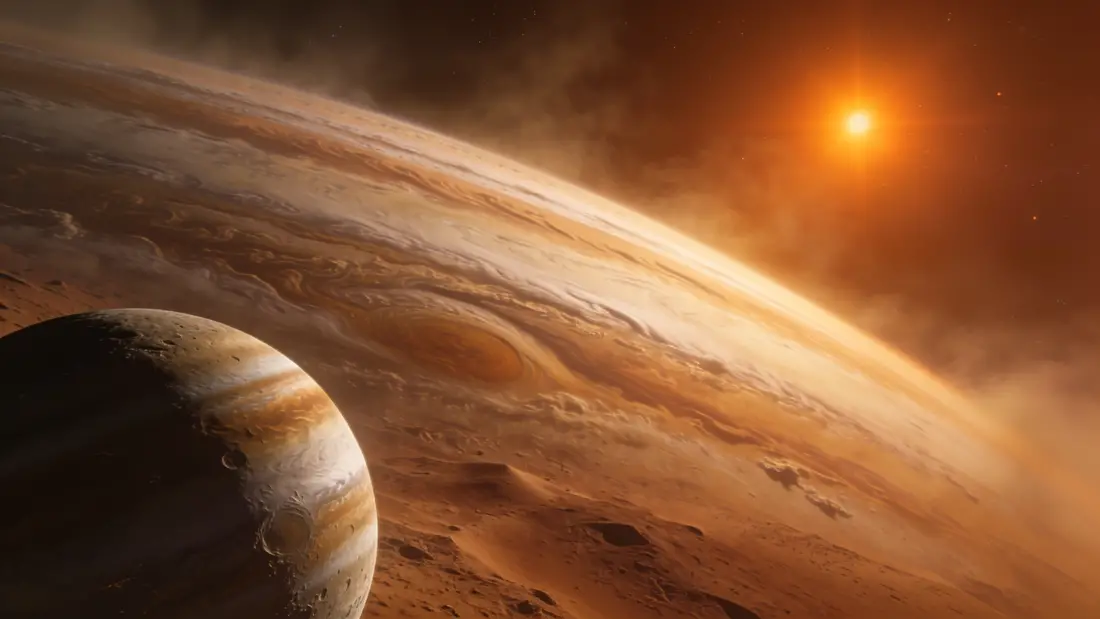
Three hundred and ten light-years from Earth, a planet quietly circles a star cooler than our own Sun. That planet is TOI-5605 b, and scientists confirmed its existence in 2026. It is already teaching us something interesting about the wide variety of worlds that fill our galaxy.
How TOI-5605 b Was Found
Astronomers discovered TOI-5605 b using the transit method. Here is how that works: when a planet passes in front of its star, it blocks a tiny amount of the star’s light. A telescope watching the star from far away notices the light getting a little dimmer, then returning to normal. If this dip happens again and again on a regular schedule, scientists can be fairly confident a planet is to blame.
The name “TOI” stands for TESS Object of Interest. TESS is a space telescope that watches large patches of the sky and looks for exactly these regular dips in starlight. Many of the planets TESS spots need follow-up study before scientists are sure they are real planets and not something else, like a background star that happens to line up. After that careful checking, TOI-5605 b was confirmed in 2026. You can see how it fits into the broader story of planet discovery on our Discovery Timeline.
The Size and Mass of TOI-5605 b

TOI-5605 b is noticeably bigger than Earth. Its radius — that is, the distance from its center to its surface — is about 2.53 times Earth’s radius. To picture that, imagine stacking two and a half Earths side by side from the center outward. The planet would look quite a bit larger in the sky if you could somehow hover above it.
Its mass, meaning how much material it contains, is also greater than Earth’s. Scientists measure it at roughly 6.92 times Earth’s mass. That combination of size and mass tells scientists something useful. When a planet is around two to three times Earth’s radius, it tends to fall into a category called a sub-Neptune — a world that is smaller than the ice giant Neptune in our own solar system but larger than Earth. Sub-Neptunes are one of the most common types of planet found so far around other stars, even though we have none in our own solar system.
Having both a radius and a mass measurement is valuable because it lets scientists estimate how dense the planet is. Density — how tightly packed the material inside a planet is — gives hints about what the planet is made of. Scientists are still working out exactly what TOI-5605 b is composed of, but a world of this size and mass likely has a thick atmosphere or a large amount of water or other lighter materials mixed in. We should be careful here: these are estimates, and there is still a lot of uncertainty.
A Scorching, Fast Orbit

One of the most striking things about TOI-5605 b is how close it sits to its star. It completes one full orbit — its year — in just 5.91 Earth days. Our own Earth takes 365 days to go around the Sun. So this planet is moving very fast and is very close to its host star.
Being that close comes with consequences. The planet’s likely temperature is around 669 Kelvin, or about 396 degrees Celsius. That is far hotter than any oven you would find in a kitchen, and well above the boiling point of water. This temperature is an estimate based on how much starlight the planet receives — scientists call it the equilibrium temperature. The actual surface temperature could be different depending on whether the planet has an atmosphere and what that atmosphere does with the heat.
At temperatures like these, liquid water on the surface seems very unlikely. TOI-5605 b does not sit in the habitable zone — the range of distances from a star where liquid water could potentially exist on a planet’s surface. It orbits well inside that zone.
The Star Behind the Planet
TOI-5605 b orbits a star called TOI-5605. This star has a surface temperature of 4,584 Kelvin. Our Sun’s surface is about 5,778 Kelvin, so TOI-5605 is cooler than our Sun. Stars cooler than the Sun tend to look more orange than yellow. They are often called K-type stars or orange dwarf stars. These stars are generally smaller and less bright than the Sun, and they are thought to be very common across the galaxy.
The system sits 310 light-years from Earth. A light-year is the distance light travels in one year — about 9.5 trillion kilometers. At that distance, no spacecraft we have today could reach TOI-5605 in any reasonable time, but telescopes can still study the light that travels to us from the system.
What Kind of World Might This Be?
Based on what we know, TOI-5605 b is almost certainly not a rocky world like Earth in the familiar sense. Its size suggests it may have a thick envelope of gas or volatile materials — things like water, methane, or ammonia — surrounding a denser core. Scientists think many sub-Neptunes fit this general picture, though the details vary a great deal from planet to planet. Until astronomers can study the planet’s atmosphere directly, which requires more detailed observations, much of this remains educated guesswork. You can compare it with other known worlds in our Atlas.
One Planet So Far — Could There Be More?
Right now, TOI-5605 b is the only confirmed planet in this system. That does not mean it is alone. Many star systems that at first appeared to have just one planet later turned out to have others once scientists looked more carefully. Planets that orbit farther from their star are harder to detect with the transit method because they pass in front of the star less often. It is entirely possible that other worlds are waiting to be found around TOI-5605 — we simply do not have enough evidence yet to say either way.
TOI-5605 b is a good reminder of how much variety exists among planets. Hot, fast-moving, and larger than Earth, it is quite different from the worlds in our own solar system. Each new confirmed planet adds one more data point to our growing understanding of how planetary systems form and what shapes they can take across the cosmos.