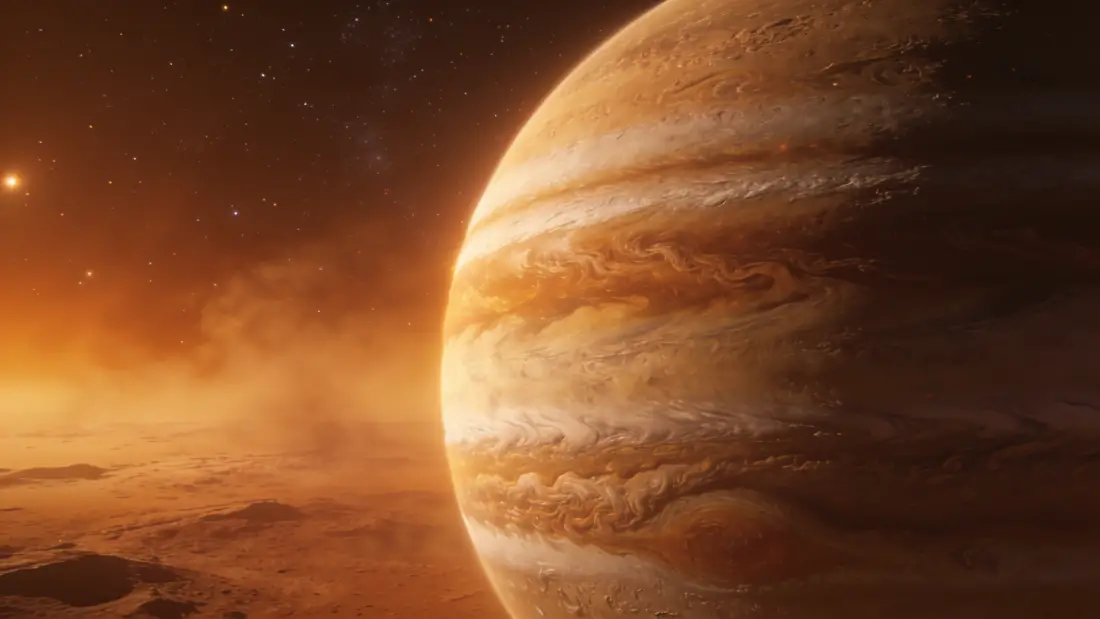
TOI-4898 b is a world quite unlike anything in our own solar system. It sits 322 light-years away, and scientists only confirmed it in 2026. Even at this early stage, its size and mass are already telling us interesting things about what it might be made of.
Where TOI-4898 b Lives
TOI-4898 b orbits a star called TOI-4898. That star is cooler than our Sun. We know this because its surface temperature is 4,202 K — where K means kelvin, a scale scientists use to measure heat starting from absolute zero. Our Sun’s surface runs at about 5,778 K, so TOI-4898 is noticeably cooler and probably appears a little more orange-red in the sky. Stars like this are called K-type stars, and they are very common in our galaxy.
The planet itself zips around this star very quickly. One full orbit — what we would call a year on TOI-4898 b — takes only 2.77 Earth days. That is faster than most people’s work week. To move that quickly, the planet must be extremely close to its star. Only one planet has been found in this system so far.
The whole system is about 322 light-years from Earth. A light-year is the distance light travels in one year — roughly 9.5 trillion kilometres. That is far enough that no spacecraft we have today could ever reach it in a human lifetime, but close enough for our telescopes to study it carefully.
How We Found It
TOI-4898 b was discovered in 2026 using the transit method. Here is how that works. When a planet passes in front of its star, it blocks a tiny bit of the star’s light. Telescopes watching the star notice a slight dimming — a dip in brightness — that repeats on a regular schedule. Each dip tells scientists that something is crossing the star’s face at regular intervals.
By measuring how much the light dims, scientists can work out how wide the planet is compared to the star. By timing the dips, they learn how long the orbit takes. The name “TOI” stands for TESS Object of Interest, which tells us the planet was first spotted by the TESS space telescope, a mission designed to hunt for planets around nearby bright stars.
The transit method is great for measuring size, but on its own it cannot tell us how heavy a planet is. To get the mass, scientists usually use a separate technique that measures the tiny gravitational tug the planet gives its star. Both pieces of information together — size and mass — are what really let scientists understand what a planet might be made of.
Size and Mass: What the Numbers Tell Us
TOI-4898 b has a radius of 3.72 times Earth’s radius. That makes it noticeably larger than our planet, but smaller than Neptune, which is about 3.9 times Earth’s radius. This puts TOI-4898 b in the category scientists call a mini-Neptune — a planet bigger than Earth but not quite as large as an ice giant like Neptune.
Its mass is 13.4 times Earth’s mass. That is a helpful number, because when you know both the size and the mass, you can work out the density — how tightly the material inside is packed together. A planet made mostly of iron and rock would be very dense. A planet with a thick atmosphere of lighter gases would be less dense for its size.
TOI-4898 b’s combination of size and mass suggests it is not a dense, rocky world. The mass is not heavy enough for the volume it takes up. This hints strongly that it has a large envelope of lighter material — probably a thick atmosphere of gases, or a deep layer of water and ices beneath the gas, or some mixture of both. Scientists use tools like the mass-radius diagram to compare planets like this one to others and narrow down what they could be made of. If you want to get a feel for just how much bigger TOI-4898 b is than Earth, the size comparison tool lets you see that visually.
Inside a Mini-Neptune
Mini-Neptunes are one of the most common types of planets found by planet-hunting telescopes, yet we have none in our own solar system. That makes them both fascinating and a little puzzling.
Scientists think a mini-Neptune probably has a small rocky or metallic core at the centre. Around that core, there is likely a thick layer of water, ammonia, or other icy materials in a very compressed form — not quite solid, not quite liquid in the way we think of it. On top of that sits a deep atmosphere made mainly of hydrogen and helium, the two lightest elements in the universe.
For TOI-4898 b specifically, scientists haven’t yet pinned down the exact mix of layers. What the mass and radius together tell us is that the planet is almost certainly not mostly rock. Beyond that, more detailed study would be needed to say anything more precise.
A Very Hot World
The estimated temperature of TOI-4898 b is about 667 K, which works out to roughly 394 degrees Celsius. That is far hotter than an oven and hot enough to melt many metals. The reason is simple: the planet orbits so close to its star that it is constantly bathed in intense heat and radiation.
At this temperature, liquid water on the surface — if there even is a surface to speak of — is out of the question. TOI-4898 b sits well inside the habitable zone, which is the range of distances from a star where liquid water could exist on a planet’s surface under the right conditions. Being this close to its star places it far too hot for that possibility.
The heat also affects what the atmosphere might look like. At such high temperatures, light gases can sometimes escape into space over long periods of time. Whether TOI-4898 b has lost part of its original atmosphere, scientists haven’t determined yet.
What We Still Don’t Know
TOI-4898 b was only confirmed in 2026, so our picture of it is still quite early. Scientists haven’t measured details like the composition of its atmosphere, the exact nature of its interior layers, or whether it has any moons. Its host star’s full properties are still being studied too.
Future observations — especially using telescopes that can analyse starlight filtered through a planet’s atmosphere — may one day tell us which gases are present. That would give a much clearer window into what this world is truly like inside.
For now, TOI-4898 b stands as a good example of why mini-Neptunes are so interesting to study. They fill a gap our solar system simply does not have, and every measurement we take brings us a little closer to understanding the full range of worlds that exist out there.