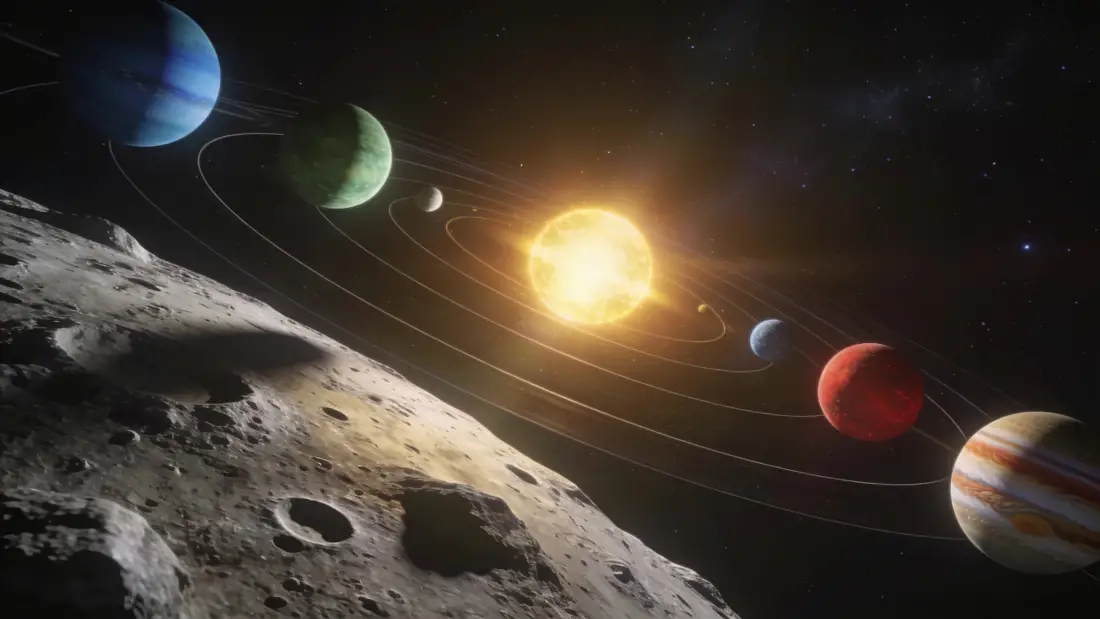
Look up at the night sky and pick any star. There is a good chance that star has at least one planet going around it — and many stars have whole families of planets. A planet system is simply a group of worlds that all orbit the same star. Learning how these families work helps us understand our own place in the universe.
One Star, Many Worlds
A planet system is made up of a star at the center and all the objects that travel around it. Those objects include planets, of course. But a system can also hold moons (smaller bodies that orbit a planet), asteroids (small rocky or metallic chunks), comets (icy bodies that travel in long, looping paths), and rings of dust and debris. All of these things are held in place by gravity — the invisible pulling force that every object with mass has. The star’s gravity is so strong that it keeps every member of the family in its orbit, pulling them in a gentle, constant curve around the center.
Our own Solar System is the planet system we know best. It has eight planets, dozens of moons, and countless smaller bodies. But it is just one example. Scientists now know that planet systems are common across the galaxy.
Born from the Same Cloud
A planet system does not just appear fully formed. It grows slowly from a huge cloud of gas and dust called a nebula. Over a very long time — millions of years — gravity pulls the cloud inward. The center grows denser and hotter until it ignites as a new star. But not all the material falls into the star. Some of it spreads out into a flat, spinning disc around the young star. Scientists call this a protoplanetary disc, which means a disc that will one day become planets.
Inside the disc, tiny grains of dust bump into each other and stick together. Slowly, they build up into pebbles, then boulders, then larger and larger bodies. Scientists call these growing lumps planetesimals — basically, the building blocks of planets. Over time, the biggest ones pull in more and more material with their gravity until they become full planets. Because all the planets in a system grow from the same disc around the same star, they share a kind of common origin. They are truly related.
Why Planets End Up Where They Do
The position of a planet in its system is not random. Temperature plays a big role. Close to a young star, it is very hot. Only rocky materials can survive that heat, so small, rocky planets tend to form near their star. Farther out, where it is cooler, ices and gases can survive too. That extra material means larger planets — gas giants and ice giants — tend to build up in the outer parts of the disc.
In our Solar System, this pattern is clear. The four inner planets are rocky and relatively small. The four outer planets are much larger and made mostly of gas or ice. Scientists call the boundary where temperatures cool enough for ice to form the frost line, or snow line. It is a key dividing point in any planet system.
Planets do not always stay where they formed, though. Gravity from one planet can nudge another, and giant planets can slowly drift inward or outward over millions of years. Scientists call this migration. It may explain why some systems look so different from ours.
Our Solar System and the Systems Beyond
For a long time, we assumed most planet systems probably looked like ours — small rocky worlds close in, giant planets far out. Then scientists started finding planets around other stars, and the picture turned out to be far more varied than anyone expected.
Many systems have giant planets orbiting very close to their star, much closer than Mercury is to our Sun. These are sometimes called hot Jupiters, because they are roughly Jupiter-sized but extremely warm. Our Solar System has nothing like them. Some systems have several planets packed into tight orbits that would all fit inside the distance between our Sun and Mercury. Others have planets spaced out over vast distances. Some stars have just one known planet so far. Others seem to have six, seven, or more.
It is worth keeping in mind that we are still early in the work of mapping other systems. The planets we find first tend to be the ones that are easiest to detect — often large ones, or ones orbiting close to their star. Smaller, farther-out planets are harder to spot, so many systems probably have more members that we have not yet found. You can explore known systems using our system explorer.
How Scientists Find Distant Planets
You cannot see most exoplanets — planets around other stars — through a telescope the way you see the Moon. They are too small and too far away, and a star’s bright light drowns them out. Instead, scientists use clever indirect methods.
The most common is the transit method. When a planet passes in front of its star from our point of view, it blocks a tiny bit of the star’s light. Sensitive instruments can measure that dip in brightness. If the dip happens regularly, scientists know a planet is orbiting there. The size of the dip gives a rough idea of how big the planet is.
Another method is called the radial velocity method. A planet’s gravity does not just make it orbit its star — it also gives the star a tiny wobble. Scientists can measure that wobble by looking at shifts in the star’s light. The bigger the wobble, the more massive the planet pulling on the star.
Both methods have limits. They work best for certain kinds of planets and certain orbits. Putting together a complete picture of a distant planet system takes time, patience, and often more than one method.
Every System Is Its Own Story
Each planet system carries the record of its own formation. The size of the star, the amount of material in the original disc, the presence of other nearby stars — all of these things shape what kind of family of worlds ends up forming. Some systems are crowded and compact. Some are wide and sparse. Some have giant worlds in places we would not expect. Scientists think that understanding this variety is key to understanding how planets — including our own — came to be.
There is something quietly remarkable about the idea that nearly every star you can see likely has its own family of worlds going around it. We have only begun to get to know a small number of them. Each one is a different story told by gravity, time, and the raw material of a young galaxy.