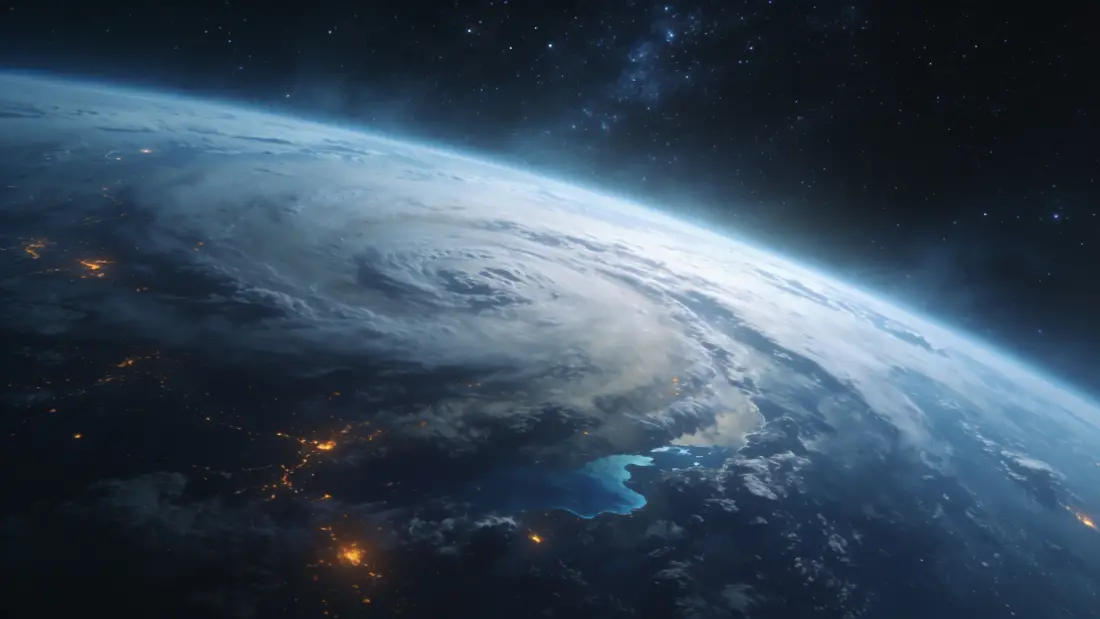
Kepler-991 b is a planet about 1,271 light-years from Earth — a distance so vast that light itself, the fastest thing in the universe, would take over a thousand years to cross it. Scientists found it in 2016, and ever since, curious minds have wondered whether a world like this could ever support life. The honest answer is: we don’t know yet, but looking closely at what we do know is a good start.
Getting to Know Kepler-991 b
Kepler-991 b was discovered using the transit method. That means astronomers watched the planet pass in front of its star, just the way you might notice a fly crossing a lamp. When the planet crossed, it blocked a tiny sliver of starlight. Instruments on the Kepler space telescope caught that dip in brightness and flagged it as a planet.
The planet sits 1,271 light-years away. A light-year is the distance light travels in one year — about 9.5 trillion kilometres. So Kepler-991 b is, for now, completely out of reach for any spacecraft we have. Everything we know about it comes from studying the light that reaches us from its star system.
So far, Kepler-991 b is the only planet scientists have found in this system. That does not mean it is alone — other planets may exist but are simply too small or at the wrong angle for us to detect yet.
The Star Kepler-991 b Calls Home

Every planet is shaped by its star. Kepler-991 b orbits a star called Kepler-991, which has a surface temperature of 4,392 K (that is about 4,119 degrees Celsius). For comparison, our own Sun has a surface temperature closer to 5,778 K. That means Kepler-991 runs cooler and dimmer than the Sun.
A star this temperature falls into a category astronomers call a K-type star — sometimes nicknamed an orange dwarf. K-type stars are a little smaller and cooler than the Sun, but they are not as faint or as small as the coolest stars known as red dwarfs. They tend to be fairly stable, which is considered a good sign when thinking about conditions for life. A calm, steady star means a planet is less likely to be blasted by violent outbursts of energy.
Scientists also think K-type stars can live for a very long time — longer than the Sun — which could give life more time to get started, if the other conditions are right.
A Year That Lasts Just 82.5 Days
Kepler-991 b completes one full orbit around its star every 82.5 Earth days. That is its year — the time it takes to loop all the way around once. Our year, of course, is 365 days, so this planet moves through its seasons much faster than we do.
A shorter year usually means the planet orbits closer to its star. How close exactly? Scientists have not published a precise distance between Kepler-991 b and its star, so we cannot give that number here. What we can say is that because the star is cooler than the Sun, orbiting somewhat closer does not automatically mean the planet is roasting. A dimmer star simply puts out less heat, so a planet can sit nearer to it and still receive a gentle amount of warmth.
That relationship between star temperature and orbital distance is at the heart of a concept called the habitable zone — the region around a star where conditions could allow liquid water to exist on a planet’s surface. You can explore how this works in more detail with our habitable zone explorer.
A World Bigger Than Earth

Kepler-991 b is noticeably larger and heavier than our planet. Its radius — the distance from its centre to its surface — is 2.54 times Earth’s radius. Its mass is about 6.99 times the mass of Earth. That puts it in a category scientists call a super-Earth or possibly a sub-Neptune. Those terms describe planets that are bigger than Earth but smaller than ice giants like Uranus or Neptune.
Here is where things get uncertain. A planet with a radius around 2.5 times Earth’s could be a few different things. It might be a rocky world with a thick atmosphere sitting on top. It might have a deep layer of water or ice under that atmosphere. Or it might be more like a small gas-dominated planet with no solid surface at all. Scientists use the mass and radius together to make a rough guess about what a planet is made of, but for Kepler-991 b, the exact make-up is still unknown.
A true rocky surface is something many researchers consider important for life as we know it. Whether Kepler-991 b has one is a question we cannot answer yet.
Temperature, the Habitable Zone, and a Careful Estimate
The estimated temperature for Kepler-991 b is 260 K, which works out to about -13 degrees Celsius. That is cold — below the freezing point of water under normal air pressure.
However, this figure is what scientists call an equilibrium temperature. It is a calculation based on how much starlight the planet receives, assuming it reflects some of that light away. It does not account for a greenhouse effect. A greenhouse effect happens when gases in an atmosphere trap heat, like a blanket around the planet. Earth’s own greenhouse effect raises our temperature well above what the equilibrium calculation alone would suggest. If Kepler-991 b has a thick atmosphere with the right gases, its actual surface temperature could be warmer — possibly warm enough for liquid water in some regions.
That is a big “if,” though. We do not yet know what gases, if any, make up Kepler-991 b’s atmosphere. Scientists have not measured it. Until they can, any talk of liquid water or warmth remains a possibility, not a fact.
What we can say is that Kepler-991 b sits in a part of its solar system where the amount of starlight it receives is not wildly too much or too little. Whether it truly falls within the habitable zone depends on details about its atmosphere that we simply do not have yet.
What “Friendly to Life” Really Means
Being “friendly to life” is not a single yes-or-no switch. Scientists look at a long list of ingredients: liquid water, a stable star, a solid surface or at least stable layers, the right chemicals, protection from harmful radiation, and time. Kepler-991 b checks some boxes on that list, at least tentatively. Its star seems calm and long-lived. Its temperature estimate, while chilly, is not extreme. Its size is within a range that sometimes includes rocky worlds.
But it does not yet check all the boxes, and for some boxes, we simply have no data. We do not know its atmosphere, its surface, or whether it has water in any form. If you want to compare it to other candidates that scientists are watching, our most Earth-like worlds list gives a good sense of what features researchers look for.
Kepler-991 b is a genuinely interesting place to think about. It is not a confirmed life-friendly world, and it may never be one. But it is the kind of planet that reminds us how much of the universe is still waiting to be understood — one careful measurement at a time.