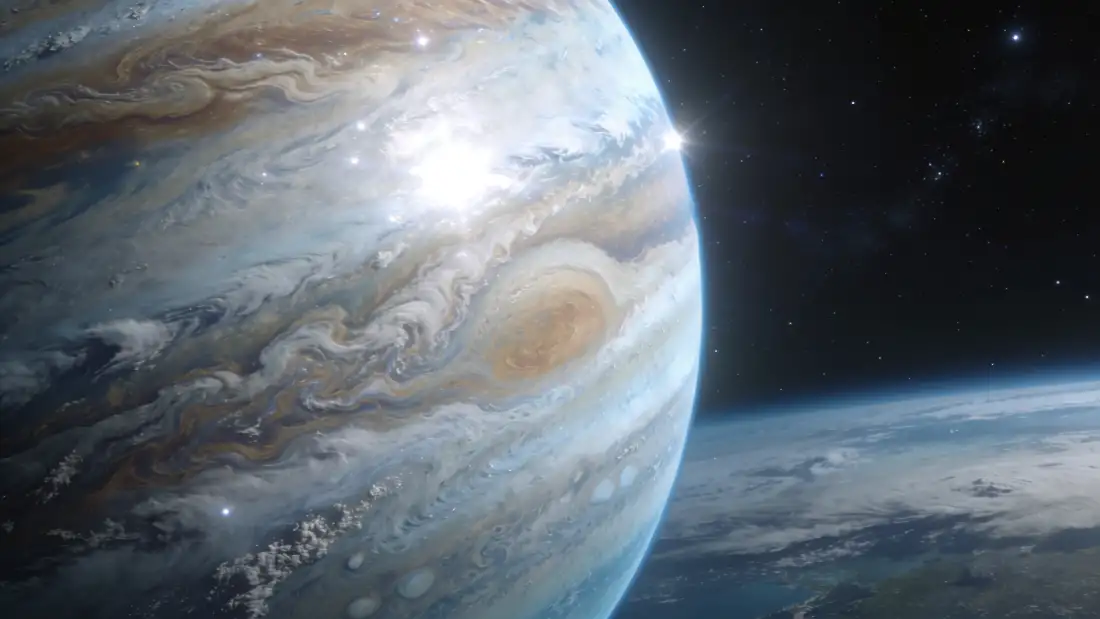
In 2026, astronomers confirmed a world called DMPP-6 c orbiting a star 178 light-years from Earth. You cannot see it in a photograph — no telescope has taken a picture of it. So how do scientists know it is there? The answer is all about watching starlight very carefully.
Meet DMPP-6 c and Its Star
DMPP-6 c travels around a star called DMPP-6. That star is a little warmer than our Sun. Scientists measure star temperatures in units called kelvins — a kelvin is a step of heat very similar to a degree Celsius, just starting from a colder zero point. The surface of DMPP-6 runs at about 6,182 kelvins. Our Sun sits around 5,778 kelvins by comparison, so DMPP-6 is somewhat hotter and likely a touch brighter.
DMPP-6 c is one of two known planets in this system. Its year — the time it takes to travel once around its star — is just 36.4 Earth days. That is a fast orbit, much shorter than any planet in our own solar system. It zips around close to its star, which tells us scientists might be able to detect its effect on the star pretty clearly.
The Radial Velocity Method — How a Planet Makes a Star Wobble
Here is the key idea: planets do not simply circle stars. The planet and the star both move. They pull on each other with gravity, so the star wobbles slightly as the planet goes around it. This tiny back-and-forth movement is called the radial velocity, which means the speed of the star toward us or away from us along our line of sight.
When the star wobbles toward Earth, the light it sends us gets compressed into slightly bluer wavelengths. When it wobbles away, the light stretches into slightly redder wavelengths. This is a version of something called the Doppler effect — the same idea that makes an ambulance siren sound higher as it comes toward you and lower as it drives away. With light, the shift is tiny, but modern spectrographs can measure it. A spectrograph is a tool that splits starlight into a rainbow of colors so astronomers can spot even very small shifts.
By measuring how fast the star moves toward and away from us, and how that movement repeats in a regular cycle, astronomers can figure out how long the planet’s orbit takes and get an estimate of the planet’s mass. The bigger the planet, and the closer it sits to its star, the stronger the wobble it causes — and the easier it is to find.
DMPP-6 c was discovered this way in 2026. Its relatively short orbit of 36.4 days means the wobble cycle repeats often, giving astronomers many chances to measure it and feel confident in the result. You can explore the idea of planet detection further with our interactive find-them simulator.
The Transit Method — When a Planet Blocks Starlight
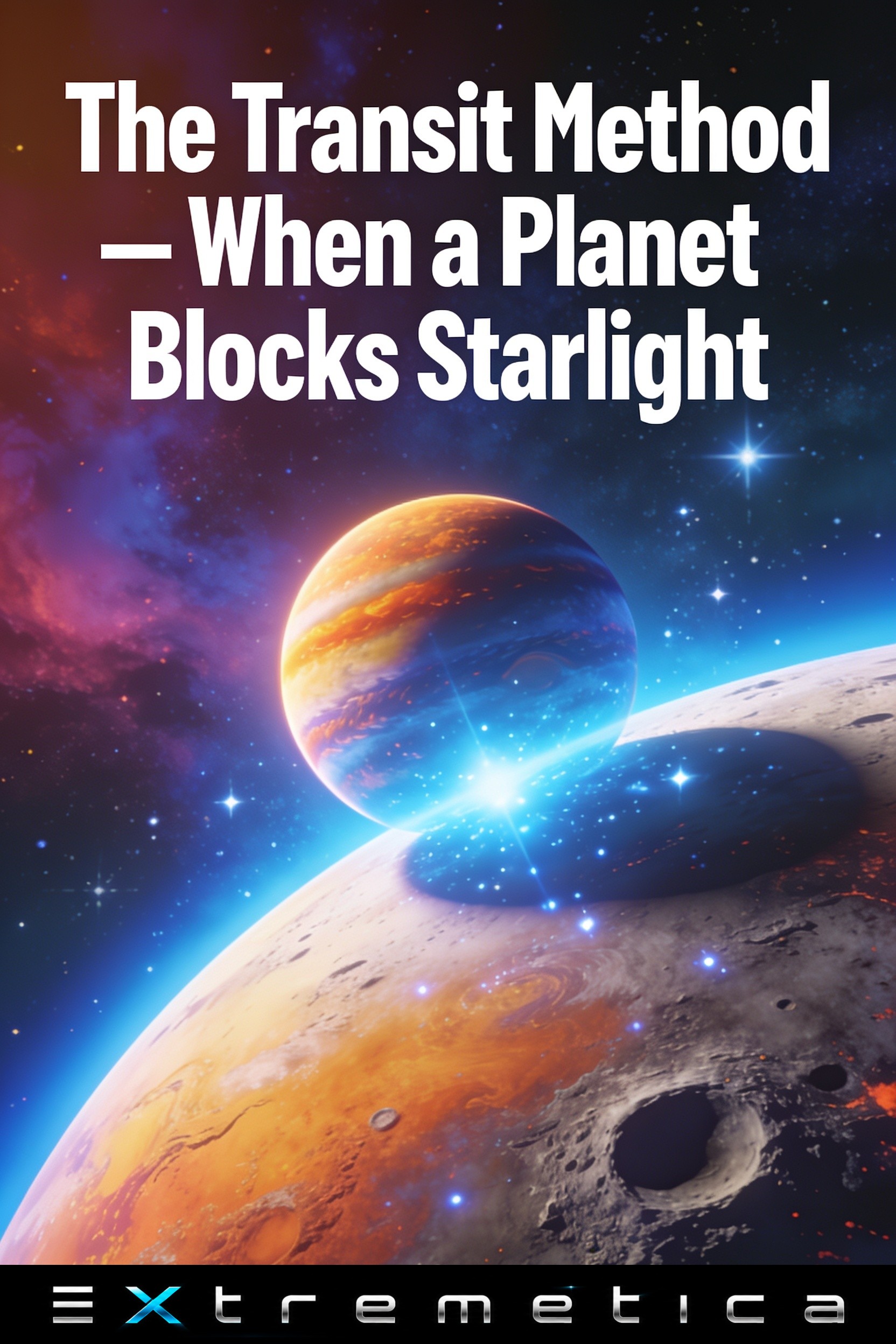
The radial velocity method is not the only way astronomers find planets. Another very common approach is called the transit method. A transit happens when a planet crosses in front of its star, as seen from Earth. As it does, it blocks a tiny fraction of the star’s light, causing a small, regular dip in the star’s brightness.
Imagine holding a marble in front of a distant lamp. The lamp dims just a little. Astronomers watch stars for exactly this kind of dimming. If the dip happens repeatedly on a fixed schedule, it is a strong sign that a planet is orbiting the star. Space-based telescopes are very good at detecting these dips, which can be smaller than one percent of the star’s total light.
The transit method is especially useful because it also tells scientists the size of the planet. A larger planet blocks more light, so a deeper dip means a bigger world. The timing of the dips reveals the length of the orbit. Many thousands of exoplanets — planets outside our solar system — have been found using this approach.
Why Radial Velocity Was the Right Tool Here
Not every planet can be found by both methods. The transit method only works when the planet’s orbit happens to line up edge-on with our view from Earth. If the orbit is tilted at the wrong angle, the planet never passes in front of its star from our perspective, so we never see a dip. Scientists have not reported detecting transits from DMPP-6 c, which suggests its orbit may not be lined up in a way that gives us that edge-on view.
The radial velocity method does not need that perfect alignment. As long as the planet’s pull nudges the star at least a little along our line of sight, we can detect the wobble. That made it the right tool for finding DMPP-6 c. Its tight, fast orbit also works in astronomers’ favor: a planet orbiting close to its star pulls on the star more strongly than a distant one would, and its short year means the wobble repeats quickly and clearly.
What the Numbers Tell Us About DMPP-6 c

The measurements astronomers collected point to a fairly substantial world. DMPP-6 c has a mass about 13.5 times the mass of Earth. It also has a radius — that is, the distance from its center to its surface — about 3.74 times the radius of Earth. Those two numbers together are interesting. A world with that mass and that size is likely denser than a pure gas ball but probably not a solid rocky planet like Earth, either. Scientists think it might fall into a category sometimes called a sub-Neptune — a world bigger than Earth but smaller than Neptune, possibly with a thick atmosphere or a deep layer of water or other materials under high pressure. But scientists haven’t measured its exact composition yet, so we are working with careful estimates for now.
Its orbit is very close to its star and takes only 36.4 days, which means it probably receives a lot more heat and radiation than Earth does. Whether that affects any possibility of interesting chemistry on or around the planet, scientists are not yet sure.
A Two-Planet System 178 Light-Years Away
DMPP-6 c shares its star with one other known planet. Astronomers have found two planets in the DMPP-6 system so far, though more could be hiding in the data, waiting to be confirmed. At 178 light-years from Earth, this system is well within the range where current instruments can study it, but still unimaginably far by any human measure. A light-year is the distance light travels in one year — about 9.5 trillion kilometers.
Finding DMPP-6 c took patience, precise instruments, and a deep understanding of physics that started with watching how light changes color by a tiny fraction. That a wobble smaller than a human heartbeat can reveal a world 178 light-years away is one of the quieter, more satisfying achievements of modern science.