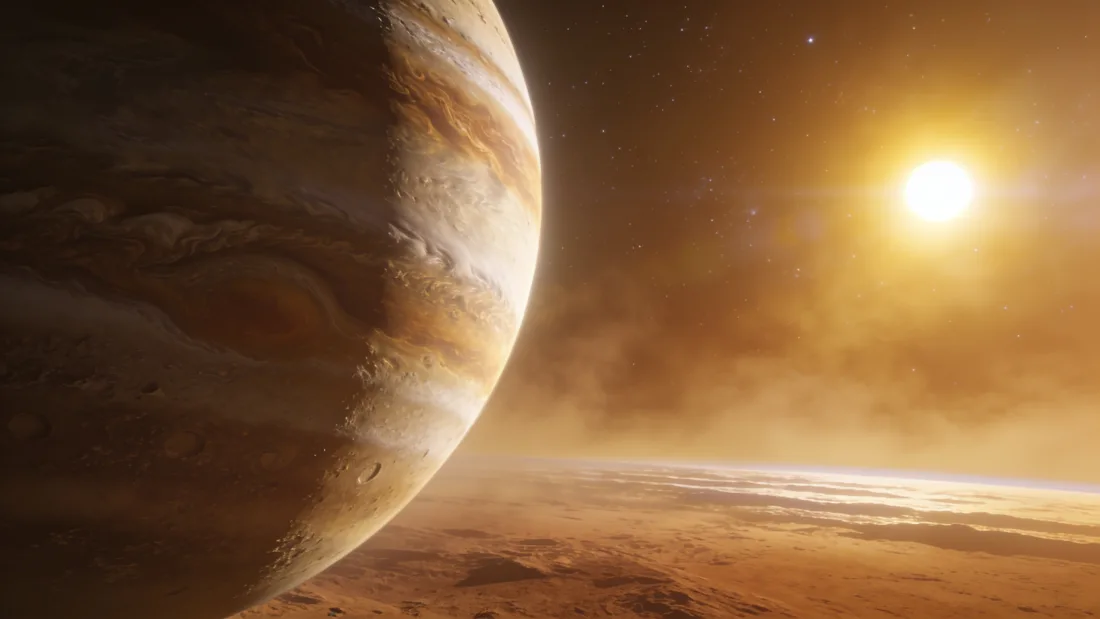
HD 85426 c is a world that sits comfortably in a category between rocky planets like Earth and giant planets like Neptune. It lives 176 light-years away, which is close enough that scientists have already learned quite a bit about it. What they have found so far gives us a useful window into how planets form and what they are made of.
Where HD 85426 c Lives
HD 85426 c orbits a star called TOI-1774. That star has a surface temperature of 5,746 K (K stands for Kelvin, a scale scientists use to measure very hot things — 5,746 K is roughly 5,473 degrees Celsius). For comparison, our Sun’s surface is about 5,778 K, so TOI-1774 is quite similar to the Sun in temperature. That is a useful thing to know, because it means the star is not extremely faint or extremely bright — it is somewhere in the middle.
The system is 176 light-years from Earth. A light-year is the distance light travels in one year — about 9.5 trillion kilometres. So 176 light-years is an enormous distance, but in the scale of our galaxy, it is actually a nearby neighbourhood. Scientists have confirmed two planets in this system so far. HD 85426 c is one of them.
Size and Mass — What the Numbers Tell Us
HD 85426 c has a radius — that is, the distance from its centre to its surface — of about 3.19 times Earth’s radius. That makes it noticeably bigger than our planet, but much smaller than Neptune, which is roughly four times Earth’s size. Its mass is about 10.3 times Earth’s mass.
Those two numbers together — radius and mass — are very helpful. When scientists divide mass by volume (the amount of space a planet takes up), they get density, a measure of how tightly packed the material inside a planet is. A planet that is large but not very heavy is probably full of lighter stuff, like thick gas or water. A planet that is small but very heavy is probably packed with rock or iron.
HD 85426 c falls into a pattern that scientists call a mini-Neptune. Mini-Neptunes are worlds larger than Earth but smaller than Neptune, and they tend to have a mix of rock, water-rich layers, and sometimes a thick envelope of gas. The size and mass of HD 85426 c both fit this picture well. If you enjoy comparing planet sizes visually, our size comparison tool can show you how HD 85426 c stacks up against Earth and Neptune.
Inside a Mini-Neptune
No spacecraft has visited HD 85426 c, so scientists cannot look inside it directly. Instead, they use the radius and mass to make careful guesses about what is there. This is a bit like guessing what is inside a wrapped box by weighing it and shaking it gently.
For a world with HD 85426 c’s size and mass, scientists think there is likely a rocky or iron-rich core in the centre. Around that core, there may be a thick layer of water or other ices — though at the temperatures inside a planet like this, “ice” does not mean frozen solid. It likely exists as a hot, pressurised fluid. On top of that, there is probably a gaseous envelope, a layer of lighter gases like hydrogen and helium wrapping the planet like a thick blanket.
Scientists think this kind of layered structure is common for mini-Neptunes. But we should be honest: these are models, not direct measurements. Different combinations of rock, water, and gas can sometimes produce the same radius and mass. So while scientists can narrow things down, there is still real uncertainty about the exact recipe inside HD 85426 c. The mass-radius diagram is a good place to see how planets of different compositions tend to cluster.
A Very Warm Orbit
HD 85426 c takes just 35.7 Earth days to complete one full orbit around TOI-1774. That is a short year — shorter than Mercury’s year, which is about 88 Earth days. To move that quickly, HD 85426 c must orbit quite close to its star.
Because it orbits so close, the planet receives a lot of energy from TOI-1774. Scientists estimate its temperature at around 640 K, which is about 367 degrees Celsius. That is hot enough to melt tin and lead. This is what scientists call the equilibrium temperature — an estimate of how hot the planet’s surface or cloud tops would be if it absorbed and released energy in a balanced way. The actual temperature could be somewhat different depending on whether the planet has an atmosphere and how reflective it is.
At 640 K, HD 85426 c is not in the habitable zone — the region around a star where liquid water could exist on a planet’s surface. It sits much closer to its star than that. Scientists have not suggested this is a place where life as we know it could survive.
How Scientists Found It
HD 85426 c was discovered in 2026 using a method called radial velocity. Here is how it works. When a planet orbits a star, its gravity gives the star a tiny tug. This tug makes the star wobble very slightly back and forth. As the star wobbles toward us, the light it sends out gets compressed into slightly shorter waves — we call this a blueshift. When the star wobbles away from us, the light stretches into slightly longer waves — a redshift. Scientists measure these tiny colour changes in the starlight very carefully. By watching the pattern, they can figure out how massive the planet is and how quickly it orbits.
The radial velocity method is especially good at measuring a planet’s mass. On its own, it does not directly tell scientists the planet’s size. To get the radius, scientists need either a transit — when a planet passes in front of its star and dims the light slightly — or other supporting observations. The data we have for HD 85426 c does include its radius, which means scientists have been able to combine more than one type of measurement to build up the picture.
What We Still Don’t Know
There is quite a lot that remains uncertain. Scientists have not yet measured whether HD 85426 c has an atmosphere, what gases might be in it, or how reflective the planet is. They do not know the exact makeup of its interior — the radius and mass narrow things down but do not settle the question completely. The second planet in the system is also not described in detail in public records yet, so that neighbour world remains mostly mysterious for now.
HD 85426 c is a good example of how science works at the frontier. A handful of careful measurements can sketch the outline of a world 176 light-years away. But filling in the details takes time, more observations, and sometimes new tools that have not been built yet. Each number scientists add to the picture makes the sketch a little clearer.