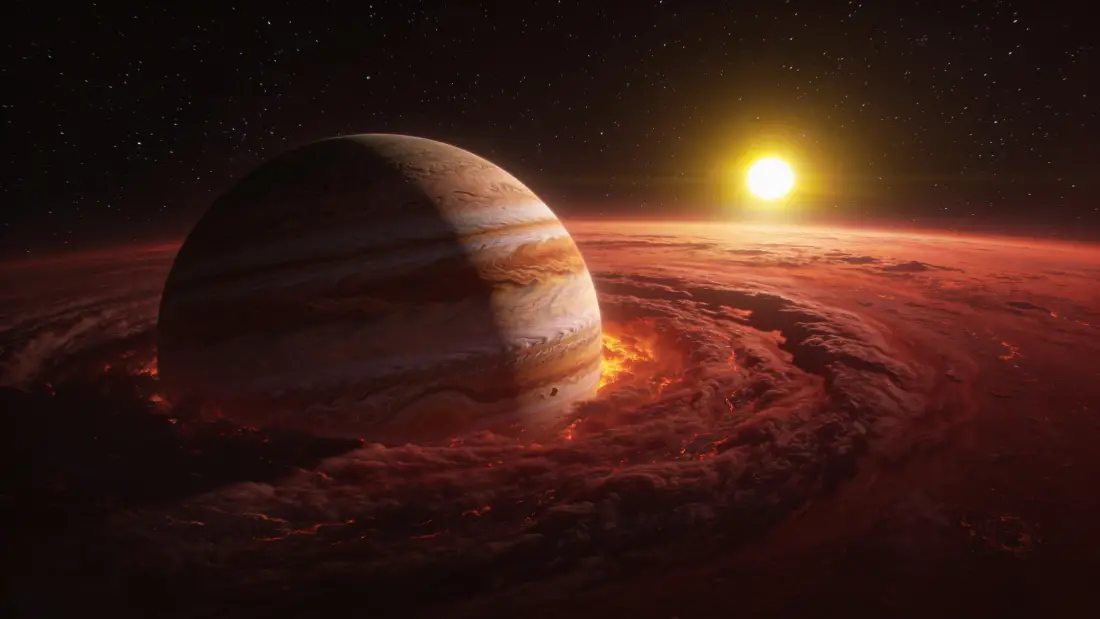
In 2026, astronomers confirmed a new world orbiting a star 171 light-years from Earth. That world is called TOI-1718 b, and it gives us another chance to study a type of planet that doesn’t exist anywhere in our own solar system. It is a fascinating find — not because it seems like a place life could thrive, but because it is so different from anything we know close to home.
Where TOI-1718 b Lives
TOI-1718 b orbits a star called TOI-1718. That star sits about 171 light-years away from Earth. A light-year is the distance light travels in one year — roughly 9.5 trillion kilometres. So 171 light-years is an enormous distance, far beyond any spacecraft we have ever launched.
The star itself is similar to our Sun in some ways. Its surface temperature is about 5,305 K (K stands for Kelvin, a scale scientists use to measure very high temperatures — our Sun’s surface is around 5,778 K by comparison). That makes TOI-1718 a little cooler than the Sun, but not by a huge amount. It is what astronomers call a Sun-like star, though we should be careful: many details about it are still being studied.
So far, scientists have confirmed only one planet in this system. That planet is TOI-1718 b. Whether other worlds are hiding there, waiting to be spotted, we simply don’t know yet.
What Kind of World Is This?

TOI-1718 b is much larger than Earth. Its radius — that is, the distance from its centre to its surface — is about 4.11 times Earth’s radius. Its mass is about 15.8 times Earth’s mass. Mass tells us how much material, or matter, the planet contains.
Those two numbers together are very useful. When scientists know both the size and the mass of a planet, they can estimate its density — how tightly packed its material is. A planet with a large radius but not an enormous mass is likely wrapped in a thick atmosphere or a deep layer of lighter materials like water or gas, rather than being a solid rocky ball all the way through.
TOI-1718 b fits into a category scientists call a sub-Neptune. Sub-Neptunes are worlds bigger than Earth but smaller than Neptune. They are among the most common types of planet we find around other stars, yet our solar system has none at all. Studying them helps astronomers understand why our neighbourhood turned out so differently from so many others in the galaxy. You can explore other confirmed worlds of this kind in the Extremetica Atlas.
A Very Short Year
One of the most striking things about TOI-1718 b is how fast it travels around its star. One full orbit — its year — takes only about 5.59 Earth days. To put that in perspective, Mercury, the closest planet to our Sun, takes about 88 Earth days to complete one orbit. TOI-1718 b races around its star in less than a week.
To move that quickly, the planet must be extremely close to TOI-1718. Orbiting so near to a star has big consequences, as we will see in the next section. Scientists haven’t yet measured the exact distance between TOI-1718 b and its star in kilometres or astronomical units, but the short orbit length tells us it must be very, very close.
Heat Beyond Imagining

Because TOI-1718 b hugs its star so tightly, it receives a huge amount of energy. Scientists estimate its temperature at around 948 K — that is roughly 675 degrees Celsius. For comparison, the temperature needed to melt iron is about 1,538 degrees Celsius, so TOI-1718 b is hot, though not quite at that extreme. Still, 675 degrees Celsius is far hotter than a kitchen oven, hotter than lava from a volcano, and far hotter than anything we would call comfortable.
At these temperatures, liquid water on the surface is out of the question. TOI-1718 b does not sit in the habitable zone — the region around a star where temperatures might allow liquid water to exist. It is far too close and far too hot for that. This doesn’t make it uninteresting. It just means the questions we ask about it are different: What is its atmosphere made of? How does heat move through it? Does it even hold onto an atmosphere at all?
How Scientists Found It
TOI-1718 b was discovered using the transit method. When a planet passes in front of its star from our point of view, it blocks a tiny bit of the star’s light. Sensitive telescopes can detect that small dip in brightness. By watching how often the dip repeats, scientists can figure out how long the planet’s orbit is. By measuring how deep the dip goes, they can estimate the planet’s size.
The name “TOI” stands for TESS Object of Interest. TESS is a space telescope designed to watch large areas of the sky and catch exactly these kinds of brightness dips. When TESS flags an interesting signal, other telescopes follow up to confirm that a real planet is responsible. TOI-1718 b was confirmed as a genuine planet in 2026. If you want to see how this discovery fits alongside others, the discovery timeline puts it all in context.
What We Still Don’t Know
Honest science means saying clearly what we haven’t figured out yet. For TOI-1718 b, the list of open questions is long. Scientists haven’t determined what its atmosphere looks like, or whether it has one at all. We don’t know its exact composition — how much of it is rock, water, or gas. We don’t know whether the planet always shows the same face to its star, which would create wildly different temperatures on its two sides. Future telescopes, able to study the light passing through or reflecting off distant atmospheres, may start to answer some of these questions.
TOI-1718 b is one small piece of a very large puzzle. Every confirmed exoplanet — a planet orbiting a star other than our Sun — adds a data point that helps scientists understand how planets form, grow, and change over billions of years. This hot sub-Neptune, quietly circling its star 171 light-years away, is now part of that growing picture.