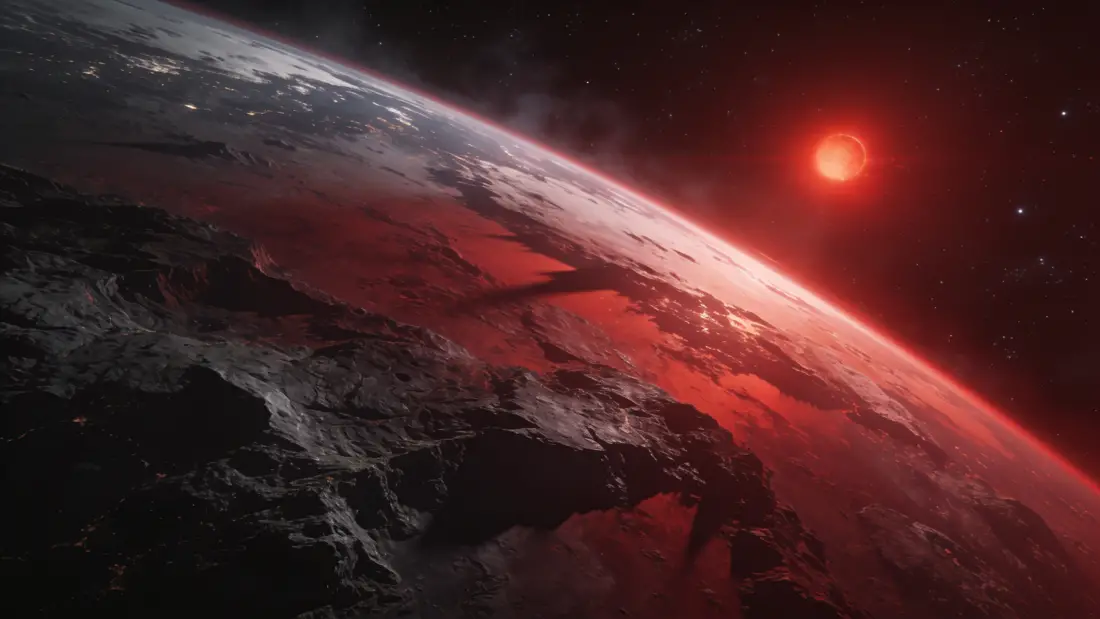
Gl 725 A b is one of the closest known exoplanets — worlds that orbit stars other than our Sun — to Earth. It sits just 11.5 light-years away, which sounds small on a cosmic scale, yet the distance is almost impossible to picture. Let’s explore what that gap really means, and how long it would actually take to get there.
Meet Gl 725 A b and Its Star
Gl 725 A b orbits a star called Gl 725 A. This star is a red dwarf, which is a small, cool, dim star. We know it is cool because its surface temperature is 3,433 K (kelvin — the unit scientists use to measure very high temperatures). For comparison, our Sun’s surface sits at about 5,778 K, so Gl 725 A is noticeably cooler and redder than our Sun.
Red dwarfs are the most common type of star in the Milky Way galaxy. They burn their fuel slowly, which means they can live for tens of billions of years — far longer than stars like our Sun.
Gl 725 A b was discovered in 2025 using the radial velocity method. This technique works by watching for a tiny wobble in a star’s light. When a planet orbits a star, its gravity gives the star a very gentle tug. That tug shifts the color of the star’s light in a way telescopes can measure. By studying that shift, scientists figured out that a planet was pulling on Gl 725 A.
Just How Far Is 11.5 Light-Years?

A light-year is the distance light travels in one year. Light moves at about 300,000 kilometers every second — the fastest speed anything in the universe can go. In one year, light covers roughly 9.46 trillion kilometers. So 11.5 light-years is about 109 trillion kilometers.
Numbers that large are hard to feel. Here is one way to think about it. If you shrunk the solar system so that the distance from Earth to the Sun was one centimeter, the nearest star to us, Proxima Centauri, would be about 4.2 centimeters away on that same scale. Gl 725 A would be about 11.5 centimeters away. Tiny on paper — yet at real scales, each centimeter hides trillions of kilometers of empty space.
In the full picture of the Milky Way, which is about 100,000 light-years across, 11.5 light-years is a very small hop. But for any spacecraft we have ever built, it is an enormous distance. You can explore how our neighborhood fits into the bigger picture on the Cosmic Map.
Travel Times at Real-World Speeds
Our fastest spacecraft ever launched is the Voyager 1 probe. It is traveling at roughly 17 kilometers per second relative to the Sun. That sounds fast. At that speed, it would take Voyager 1 about 209,000 years to travel 11.5 light-years. No human civilization we know of has even existed for that long.
What about a fast jet plane? A commercial jet flies at about 0.9 kilometers per second. At that speed, the trip to Gl 725 A b would take roughly 3.8 billion years — longer than Earth itself has supported complex life.
Even a future spacecraft moving at 100 kilometers per second — far faster than anything we can build today — would take around 34,500 years to arrive. The gap between the stars is not just large; it is humbling in a quiet, serious way.
If you want to calculate travel times for different speeds yourself, the Distance and Travel Time tool lets you try different scenarios for Gl 725 A b and other nearby worlds.
What a Journey at a Fraction of Light Speed Might Look Like

Some scientists and engineers have imagined future spacecraft that could reach a few percent of the speed of light. One concept, called Breakthrough Starshot, has discussed tiny laser-propelled sails that might someday hit around 20 percent of light speed. These are still ideas, not real missions, and reaching even 20 percent of light speed faces enormous engineering challenges we have not solved.
Still, it is worth thinking through the math. At 10 percent of the speed of light, a craft would cover 11.5 light-years in about 115 years. At 20 percent, the trip would take roughly 57 years — still longer than most human lifetimes, and that is for a tiny, unmanned probe, not a crewed ship. Getting people there safely and quickly remains far beyond anything we can do today, and perhaps for a very long time.
There is also a strange effect from special relativity — a set of rules about space and time worked out by Albert Einstein. At very high speeds close to light speed, time on the ship would actually pass more slowly than time back on Earth. This effect is real and measurable, but it only becomes significant at speeds much higher than 10 or 20 percent of light. At the speeds discussed above, the difference would be very small.
Where This World Sits in Our Cosmic Neighborhood
At 11.5 light-years, Gl 725 A is one of the nearest stellar systems to our own. The closest star system to the Sun is Alpha Centauri, at about 4.2 light-years. Gl 725 A sits further out, but it is still among a small group of stars that could be called our Sun’s close neighbors in galactic terms.
So far, scientists have found one confirmed planet in the Gl 725 A system. That does not mean there are no others — planets can be hard to detect, and the radial velocity method tends to find bigger, closer-orbiting planets more easily. Other planets may exist and simply have not been spotted yet.
What We Know About the Planet Itself
Gl 725 A b is a super-Earth — a planet bigger and heavier than Earth but likely much smaller than the giant ice worlds like Neptune. Its radius is 1.48 times Earth’s, and its mass is 2.78 times Earth’s. Scientists haven’t measured its surface temperature yet, so we don’t know exactly where it sits in the habitable zone — the region around a star where liquid water could exist on a planet’s surface. Whether this world has an atmosphere, water, or anything like Earth’s conditions is still unknown.
One year on Gl 725 A b lasts only 11.2 Earth days. That means the planet orbits very close to its star. Red dwarfs are much dimmer than our Sun, so even a close orbit might not make a planet too hot — but we don’t have enough information yet to say much more than that.
Gl 725 A b reminds us that even our closest cosmic neighbors are separated from us by distances that dwarf anything in human experience. The universe is extraordinarily large, and we are at the very beginning of learning what lies just next door.