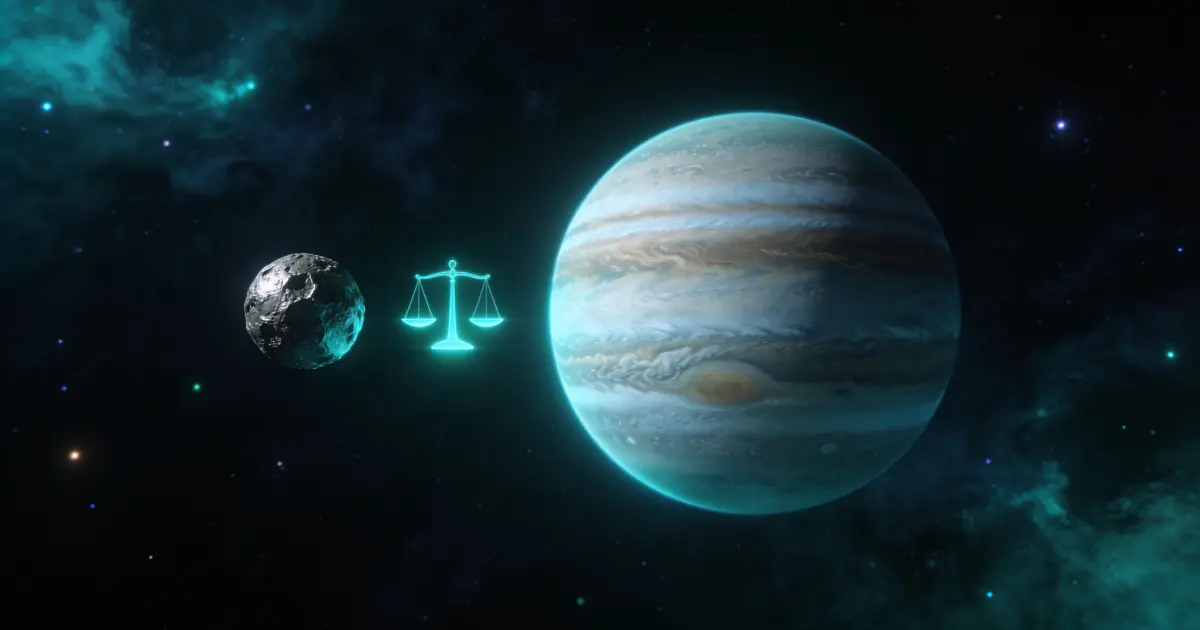
For many planets far away, scientists can measure two things: how big the planet is, and how heavy it is. That might not sound like much. But those two clues, put together, can tell us something amazing — what the planet is probably made of. Here’s the trick.
Two clues: size and weight
The first clue is size — how big across the planet is. The second is weight, which scientists call its mass. It just means how much stuff the planet is made of.
Where do those clues come from? When a planet crosses in front of its star, it blocks a little light, and the size of that dip tells us how big the planet is. When a planet tugs on its star and makes it wobble, the size of the wobble tells us how heavy the planet is. (You can play with both of those in our How We Find Them simulator.)
One clue by itself isn’t enough. The magic happens when we put size and weight together.
The bowling ball and the beach ball
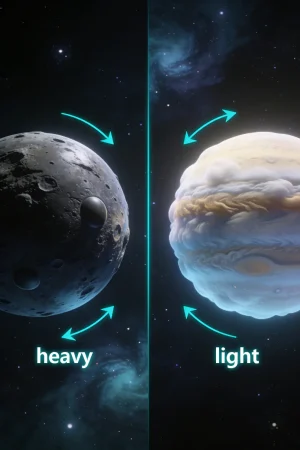
Picture a bowling ball and a beach ball sitting side by side. They’re about the same size, right? Now pick them up. The bowling ball is super heavy. The beach ball weighs almost nothing.
Why? The bowling ball is packed full of heavy stuff. The beach ball is mostly air. Same size, totally different weight.
Planets work the exact same way. Two planets can be the same size, but one might be heavy and packed tight while the other is light and puffy. Scientists call how packed-together something is its density. Heavy for its size means dense, like the bowling ball. Light for its size means not very dense, like the beach ball.
Three kinds of worlds
When scientists compare size and weight, planets usually fall into three groups:
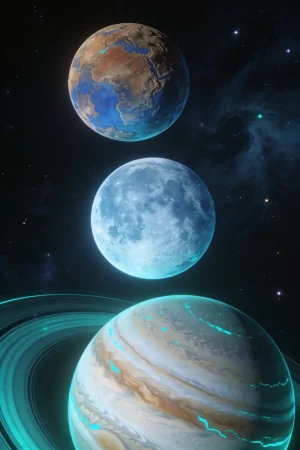
- Rocky worlds. These are heavy for their size, like that bowling ball. They’re made of rock and metal, and they have solid ground. Earth, Mars, Venus, and little Mercury are all rocky worlds.
- Water and ice worlds. These are in the middle — lighter than pure rock, because they hold a lot of water or ice mixed in with their rock.
- Gas worlds. These are big and puffy and very light for their size, like the beach ball. They’re mostly gas, with no solid ground at all. Jupiter, Saturn, and Neptune are gas worlds.
This really matters. If you ever wanted to land on a planet, it would have to be a rocky one. A gas planet has no ground to stand on — you’d just keep sinking down and down into thicker and thicker gas until it crushed you. So when we hunt for places life could exist, the rocky worlds are the ones we get excited about.
The in-between worlds
Here’s something fun. Our Solar System has small rocky planets and big gas planets, but nothing in between. Out among the other stars, though, scientists keep finding worlds that are bigger than Earth but smaller than Neptune.
Some of these are called “super-Earths” — rocky worlds a few times heavier than ours. Others are “mini-Neptunes” — small puffy worlds wrapped in gas. They’re some of the most common planets in the whole galaxy, and yet we have nothing like them at home. Size and weight are exactly how scientists tell these in-between worlds apart.
Same size, totally different
Here’s why scientists always want both clues. Imagine two planets that look exactly the same size through a telescope. One is a dense ball of rock. The other is a puffy ball of gas.
From the size alone, you couldn’t tell them apart. They look identical! But the moment you measure their weight, the secret pops out. The heavy one must be rock. The light one must be mostly gas. Size plus weight cracks the case wide open.
A good clue, not a final answer
Now for the honest part. Size and weight give us a really good guess about what a planet is made of. But it’s a guess, not a sure thing.
A planet could be a mix — maybe rock with a deep ocean on top, or rock wrapped in a thick layer of gas. Sometimes two very different mixes end up with the same size and weight, so they look the same on our charts. And our measurements always have a little wiggle room, because the planets are so far away. So scientists carefully say a planet is “probably rocky” or “likely a gas world,” not “definitely.” Being honest about what we don’t know for sure is a big part of good science.
A planet that could float
Here’s a fun fact about density. Saturn, the giant ringed planet, is so light and puffy for its size that it is actually less dense than water. That means if you could somehow find a bathtub big enough, Saturn would float in it, rings and all! Earth, on the other hand, is the densest planet in our whole Solar System. Drop Earth in that same giant bathtub and it would sink straight to the bottom like a stone.
It’s the same idea as the bowling ball and the beach ball, just blown up to planet size. And it’s a perfect reminder that two worlds can be wildly different even when they’re both called “planets.”
See it on a chart
The best way to see all this is to look at lots of planets at once. Our Mass–Radius diagram puts every measured planet on one chart, lined up by its size and its weight. It even draws lines showing where rocky, watery, and gassy worlds usually fall. Tap a planet and you’ll see how heavy it is for its size — and what that hints it’s made of.
After that, you can compare planet sizes head-to-head in our Size Comparison tool, or go exploring in the Atlas. Next time you hear about a brand-new planet, you’ll know the two questions that unlock its biggest secret: how big, and how heavy?