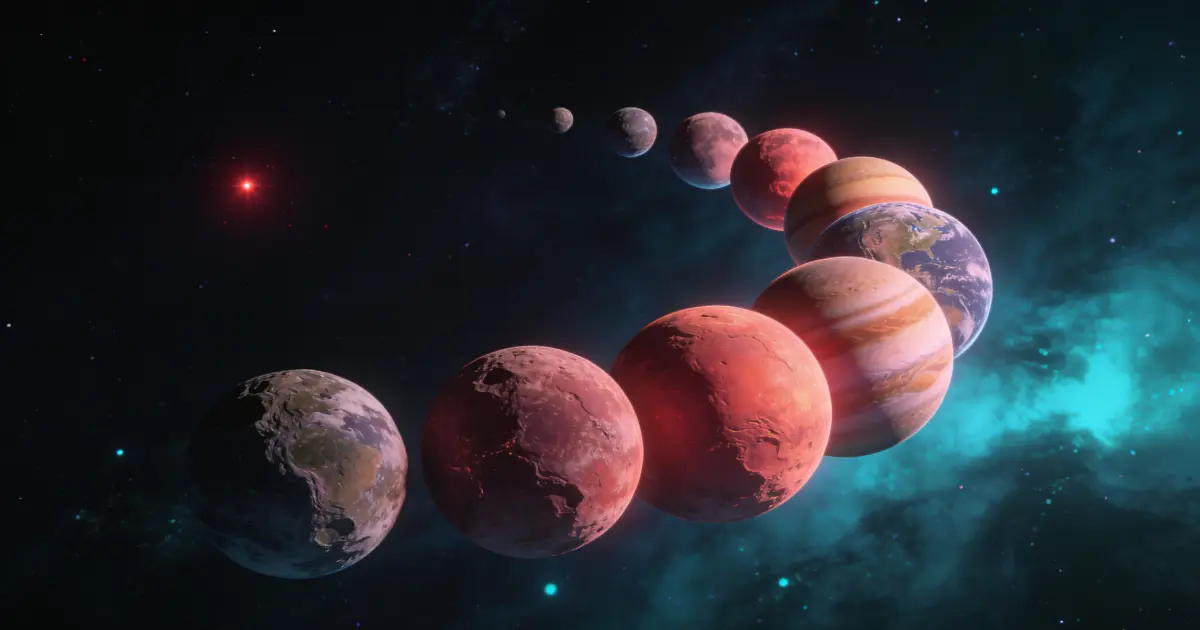
Sometimes scientists don’t find just one planet around a star. They find a whole family of them. We call that a planetary system, just like our own Solar System. A few of these families are famous, and one of them is downright amazing. Let’s go meet it — and a couple of its rivals.
What is a “system,” anyway?
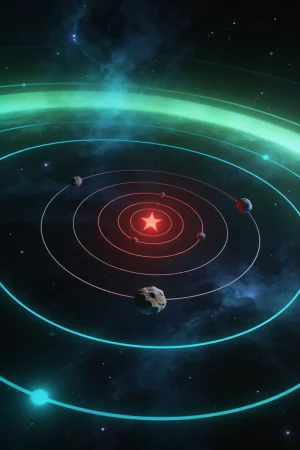
A planetary system is a star plus all the planets that circle it. Our Solar System is the Sun plus its eight planets, including the one you’re standing on right now.
Other stars have their own families of planets. Finding a whole family at once is extra exciting. It’s like meeting a bunch of siblings — you can line them up and compare them. Which one is biggest? Which one is closest to the star? Which one might have water? A system lets us ask all those questions at the same time, and that teaches us how planets grow up together.
Where do these families come from?
Here’s something neat about how systems are born. A star starts as a giant spinning cloud of gas and dust. The middle squeezes together to make the star. The leftover dust keeps spinning around it in a flat disk, like a record or a pizza. Over millions of years, bits of that dust bump and stick together, growing into rocks, then boulders, then whole planets — all circling the same way, in the same flat ring. That’s why the planets in a system tend to line up so neatly.
Meet TRAPPIST-1, the superstar
The most famous family belongs to a star called TRAPPIST-1. It sits about 40 light-years away. (A light-year is a giant distance — so this is very far, but close by space standards.)
The star itself is a surprise. It’s tiny and cool and red — barely bigger than the planet Jupiter, and so dim you can’t see it without a telescope. In fact, the star got its strange name from the telescope in the mountains of Chile that first spotted its planets, which was called TRAPPIST. But this little star is hiding something huge: seven planets. And they are all rocky and roughly the size of Earth. That’s the most Earth-sized planets we’ve ever found around a single star.
Here’s the wild part. These seven planets huddle in super close to their star. The whole system would fit inside the orbit of Mercury, the closest planet to our Sun! Because they’re so close, their “years” are incredibly short — a full trip around the star takes only a few days. You could have a birthday every week.
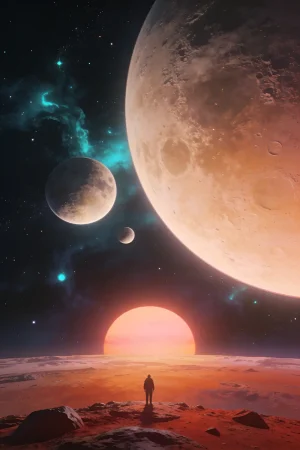
Three of the seven planets sit in the “just right” zone, where water could stay liquid. And since the planets are packed so tightly together, the view from one would be jaw-dropping. If you stood on one planet and looked up, a neighbor planet would hang in the sky bigger than our Moon — you might even see its clouds. Imagine looking up and seeing another whole world floating right there above you.
The sky itself would look strange and beautiful, too. TRAPPIST-1 is a cool red star, so its light is soft and reddish, not bright white like our Sun. Standing there, you’d see a big, dim, salmon-colored sun, and the daylight would feel more like a warm sunset that never quite ends. It would be a world that looks nothing like home, even if it’s about Earth’s size.
A space dance
The TRAPPIST-1 planets do something special. They move in a steady rhythm. Each planet’s trip around the star lines up with its neighbors’ trips, over and over, like a beat in a song.
Think of kids on swings pumping their legs in time, so the swings rise and fall together. The planets keep a rhythm like that, gently tugging each other into step. Scientists were even able to turn the pattern into music you can listen to. That tidy dance actually helped them find the planets and prove they were really there.
What are their skies made of?
The biggest question about these worlds is whether they have air, and what kind. Air is the difference between a frozen rock and a place that could hold water and warmth.
Right now, powerful telescopes are studying the light around the TRAPPIST-1 planets, hunting for signs of an atmosphere. It’s incredibly hard work, and the early answers have been surprising. Some of the planets may have thin air or none at all. Scientists are still puzzling it out. That’s normal in science — finding the question is often easier than finding the answer.
Other famous families
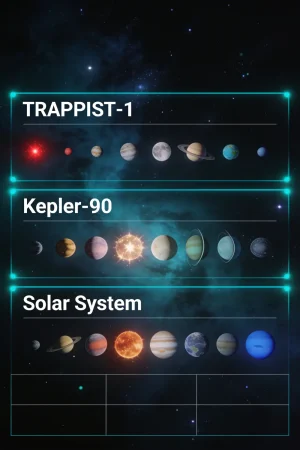
TRAPPIST-1 isn’t the only star with a big family.
Kepler-90 has eight planets. That ties the record with our own Solar System! But don’t pack a bag — these planets crowd in close to their star and get very hot. And the system is extremely far away, around 2,800 light-years.
Kepler-11 has six planets, all bunched up closer to their star than Venus is to our Sun. It showed scientists that crowded little systems are actually pretty common in space.
And let’s not forget the most famous system of all: our own. The Solar System has eight planets too, spread out with lots of room between them. And one of them, Earth, is the only place we know of anywhere with actual life. When you study other systems, you’re really comparing them to the one you live in.
See a system for yourself
The best way to understand a planet family is to see it. Our System Explorer draws TRAPPIST-1, Kepler-90, and other systems with their orbits to scale, and it shades the “just right” zone right on top. You can watch the planets circle their star and spot which ones land in the zone.
Once you’ve explored a system, try dropping one of its planets into the Habitable Zone tool, or go meet thousands of other worlds in the Atlas. Out of all those families scattered across the galaxy, which one do you think we’ll explore first?