Space is big. Not big like an ocean or a country — big in a way your brain doesn’t really want to believe. The planets we talk about are so far away that we need a special kind of ruler just to measure the distance. Let’s try to wrap our heads around how far “far” really is.
The fastest thing there is: light
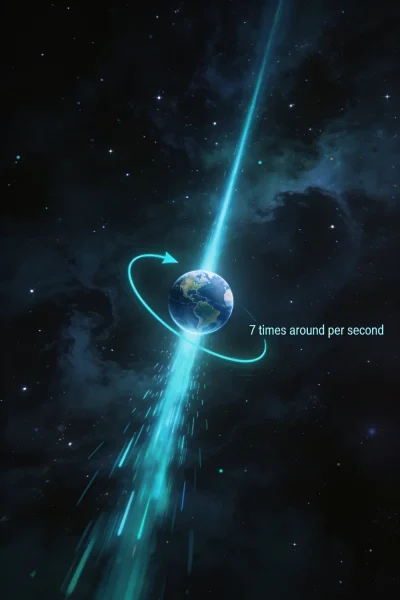
Light is the speed champion of the whole universe. Nothing goes faster. It travels about 300,000 kilometers every single second. In just one second, a beam of light could zip all the way around the Earth more than seven times. Whoosh!
Even at that incredible speed, light takes time to cross space. Sunlight needs about 8 minutes to travel from the Sun to your face. So the sunshine warming you right now actually left the Sun 8 minutes ago. You’re always seeing the Sun a tiny bit late — and there’s nothing anyone can do to speed it up.
A ruler made of light
Distances in space get so huge that counting them in kilometers turns silly fast. The numbers would have endless zeros, and nobody could keep track. So scientists invented a smarter ruler: the light-year.
A light-year is simply how far light travels in one whole year. That works out to about 9 trillion kilometers. (A trillion is a million millions — a number so big it’s almost impossible to even picture.)
So when we say a star is “40 light-years away,” we mean light needs 40 whole years to make the trip from there to here. The light-year is the perfect space ruler, because it turns those impossible numbers into something we can actually say out loud.
Let’s shrink it down
Giant numbers are hard to feel, so let’s shrink everything. Imagine the Sun was the size of a beach ball you could hold.
On that tiny scale, Earth would be a crumb smaller than a grain of rice, sitting across the room from the beach ball. All eight planets would fit inside a single house. But the nearest star? On the same scale, it would be another beach ball — sitting almost on the far side of the world. That huge, empty gap between two beach balls is what space is really like: a little bit of stuff, and a whole lot of nothing in between. Try picturing that gap the next time you look up at the night sky.
Looking far means looking back in time
Now here’s a real brain-twister. Because light takes time to reach us, looking at faraway things is like peeking into the past.
Take the star TRAPPIST-1, about 40 light-years away. The light we see from it tonight left that star 40 years ago. We’re seeing it the way it looked back then — not the way it looks right this second. For stars that are thousands of light-years away, we’re seeing light that left before there were cars or even cities on Earth.
In a way, telescopes are like time machines. The farther out you look, the further back in time you see. The night sky isn’t a photo of “now.” It’s a giant collage of different moments in the past, all arriving at your eyes at once. The most powerful telescopes can catch light that has traveled for billions of years, showing us baby pictures of the universe from long before Earth even existed.
The nearest star is still incredibly far
The closest star to our Sun is called Proxima Centauri. It’s about 4 light-years away. That sounds close next to 40, doesn’t it? Don’t be fooled. It’s still mind-bogglingly far.
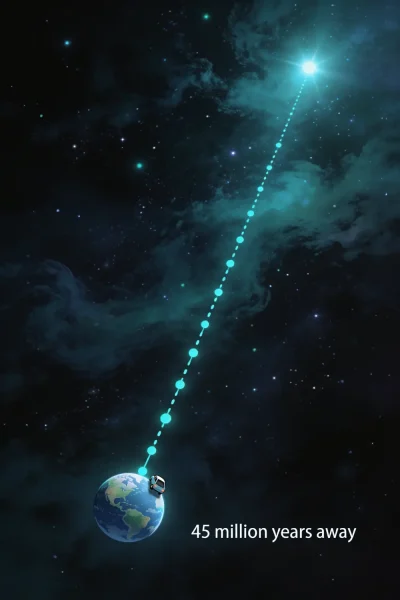
Imagine you could drive a car there on a space highway. Even going highway speed the whole way, without ever stopping, the trip would take about 45 million years. Your great-great-great-grandkids, many millions of times over, still wouldn’t have arrived. You’d need to pack a lot of snacks.
Our real spaceships are slow compared to light, too. One of our fastest probes, called Voyager, has been zooming through space for decades. But if it were headed for the nearest star, it would still need tens of thousands of years to get there. Space is just that enormous.
Why can’t we just go faster?
Good question. The trouble is that going fast in space takes a staggering amount of energy, and going really fast — anywhere close to the speed of light — takes more energy than we know how to make. So far, nothing humans have ever built comes even close.
But people are dreaming. Some scientists have imagined tiny spacecraft, smaller than your hand, pushed by powerful beams of light like sails catching wind. A fleet like that might one day reach the nearest star in a couple of dozen years instead of thousands. It’s still just an idea on paper — but every big journey starts as a daydream.
So how do we explore?
For now, we don’t travel to these worlds. We explore them with light. We catch the light that has crossed all that empty space and read its secrets — how big a planet is, how heavy it is, even hints about its air.
And that’s the honest truth: we can’t visit these planets, at least not yet. But we don’t have to in order to learn about them. From right here on Earth, using light and clever telescopes, we can map them, measure them, and discover an astonishing amount about worlds we may never set foot on.
See the distances for yourself
Numbers this big are easier to feel when you can play with them. Our Distance & Travel tool lets you pick a world and see how far away it is — and how long the trip would take at different speeds, from a jet to a spaceship to the speed of light itself.
You can also fly through the real positions of nearby stars in our 3D Cosmic Map, or go meet the planets themselves in the Atlas. Space is unbelievably huge — but light carries all those distant worlds right to us, if we only know how to look.