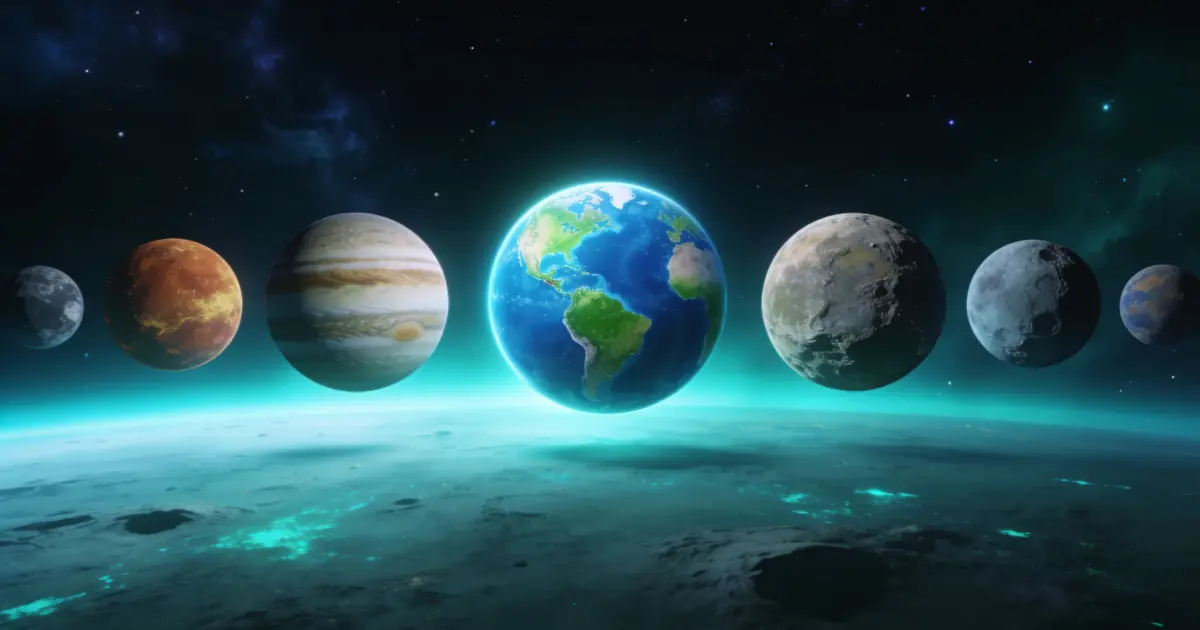
Scientists have found more than 6,000 planets around other stars. That’s a lot of worlds! So it’s only natural to ask: which ones are the most like Earth? It turns out there’s a way to score that. But “most like Earth” is a sneakier idea than it sounds.
A score for being like Earth
Scientists made a kind of “how much does this look like home?” score. It’s a number between 0 and 1. Earth gets a perfect score of 1. The closer a planet’s score is to 1, the more it looks like Earth.
What goes into the score? Mostly two things:
- Size. Is the planet about as big as Earth? Or is it much bigger or much smaller?
- Warmth. Does it get about the same amount of starlight as Earth? Or is it roasting hot or freezing cold?
A planet that is close to Earth’s size and gets close to Earth’s warmth earns a high score. A giant, boiling planet gets a low one. Think of it like a meter that climbs the more a world reminds us of home. Scientists use it to sort thousands of planets fast and flag the ones worth a closer look.
“Looks like Earth” is not “like Earth”
Here comes the sneaky part, and it’s the most important thing on this page. A high score does not mean a planet has air, water, or life. It only means the planet is about Earth’s size and gets about Earth’s warmth. That’s it.
Remember Venus? Venus is almost exactly Earth’s size, and it’s not too far from the Sun. So it would earn a pretty high score. But Venus is a furnace — about 460 degrees Celsius, hot enough to melt a metal spoon. Its thick air traps heat like a closed-up car on a sunny day. If our own neighbor can fool the score, a faraway planet can too.
So a high score is really a way of saying, “Hey, this one is worth a closer look!” It is not a promise that anyone could live there. Keep that in your back pocket every time you hear a planet called “Earth-like.”
What would a true twin need?
The score checks size and warmth. But a real twin of Earth would need a lot more boxes checked:
- It would need to be rocky, with solid ground, not a ball of gas.
- It would need the right air — enough to stay warm and breathe, but not a heavy, scorching blanket like Venus has.
- It would need liquid water on its surface.
- And it would need a calm star and a long, peaceful history so life had time to grow.
The score can’t see any of those things from light-years away. So even the top planets on the list are really just our best guesses, based on the little we can measure.
Some of the most Earth-like worlds
Even with that warning, a few worlds really do stand out. Here are some of the most famous.
Proxima Centauri b is special because it’s the closest planet to us. It circles the nearest star to our Sun, only about 4 light-years away. That’s still incredibly far — but in space terms, it’s right next door. It’s about as heavy as Earth and sits in the just-right zone. The catch? Its star is a small red star that sometimes blasts out bursts of energy, which could be rough on the planet.
TRAPPIST-1 e is part of an amazing family. Its star has seven planets, and several of them are rocky and Earth-sized. Planet “e” is one of the most Earth-like worlds we’ve ever measured. The whole system is about 40 light-years away. You can watch all seven planets circle their star in our System Explorer.
Kepler-186f was a big deal when it was found. It was one of the first Earth-sized planets discovered in the just-right zone of its star. It’s far away, hundreds of light-years off, but it showed everyone that Earth-sized worlds in good spots really are out there.
TOI-700 d is another rocky, Earth-sized world in its star’s habitable zone. It was spotted by the planet-hunting telescope TESS, and it’s one of the closer good candidates we know of.
By the way, scientists gave this whole “how Earth-like is it?” idea a real name: the Earth Similarity Index. It’s a fancy title, but you can just think of it as an Earth-likeness score. And here’s a fun fact to keep things humble — if you measured Mars with it, our dusty, frozen neighbor would still score fairly high, even though no one is living there. Once again, looking like Earth is not the same as being like Earth.
Why do so many circle red stars?
You might notice that a lot of the top worlds circle small, cool, red stars. There’s a reason. Small planets are much easier to spot around small stars, because a little planet blocks more of a little star’s light and tugs on it harder. So our tools find them there first.
That doesn’t mean red stars are the only good homes. It mostly means they’re the easiest places for us to look right now. There could be plenty of Earth-like worlds around Sun-like stars that we simply haven’t caught yet. The hunt is far from over.
Why the list keeps changing
Here’s something cool. The list of “most Earth-like” worlds is not frozen. Scientists find new planets all the time, and better measurements can change a planet’s score. A world near the top today might get bumped tomorrow by a fresh discovery.
That’s why we keep a living list instead of printing one in a book. Our Most Earth-like Worlds page ranks the planets by their score and updates as the science updates. You can always see what’s near the top right now.
See for yourself
Go check out the Most Earth-like Worlds leaderboard and see which planets are leading today. Then drop one into our Habitable Zone tool to see exactly where it sits, or explore the whole crowd in the Atlas.
And remember the rule: a high Earth score means “worth a closer look,” not “pack your bags.” The most exciting part of the search is that the best world might still be out there, waiting for someone to find it. Maybe that someone is you.