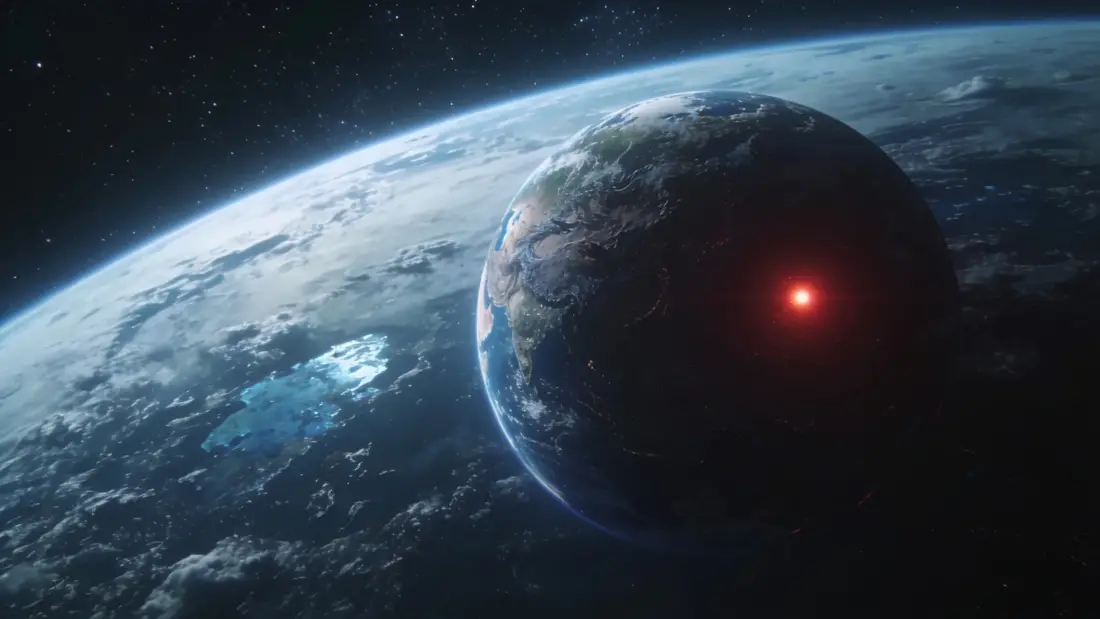
About 40.5 light-years away — a light-year is the distance light travels in one year — a small, dim star holds seven planets in its orbit. That star is called TRAPPIST-1, and the family of worlds around it is one of the most studied in all of astronomy. One of those worlds, TRAPPIST-1 f, is especially interesting to scientists thinking about what planets beyond our Solar System can be like.
What Kind of Star Is TRAPPIST-1?
TRAPPIST-1 is what astronomers call a red dwarf. A red dwarf is a star that is much smaller and cooler than our Sun. Where the Sun’s surface runs at about 5,778 K (K stands for Kelvin, a way of measuring very high temperatures), TRAPPIST-1’s surface is only about 2,566 K. That makes it a very faint, reddish star.
Because TRAPPIST-1 is so cool and dim, it gives off far less light and heat than our Sun. A planet would need to orbit quite close to this star just to get enough warmth to stay above freezing. This is one reason the seven known planets all sit very near to TRAPPIST-1 — much closer than Earth is to the Sun.
Red dwarfs like TRAPPIST-1 are actually the most common type of star in our galaxy. That means systems like this one might be very widespread across the Milky Way. Scientists are paying close attention to what they find here because it could teach us about a huge number of other star systems we haven’t studied yet.
Seven Worlds in One System
What makes TRAPPIST-1 stand out right away is the number of planets. As far as we know, seven planets orbit this single star. That is a full family of worlds packed into a very small space. All seven orbit closer to their star than Mercury — the innermost planet in our Solar System — orbits the Sun.
Because the planets are so tightly grouped, their orbits are very short. The innermost ones zip around the star in just a couple of Earth days. Even the outermost known planet finishes one orbit in less than nineteen Earth days. By comparison, Earth takes 365 days to go around the Sun.
Scientists think that several of the seven planets sit in or near what is called the habitable zone — the region around a star where temperatures might allow liquid water to exist on a planet’s surface. This does not mean any of them definitely has liquid water or life. It simply means the conditions are not obviously too hot or too cold. Whether any of these worlds actually has water or an atmosphere is something scientists are still working to find out.
Another interesting thing about the TRAPPIST-1 system is how the planets seem to be in a rhythm with each other. The time each planet takes to orbit the star forms a pattern, almost like a slow, steady drumbeat. Astronomers call this kind of pattern an orbital resonance. It tells us something about how the planets formed and moved into their current positions long ago.
How Scientists Found Them
All seven planets were confirmed using a technique called the transit method. A transit happens when a planet passes in front of its star, as seen from our direction. When that happens, the star looks very slightly dimmer for a short time — the planet is blocking a small amount of starlight. Scientists watch for these tiny dips in brightness, over and over, to confirm a planet is really there.
The TRAPPIST-1 planets were announced in 2017. Because the planets orbit so close to their star, transits happen often, which makes the transit method especially useful here. Scientists were able to spot repeated dips in the star’s light and confirm planet after planet in the same system. You can explore other confirmed systems using the system explorer.
The transit method also gives scientists a way to measure a planet’s size. By watching how much the star dims during a transit, they can work out how wide the planet is compared to the star. Other methods, like watching how the planets gently tug on their star as they orbit, help scientists estimate mass — how much matter a planet contains.
A Closer Look at TRAPPIST-1 f
Among the seven planets, TRAPPIST-1 f is one of the most carefully measured. Its radius — that is, its width from center to edge — is about 1.05 times Earth’s radius. Its mass is about 1.04 times Earth’s mass. In other words, it is almost exactly the same size and mass as our own planet. That makes it one of the most Earth-sized worlds we have found anywhere.
TRAPPIST-1 f completes one full orbit around its star in just 9.21 Earth days. So its year is less than ten of our days long. Even though it is so close to its star, the star is so faint that the planet does not receive much warmth. Scientists estimate its likely temperature at around 218 K, which is about -55 degrees Celsius. That is very cold — colder than the coldest places on Earth.
At that temperature, liquid water on the surface seems unlikely without something to warm the planet further. One thing that could make a difference is an atmosphere — a layer of gas around the planet that traps heat, the way Earth’s atmosphere does. Scientists haven’t yet confirmed whether TRAPPIST-1 f has an atmosphere, or what it might be made of. That is one of the big open questions about this world.
We also don’t know what the surface of TRAPPIST-1 f looks like. Scientists haven’t measured its surface conditions directly. It might be rocky, like Earth, but that has not been confirmed beyond doubt. What we do know — its size, its mass, its orbit, its estimated temperature — already gives scientists a lot to work with as they compare it to other worlds.
What the Whole System Tells Us
The TRAPPIST-1 system shows us that a single, small star can hold a whole collection of Earth-sized planets. It tells us that planet formation is not rare and that rocky worlds can gather close together in tight, orderly orbits. It also reminds us how much we still don’t know. For most of these seven planets, scientists haven’t yet measured things like surface conditions, atmospheric makeup, or whether any kind of water exists in any form.
Every new measurement — of TRAPPIST-1 f or any of its neighbors — adds a piece to a much larger picture. That picture is about how common planets are, what shapes families of worlds can take, and what conditions are needed for a world to be more than just a cold, silent rock. TRAPPIST-1 is one of the best places in the sky to keep asking those questions.