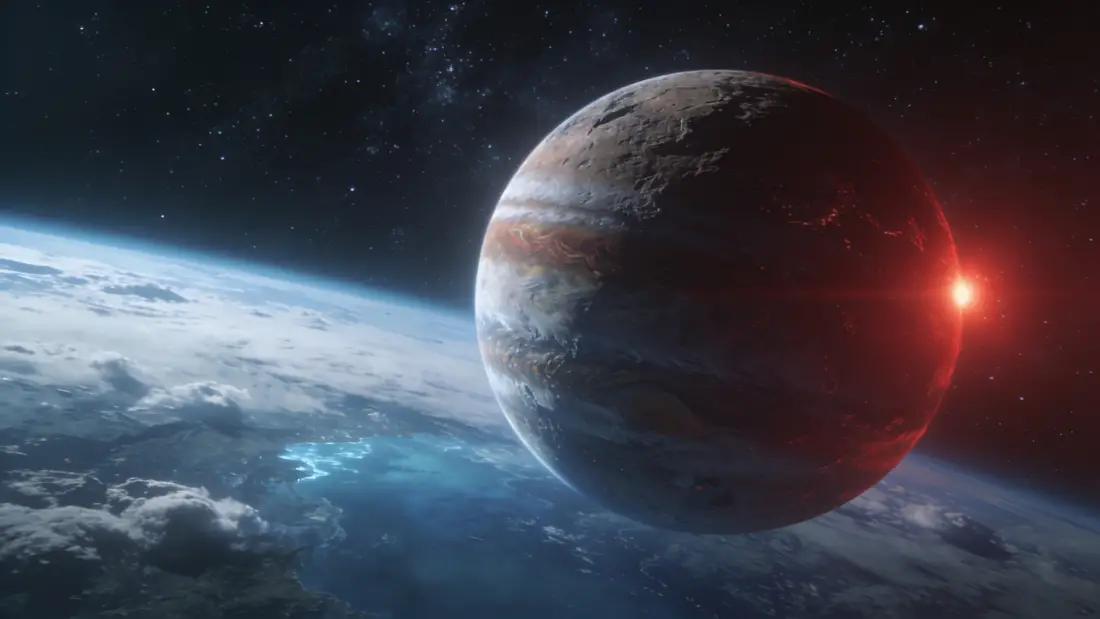
Just 10.7 light-years from Earth — one of our closest cosmic neighbors — a small, dim star called GJ 887 quietly hosts a family of worlds. One of them, GJ 887 d, is a type of planet our own solar system doesn’t have. Learning about it helps us understand just how varied planets can be across the universe.
A Nearby Red Dwarf and Its Family of Worlds
GJ 887 is what astronomers call a red dwarf — a star that is smaller and cooler than our Sun. Its surface temperature is about 3,688 K (kelvin is the unit scientists use to measure temperature; 3,688 K is roughly 3,415 degrees Celsius). Our Sun, for comparison, is around 5,778 K, so GJ 887 burns noticeably cooler and gives off a reddish-orange glow rather than the bright yellow-white of the Sun.
Red dwarfs are the most common type of star in the Milky Way. They can burn steadily for tens of billions of years, far longer than the Sun will last. Many of them, including GJ 887, are now known to have planets orbiting them.
At only 10.7 light-years away, GJ 887 is remarkably close in cosmic terms. A light-year is the distance light travels in one year — about 9.5 trillion kilometers. Even so, no spacecraft we have today could reach GJ 887 in a human lifetime. Its closeness simply makes it easier for telescopes to study in detail.
How Scientists Found GJ 887 d
GJ 887 d was discovered in 2026 using the radial velocity method. Here is how that works: when a planet orbits a star, its gravity gives the star a tiny tug. That tug makes the star wobble very slightly toward and away from Earth. As the star moves toward us, its light shifts to slightly bluer wavelengths. As it moves away, the light shifts to slightly redder ones. Scientists can measure these shifts and use them to figure out that a planet must be there — and roughly how massive it is.
The radial velocity method does not directly show us the planet. Instead, it reveals the planet’s gravitational fingerprint on its star. It is a bit like watching a ball on a string spin around — you can tell the ball is there by watching the hand holding the string move in a circle.
This method is especially good at finding planets that are fairly massive and orbit close to their star, because those planets produce the strongest wobbles. GJ 887 d fits that profile.
Size and Mass: What the Numbers Tell Us
GJ 887 d has a radius of 2.34 times Earth’s and a mass of 6.1 times Earth’s. Those two numbers together are more useful than either one alone. When scientists know both the size and the mass of a planet, they can calculate its density — how much material is packed into a given space. Density is a powerful clue about what a planet is made of.
Rocky planets like Earth are dense because they are made mostly of iron and rock. Gas giants like Jupiter are much less dense because they are mostly hydrogen and helium gas. GJ 887 d sits somewhere in between. Its size and mass suggest it is denser than a pure gas ball but not as dense as a purely rocky world. Scientists think planets in this size range — roughly 2 to 4 times Earth’s radius — often have a rocky or icy core surrounded by a thick layer of gas or water. That is why they are called mini-Neptunes: they resemble a smaller version of our own ice giant, Neptune.
You can explore how GJ 887 d compares to other planets visually using the mass-radius diagram, which shows how a planet’s size and mass together hint at its inner makeup.
Inside a Mini-Neptune
So what might the inside of GJ 887 d actually look like? Scientists are careful here, because no one has directly seen inside any exoplanet (a planet outside our solar system). What we have are educated guesses based on density and comparisons to planets in our own solar system.
A mini-Neptune probably has a core made of rock or ice — or a mix of both. Around that core there is likely a thick envelope of lighter materials. This could be water in a very hot, high-pressure form, or it could be hydrogen and helium gas, or some combination. The exact recipe depends on where the planet formed in its solar system and how its star’s energy has shaped it over time.
What a mini-Neptune almost certainly does not have is a solid surface you could stand on. The outer layers probably blend gradually from gas to liquid to something in between as you go deeper, without a clear ground underfoot. It is a very different kind of world from Earth.
If you are curious how GJ 887 d compares in sheer size to familiar planets, the size comparison tool lets you put worlds side by side.
A Cold Orbit — and What That Means for Habitability

GJ 887 d takes 50.8 Earth days to complete one orbit around its star. That means one year on this planet lasts only about seven weeks by our calendar. Despite being relatively close to its star, GJ 887 d has a likely temperature of around 241 K, which is about -32 degrees Celsius. That is colder than most places on Earth’s surface in winter.
This cold temperature puts GJ 887 d outside what scientists call the habitable zone — the range of distances from a star where liquid water could exist on a planet’s surface. The habitable zone is sometimes called the “Goldilocks zone” because conditions there are not too hot and not too cold. Scientists think GJ 887 d sits beyond the warm edge of that zone for its star, making surface liquid water unlikely.
That said, we do not know enough about GJ 887 d’s atmosphere yet to say anything final. A thick atmosphere can trap heat. Scientists simply haven’t measured it yet, so we keep an open mind.
GJ 887 d in a Four-Planet System
GJ 887 d is one of four known planets in its system. As of now, scientists haven’t published detailed confirmed data for the other three planets, so we can only say that GJ 887 hosts a busy neighborhood of worlds. Finding four planets around a single nearby red dwarf is a reminder that planetary systems are common across the galaxy — and that even our closest stellar neighbors can surprise us.
GJ 887 d is not the most dramatic world you could imagine: no scorching lava, no towering storms we know of. It is, quietly, a very typical mini-Neptune — and that is exactly what makes it valuable. Every world like this one helps scientists build a clearer picture of how planets form, what they are made of, and how different the universe’s variety of worlds truly is from our own familiar home.