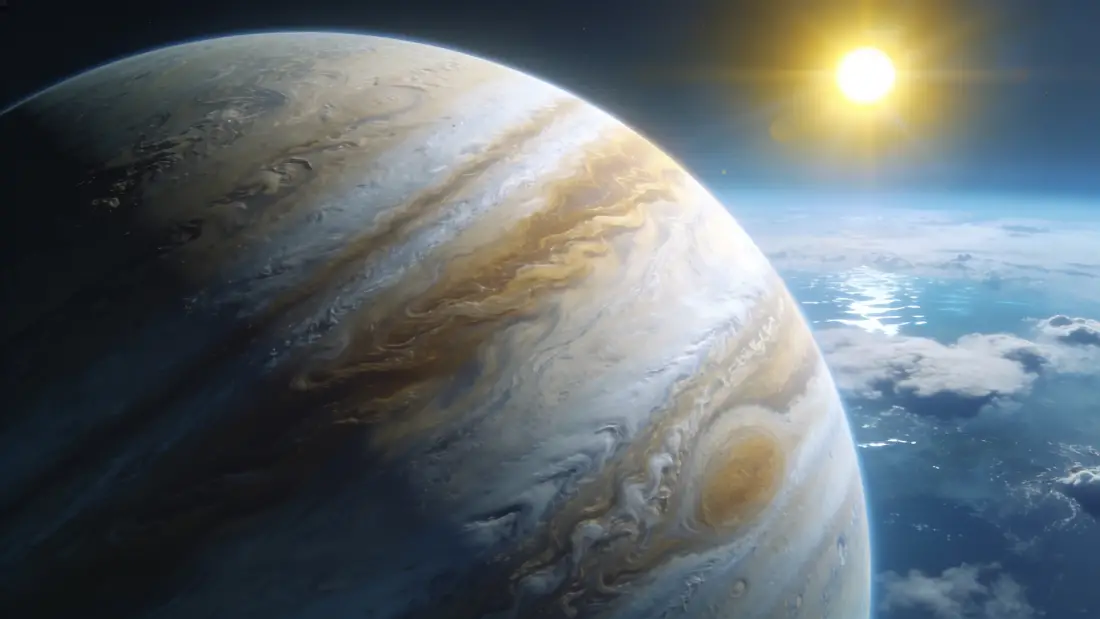
TOI-1338 b is an unusual world. It orbits not one star but two, making it a little like the fictional planet Tatooine from Star Wars. Found about 1,301 light-years from Earth, it raises a natural question: could a place like this support life? To answer that, we need to think carefully about something called the habitable zone.
A World with Two Suns
Most planets we know of orbit a single star. TOI-1338 b is different. It circles two stars at once. Scientists call this a circumbinary planet — “circum” means around, and “binary” means two. The planet’s main host star is called TOI-1338 A.
The system sits 1,301 light-years away. A light-year is the distance light travels in one year — about 9.5 trillion kilometres. That makes TOI-1338 b very far away by everyday standards, though in galaxy terms it is actually a fairly close neighbour.
Scientists found TOI-1338 b in 2020 using the transit method. This means they watched the star’s light and noticed it dimmed slightly at regular intervals. That dimming happens when a planet passes in front of its star and blocks a small amount of light. The pattern helped researchers confirm a planet was there.
What the Habitable Zone Actually Means
The habitable zone is the band of space around a star where conditions might allow liquid water to exist on a planet’s surface. Scientists also call it the Goldilocks zone, because — like the porridge in the old story — it is not too hot and not too cold. It is just right for water to stay liquid rather than boiling away or freezing solid.
It is very important to understand what the habitable zone does not mean. Being in this zone does not mean a planet has liquid water. It does not mean a planet has life. It simply means the temperature from starlight alone could, in the right conditions, allow water to stay liquid. A planet’s atmosphere, chemistry, and many other things all play a role too. If you want to explore how scientists map this zone for different stars, you can visit our habitable zone explorer.
Where TOI-1338 b Sits in Its System
TOI-1338 b takes 95.4 Earth days to complete one full orbit around its two stars. That is roughly three Earth months for one local year. Whether that orbit places the planet inside the habitable zone is not a simple question, partly because two stars together put out a combined amount of energy, and partly because the zone shifts depending on how bright and warm those stars are.
TOI-1338 A has a surface temperature of 5,723 K (kelvin — a temperature scale scientists use that starts at absolute zero). Our own Sun has a surface temperature of about 5,778 K, so TOI-1338 A is quite similar to our Sun in warmth. Scientists haven’t published a full habitable zone boundary for this specific two-star system in the data we have, so we can’t say with certainty exactly where the zone falls. What we can say is that the planet’s estimated temperature gives us a useful clue.
Size, Mass, and What Kind of World This Might Be
TOI-1338 b has a radius of 7.66 times Earth’s radius and a mass of 11.3 times Earth’s mass. That makes it quite a bit larger and heavier than our home planet, but not nearly as large as the gas giants in our own solar system like Saturn or Jupiter.
Worlds in this size and mass range are often called sub-Neptunes or sometimes mini-Neptunes — planets larger than Earth but smaller than Neptune. Scientists think planets like this are probably wrapped in thick layers of gas and may not have a solid surface you could stand on. They are quite different from rocky worlds like Earth or Mars.
This matters a lot when thinking about life. Life as we know it needs a surface or liquid environment to exist. A world dominated by thick gas layers with crushing pressures is not a place where life — at least the kind we understand — would find easy footing. Scientists are still working out exactly what the interiors of sub-Neptune worlds look like, so there is real uncertainty here.
Temperature and What It Tells Us
The estimated temperature for TOI-1338 b is around 255 K, which is about -18 degrees Celsius. That is colder than a household freezer. At that temperature, pure water would be frozen solid on the surface.
This estimate is called an equilibrium temperature — the temperature a planet would reach if it simply absorbed starlight and radiated it back out, with no atmosphere involved. In reality, an atmosphere can change things significantly. Earth’s own equilibrium temperature would be well below freezing without the warming effect of our atmosphere. So 255 K doesn’t rule out warmer conditions entirely, but it does suggest TOI-1338 b sits on the cooler side, possibly at or beyond the outer edge of the habitable zone, or just within it.
We should be honest: scientists haven’t measured this planet’s atmosphere yet, and its true surface conditions — if it even has a surface — are unknown.
Why Circumbinary Planets Are Tricky for Life
Having two stars instead of one adds complications. The two stars move relative to each other, which means the combined light and heat reaching the planet changes over time. This could cause seasons that are far more complex and unpredictable than Earth’s. It also means the habitable zone itself shifts around, rather than staying fixed in one place.
Scientists are still studying how stable the climates of circumbinary planets could be over long periods. Stability seems to matter for life — on Earth, relatively steady conditions over billions of years gave life time to develop. Whether a two-star system can offer that kind of steadiness is an open question.
There is a second planet known in the TOI-1338 system, though detailed data on it is limited. The gravitational influence of nearby planets can also affect a world’s orbit and climate over time.
What Comes Next for This System
TOI-1338 b is an interesting case study, but it sits far from the top of the list of worlds that scientists consider most likely to harbour life. Its large size, likely gaseous nature, and cool estimated temperature all make it a challenging candidate. If you are curious about planets that sit closer to Earth in size and temperature, our most Earth-like worlds list is a good place to look.
Future telescopes may one day be able to study the atmospheres of planets like TOI-1338 b in more detail. For now, it remains a fascinating example of the strange variety of worlds that exist beyond our solar system — a large, cold, double-sunned planet sitting in a part of space where the conditions for liquid water are uncertain, but not impossible to imagine.