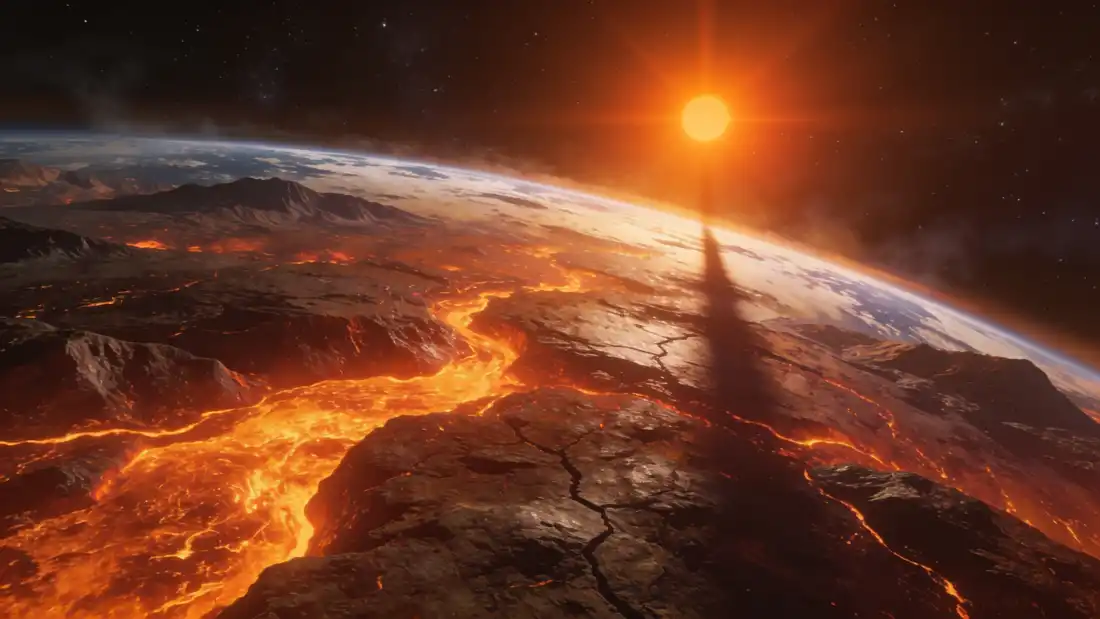
TOI-5789 b is a planet that no telescope has ever photographed directly. It sits 66.7 light-years from Earth, orbiting a star we can barely see. Yet scientists know it exists, know roughly how big it is, and even have a good idea how hot it gets. This is the story of how we found it — and what that tells us about the clever ways astronomers explore worlds they cannot see.
What Kind of World Is TOI-5789 b?
TOI-5789 b is a small planet, but it is larger than Earth. Its radius — that is, the distance from its center to its surface — is about 1.26 times Earth’s radius. Its mass, meaning how much matter it contains, is about 2.12 times Earth’s mass. That makes it what scientists sometimes call a “super-Earth,” a planet bigger and heavier than our own but much smaller than a giant like Neptune.
One year on TOI-5789 b lasts just 2.76 Earth days. That means it completes a full trip around its star in under three of our days. Because it orbits so close and so fast, it is baked by its star’s energy. Scientists estimate its likely temperature is around 1,201 K — roughly 928 degrees Celsius. That is far hotter than any oven and hot enough to melt many kinds of rock. As far as we know, this is not a place where life could exist.
A Star 66.7 Light-Years Away
TOI-5789 b circles a star called TOI-5789. A light-year is the distance light travels in one year — about 9.5 trillion kilometres. The star sits 66.7 light-years from Earth, which means the light we see from it left home before many of today’s adults were born.
TOI-5789 has a surface temperature of 5,185 K. Our own Sun’s surface is around 5,778 K, so TOI-5789 is a little cooler and probably a little dimmer and more orange in colour. Scientists haven’t published a full set of measurements for this star’s size or age yet, so those details remain uncertain for now.
How the Radial Velocity Method Works
TOI-5789 b was discovered in 2026 using a technique called the radial velocity method, sometimes nicknamed the “wobble” method. Here is how it works.
When a planet orbits a star, it does not simply spin around a perfectly still point. The planet’s gravity gives the star a tiny tug. That tug makes the star wobble very slightly back and forth. As the star wobbles toward us, the light it sends reaches Earth in slightly compressed waves — the colour shifts a tiny bit toward blue. As the star wobbles away, the light stretches out and shifts a tiny bit toward red. Scientists call this the Doppler effect. You hear the same idea when a siren sounds higher as an ambulance rushes toward you and lower as it drives away.
Astronomers measure these tiny colour shifts in a star’s light very carefully. By tracking the rhythm of the wobble — how fast the star moves and how often it repeats — they can work out how heavy the planet is and how long its orbit takes. The wobble caused by a super-Earth is incredibly small, about the speed of a person jogging. Detecting it requires very sensitive instruments and many careful observations over time.
One important thing to know: the radial velocity method tells us the planet’s mass, but it cannot directly tell us the planet’s size. For that, scientists often use a different approach.
How the Transit Method Works
The other main way astronomers find and measure exoplanets — that is, planets outside our solar system — is called the transit method. A transit happens when a planet passes directly in front of its star, from our point of view. When that happens, the planet blocks a tiny sliver of the star’s light. The star appears ever so slightly dimmer for a short time.
By measuring exactly how much dimmer the star gets and for how long, scientists can calculate the planet’s size. A bigger planet blocks more light. A longer dip in brightness means the planet takes more time to cross the star’s face.
Space telescopes that stare steadily at thousands of stars at once — watching for these small dips — have found thousands of planets this way. The name “TOI” at the start of TOI-5789 stands for TESS Object of Interest, which means this star was flagged by the TESS space telescope as something worth studying closely. That is how the system first came to scientists’ attention.
If you want to see how these detection ideas work in a hands-on way, you can explore how we find exoplanets with an interactive simulator.
What the Numbers Tell Us
When scientists combine both the mass from radial velocity and the radius from transit measurements, they can work out a planet’s density — how tightly its matter is packed together. Density helps scientists guess whether a planet is mostly rock, mostly water, or wrapped in a thick layer of gas.
TOI-5789 b has a mass of 2.12 Earths and a radius of 1.26 Earths. That combination points toward a rocky world, though scientists are careful here. Models suggest it could be mostly rock with perhaps a thin atmosphere, but we do not yet have measurements of its air, its surface, or its detailed composition. Scientists think the numbers are consistent with a rocky super-Earth, but more study is needed to say so with confidence.
Three More Planets in the Same System
TOI-5789 b is not alone. Scientists have so far found four planets in the TOI-5789 system. TOI-5789 b is just one of them. The others have not been described in full detail that is available here, so rather than guess at their properties, it is worth simply noting that multi-planet systems like this one are very common in the galaxy. Finding several planets around one star helps scientists compare worlds that formed from the same material and the same cloud of gas and dust — a bit like comparing siblings who grew up in the same household.
Why a World This Hot Still Matters to Science
TOI-5789 b is far too hot and close to its star to be a candidate for life. But that does not mean it is unimportant. Studying extreme planets helps scientists test their models of how planets form and change over time. A world with such a short orbit likely formed farther out from its star and then slowly drifted inward — a process called orbital migration. Understanding why that happens, and how common it is, teaches us something about how our own solar system came to look the way it does.
TOI-5789 b also reminds us that most of what we know about distant worlds comes not from pictures, but from patient, careful reading of starlight. A tiny wobble. A faint dimming. From 66.7 light-years away, that is often all we have — and it turns out to be enough.