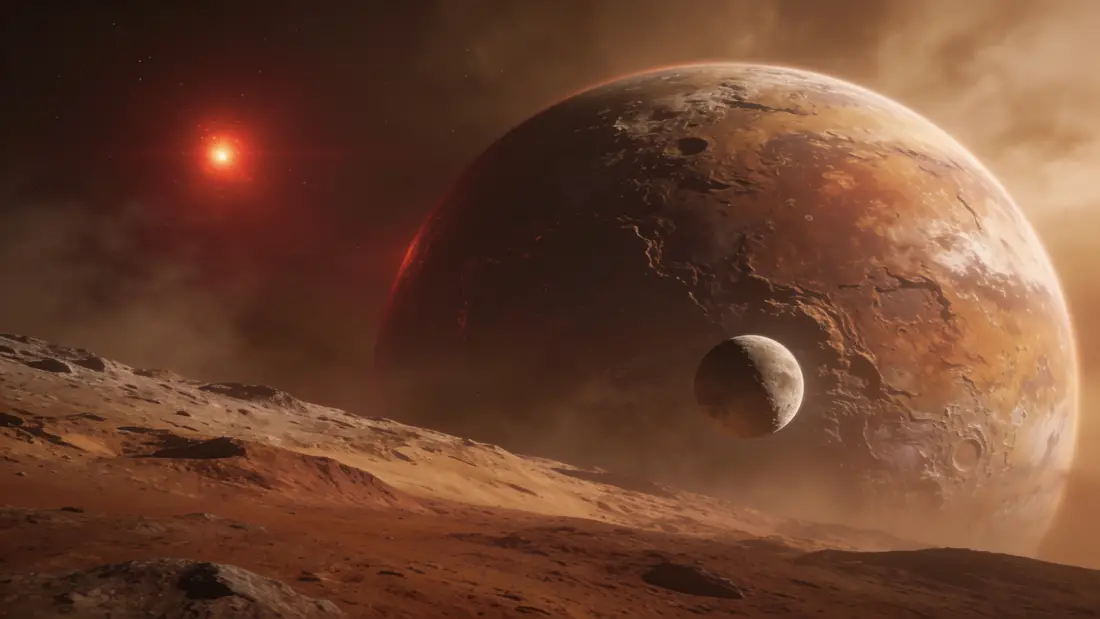
GJ 15 A b is one of the closest known exoplanets — that is, planets orbiting a star other than our Sun — to Earth. It circles a dim, reddish star just 11.6 light-years away, making it a fascinating subject for anyone curious about what lies just beyond our solar neighborhood.
What Is GJ 15 A b?
GJ 15 A b is a planet that orbits a star called GJ 15 A. The star sits in the constellation Andromeda, though you would need a good telescope to spot it. GJ 15 A is a red dwarf — a type of star that is much smaller, cooler, and dimmer than our Sun. Red dwarfs are the most common type of star in the Milky Way, so studying planets around them tells us a lot about what worlds are like across the galaxy.
The planet was discovered in 2014, making it a relatively recent addition to our growing list of known worlds beyond our solar system. Scientists found it using a clever technique called the radial velocity method, which we will explain later in this article.
11.6 Light-Years: What Does That Actually Mean?
A light-year is the distance light travels in one year. Light moves at about 300,000 kilometres every single second. In one year, it covers roughly 9.46 trillion kilometres. GJ 15 A b is 11.6 light-years away, which means the light you would see from its star has been travelling for 11.6 years before it reaches your eyes.
That sounds enormous — and it is, by any human measure. But in the context of our galaxy, it is practically next door. The Milky Way stretches about 100,000 light-years across. GJ 15 A b sits within a tiny bubble of space surrounding our Sun, a bubble that contains only a handful of known star systems.
To put the distance another way: if you shrank the solar system so that the distance from the Sun to Earth was just one centimetre, the distance to GJ 15 A b would still be about 740 metres. The nearest stars are far, even when they are considered close.
If you want to explore how GJ 15 A b compares to other nearby worlds, the Cosmic Map shows you where known exoplanets sit in relation to Earth in a visual, easy-to-explore way.
How Long Would It Take to Get There?

This is where the numbers become truly humbling. Our fastest spacecraft so far have travelled at speeds of around 60,000 to 70,000 kilometres per hour. At that pace, reaching GJ 15 A b would take somewhere around 75,000 to 80,000 years. No human technology today could make that journey in any reasonable timeframe.
Even if we imagine a future spacecraft travelling at one percent of the speed of light — far beyond anything we can build right now — the trip would still take about 1,160 years.
At ten percent of the speed of light, which is the kind of speed that shows up in bold engineering proposals and science discussions but remains far out of reach, the journey would take roughly 116 years. A crew would need multiple generations to complete such a voyage.
Only at speeds approaching the speed of light itself would the trip shrink to a human lifetime — and physics makes reaching those speeds extraordinarily difficult for any object with mass. You can explore travel times to GJ 15 A b and other worlds using the Distance and Travel Time tool, which lets you adjust speed and see what happens.
A Very Tight Orbit Around a Cool, Dim Star
GJ 15 A b completes one full orbit around its star in just 11.4 Earth days. That is an extremely short year. For comparison, Earth takes 365 days to orbit the Sun. GJ 15 A b is so close to its star that it zips all the way around in less than two Earth weeks.
Being so close to a star usually means a planet is quite hot. Scientists estimate the likely temperature of GJ 15 A b at around 550 K, which works out to about 277 degrees Celsius. That is far hotter than any place comfortable for life as we know it. It is hotter than a kitchen oven set to its maximum temperature.
Even though GJ 15 A is a cool star — its surface temperature is about 3,607 K, compared to our Sun’s roughly 5,778 K — a planet orbiting so closely still picks up a lot of heat. GJ 15 A b sits well inside what scientists call the habitable zone — the range of distances from a star where liquid water could exist on a planet’s surface. In other words, this world is too hot to be in that zone. It is not a candidate for the kind of life we know.
Size, Mass, and What Kind of World This Might Be

GJ 15 A b has a radius of 1.55 times Earth’s radius, meaning it is a bit wider than our planet but not dramatically so. Its mass is about 3.03 times Earth’s mass. A planet in this size and mass range is often called a super-Earth — a world bigger than Earth but smaller than the ice giants Uranus and Neptune in our own solar system.
What the surface is actually like, scientists aren’t yet sure. A planet of this size and mass could be rocky like Earth, or it might have a thick atmosphere or layers of water or other materials beneath any surface. We don’t have enough data to say with confidence. What we can say is that its combination of high temperature and tight orbit makes it a challenging environment by any measure we understand.
A Two-Planet System Next Door
GJ 15 A b is not alone. Scientists currently know of two planets in the GJ 15 A system. That makes it a multi-planet system, which is common among stars that have been studied carefully. The second planet has not been verified with the same level of detail, and scientists continue to study the system to better understand what else might be orbiting this nearby star.
The star GJ 15 A is also part of a wider grouping. It shares space with another star called GJ 15 B, making the overall system a binary — two stars gravitationally linked to each other. GJ 15 A b orbits only GJ 15 A, but the presence of a companion star adds another layer of complexity to understanding how planets formed and evolved there.
How We Found It
GJ 15 A b was discovered using the radial velocity method. Here is how it works. When a planet orbits a star, its gravity gives the star a tiny tug. That tug makes the star wobble very slightly — moving toward us and then away again as the planet goes around. When a star moves toward us, the light it sends out gets squeezed to slightly shorter wavelengths. When it moves away, the light stretches to longer wavelengths. Scientists call this the Doppler effect. By measuring those tiny shifts in starlight very precisely, astronomers can tell that a planet is there, even though they can’t see it directly.
This method works especially well for finding planets that are relatively massive and orbit close to their stars — exactly the situation with GJ 15 A b. At 11.6 light-years away, GJ 15 A is close enough that its light reaches us with enough detail for careful measurements. The 2014 discovery added a genuinely nearby world to our catalog, reminding us that interesting planets don’t always need to be far away to be worth studying.