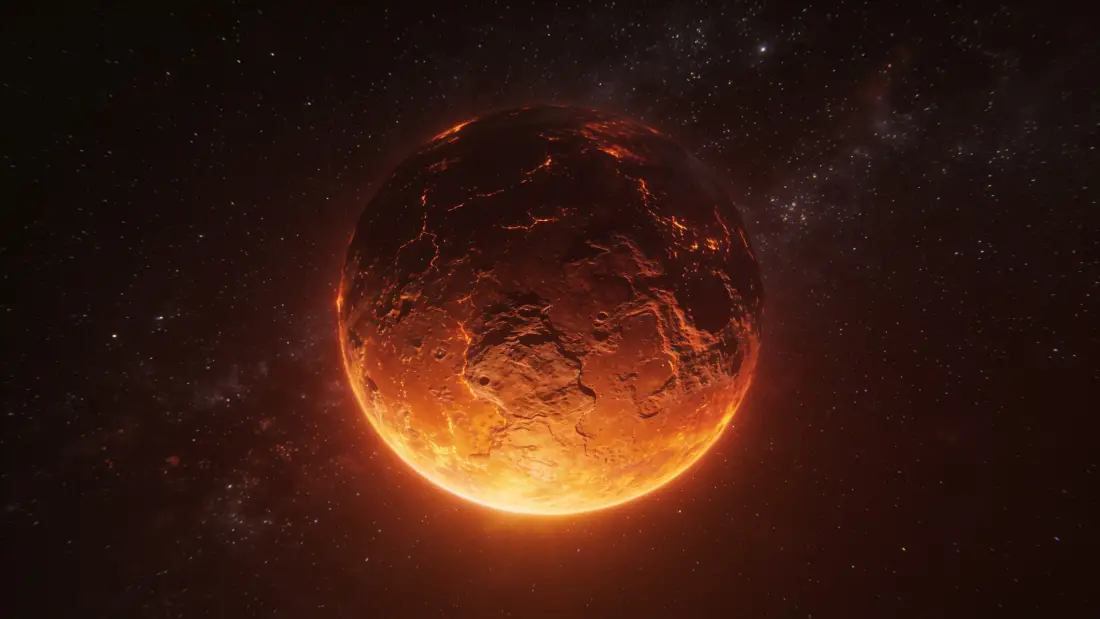
TOI-5159 b is a world about 180 light-years from Earth, and it sits in a category that fascinates scientists: the super-Earth. It is bigger than our planet but smaller than the ice giants of our own solar system, and that in-between size makes it especially interesting to study.
Where TOI-5159 b Lives
TOI-5159 b orbits a star called TOI-5159. That star sits roughly 180 light-years away from us. A light-year is the distance light travels in one year — about 9.5 trillion kilometers. So 180 light-years is an enormous distance, far beyond anything any spacecraft we have today could reach in a human lifetime.
TOI-5159 is a star a little cooler than our Sun. Its surface temperature is 5,156 K — where K stands for Kelvin (a scale scientists use to measure very hot things, starting from absolute zero, the coldest possible temperature). Our own Sun’s surface runs at about 5,778 K, so TOI-5159 is a bit dimmer and more orange than what we see each morning. As far as scientists know right now, TOI-5159 b is the only planet confirmed in this system.
What Is a Super-Earth, Exactly?
The name “super-Earth” does not mean a planet is like Earth, just bigger. It is simply a size category. Scientists use it for worlds that are larger than Earth but smaller than Neptune. Neptune is an ice giant — a planet made mostly of water, methane, and ammonia in a slushy, high-pressure state, wrapped in thick gas. Super-Earths fall somewhere between small rocky worlds and those cold, huge planets.
Interestingly, our solar system has nothing in this size range. Earth is the largest rocky planet we have here, and Neptune is much larger. That gap means we have no nearby example to study up close. Worlds like TOI-5159 b are some of the only chances scientists get to learn what these in-between planets are actually like.
Super-Earths are also among the most common types of planets found around other stars so far, which makes understanding them even more valuable. TOI-5159 b is one piece of a much larger puzzle.
Size and Mass: What the Numbers Tell Us
TOI-5159 b has a radius — that is, the distance from its center to its surface — that is 1.55 times Earth’s. Picture Earth, then imagine stretching it out about halfway again in every direction. That gives you a rough sense of how wide this world is.
Its mass — the amount of matter packed inside it — is 3.01 times Earth’s mass. So it is heavier than Earth, which makes sense for a bigger world. But here is where it gets interesting: the mass does not grow as fast as the size. If TOI-5159 b were made of exactly the same stuff as Earth, we might expect the mass to be even higher for that radius. The relationship between size and mass is one of the most useful clues scientists have about what a planet is made of.
If you enjoy comparing planet sizes visually, you can explore our size comparison tool to see how TOI-5159 b stacks up against Earth and other worlds.
Clues About What’s Inside
When scientists know both a planet’s size and its mass, they can work out its density. Density means how much matter is packed into a given space. A bowling ball is denser than a beach ball of the same size, because it has more matter crammed in. Density tells scientists a great deal about a planet’s interior, even without ever visiting it.
A planet with very high density is probably made mostly of rock and metal, like Earth. A planet with lower density for its size likely contains lighter materials — perhaps a lot of water, ice, or thick atmosphere of gases like hydrogen and helium.
For TOI-5159 b, scientists think the numbers suggest a composition that could include rock, but possibly also a significant amount of water or a gaseous envelope — a layer of atmosphere that adds to the planet’s size without adding much mass. Scientists are still working to understand exactly what mix of materials produces a planet like this one. It may not have a clean answer. Many super-Earths seem to sit right on the boundary between rocky worlds and what are called “mini-Neptunes” — smaller, gassy cousins of Neptune. Whether TOI-5159 b is mostly solid or partly wrapped in gas is something researchers are still working out.
To understand how scientists use mass and size together, take a look at the mass-radius diagram, which shows how different materials produce different combinations of size and weight in planets.
A Very Short, Very Hot Year
One orbit around TOI-5159 takes just 5.84 Earth days. That means a year on TOI-5159 b is less than six of our days long. The planet moves very fast through space, sweeping close to its star and circling back in under a week.
That closeness to its star has a big effect on temperature. The estimated surface temperature of TOI-5159 b is about 866 K, which is roughly 593 degrees Celsius. That is far hotter than any oven on Earth, and far beyond what any life as we know it could survive. This also means TOI-5159 b does not sit in what scientists call the habitable zone — the range of distances from a star where liquid water could possibly exist on a surface. TOI-5159 b is much too close and much too hot for that.
It is worth noting that 866 K is what scientists call an equilibrium temperature — a kind of starting estimate based on how much light the planet receives. The real surface temperature could be different depending on whether the planet has an atmosphere and what that atmosphere is like. Thick clouds or certain gases can trap heat or reflect it. Scientists haven’t measured that directly for this planet yet.
How Scientists Found It
TOI-5159 b was discovered in 2026 using the transit method. This means scientists watched the star TOI-5159 and noticed its light dimming slightly at regular intervals. That dimming happens when a planet passes in front of the star from our point of view, blocking a tiny fraction of the starlight. By measuring how much the light dips and how often it happens, scientists can figure out the planet’s size and how long its orbit takes.
The transit method is one of the most reliable tools astronomers — scientists who study space — have for finding planets around distant stars. It works especially well for planets that orbit close to their stars, completing many orbits in a short time. That is likely one reason TOI-5159 b, with its 5.84-day year, was a good candidate for detection.
TOI-5159 b is a quiet reminder that the universe is full of worlds that do not match anything in our own solar system. Each one we study carefully adds something real to our understanding of how planets form, what they are made of, and just how varied planetary systems can be.