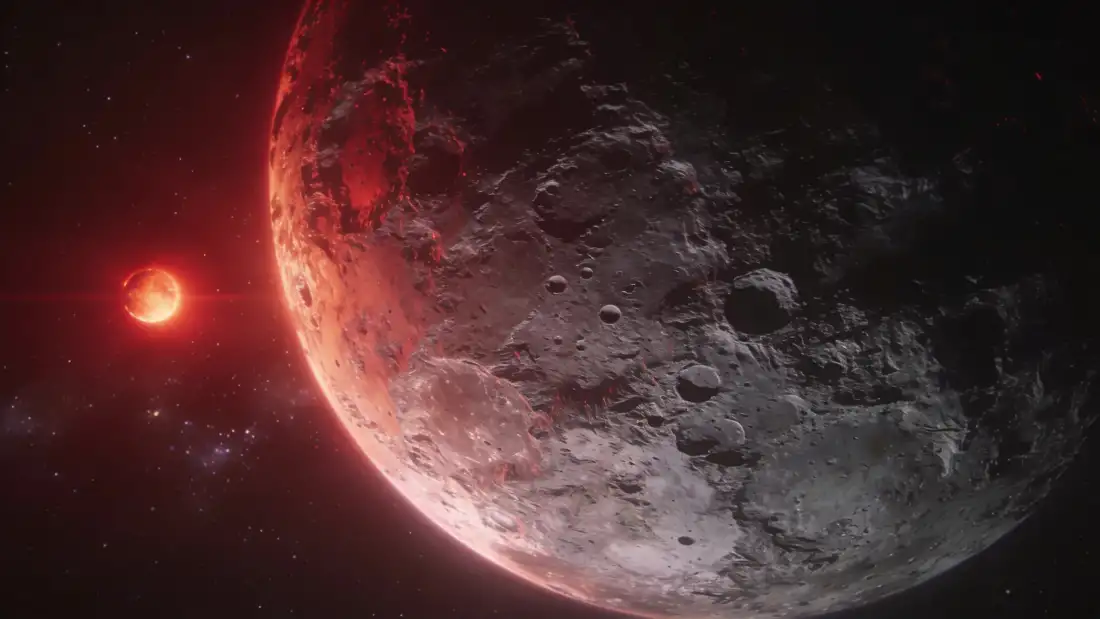
About 40 light-years away, in the direction of the constellation Cancer, a small star quietly holds a family of at least seven worlds in its gravity. One of those worlds, 55 Cnc B b, was confirmed in 2025, and it gave scientists a rare close look at a planetary system that had been hiding in plain sight. This is its story.
A Star You Might Not Know
The star at the center of this system is called 55 Cnc B. It sits 40.7 light-years from Earth. A light-year is the distance light travels in one year — about 9.5 trillion kilometers — so 40.7 light-years is an enormous distance, yet it is still considered a close neighbor in the grand scale of our galaxy.
The name might look familiar. That is because 55 Cnc B is not alone. It is one half of a double-star system called 55 Cancri, meaning two stars orbit each other while each star also has its own planets. We will come back to that bigger picture a little later.
55 Cnc B is classified as an M-dwarf, which is another way of saying a red dwarf star. Red dwarfs are the most common type of star in our galaxy. They are smaller, cooler, and dimmer than our Sun. The surface temperature of 55 Cnc B is 3,286 Kelvin. To put that in perspective, our Sun’s surface sits at about 5,778 Kelvin, so 55 Cnc B runs considerably cooler. Stars like this burn their fuel slowly and can last far longer than the Sun ever will.
Meet 55 Cnc B b
55 Cnc B b is the one planet in this system for which scientists have solid, measured numbers — and those numbers are already telling an interesting story.
The planet has a radius of 1.69 times Earth’s radius and a mass of 3.5 times Earth’s mass. That combination puts it in a category scientists call a super-Earth — a planet larger and more massive than Earth but smaller than the ice giant planets Uranus and Neptune in our own Solar System.
One year on 55 Cnc B b lasts just 6.8 Earth days. That means it completes a full orbit around its star in under a week. For comparison, Earth takes 365 days to go once around the Sun. A planet with such a short year must be orbiting very close to its star.
Being so close to a star affects a planet enormously. Scientists haven’t yet measured the planet’s temperature directly, but a world orbiting that quickly around a cool red dwarf is likely receiving a very different mix of heat and light than Earth does. Whether conditions there could support liquid water is something researchers are still working to understand.
Scientists also haven’t yet measured details like the planet’s atmosphere or exact surface conditions. Those answers may come from future observations.
How Scientists Found These Worlds

55 Cnc B b was discovered in 2025 using a technique called the radial velocity method. Here is how it works. A planet’s gravity does not just make the planet orbit the star — it also gives the star a tiny tug. That tug causes the star to wobble ever so slightly toward and away from Earth as the planet moves around it.
When a star moves toward us, the light it sends reaches us at a slightly higher frequency, shifting it toward the blue end of the rainbow. When it moves away, the light shifts toward the red end. Scientists can measure these tiny color shifts very carefully, and from the pattern of wobbles they can work out how massive a planet is and how long its orbit takes.
This method has been one of the most productive planet-hunting tools astronomers have. It works especially well for planets that are massive and orbit close to their stars — both of which describe 55 Cnc B b nicely.
Seven Worlds in One System
55 Cnc B b is not alone. The system around 55 Cnc B is known to hold at least seven planets in total. That is a richly populated family by any measure.
However, scientists haven’t yet published confirmed sizes, masses, and year lengths for all seven worlds. So while we know they exist, we can’t yet describe each one in detail. What we can say is that finding seven planets around a single star is genuinely significant. It suggests that planet formation — the process by which dust and gas clump together over millions of years to build worlds — was very productive around this star.
Our own Solar System has eight planets, but systems with five, six, or seven known planets around other stars are rare finds. Each new confirmed world adds a data point that helps scientists understand how planetary systems form and arrange themselves. You can explore how planetary systems are laid out using our system explorer.
A Cool, Dim Star and What That Means
The surface temperature of 55 Cnc B — 3,286 K — tells us a lot about what life is like for its planets. A cooler star puts out less visible light and more of its energy as infrared light, which is a kind of heat radiation we can’t see with our eyes.
The habitable zone — the range of distances from a star where liquid water could exist on a planet’s surface — sits much closer to a red dwarf than it does to a star like our Sun. Because red dwarfs are so dim, a planet has to be quite close in to receive enough warmth. Whether any of the seven worlds in the 55 Cnc B system fall in that zone is something scientists are still working out.
Red dwarfs also tend to be more active when they are young, sending out powerful flares of energy. How those flares affect planets on tight orbits is an open question that researchers study carefully.
Part of a Bigger Family
55 Cnc B is gravitationally linked to another star, 55 Cnc A, which is a Sun-like star. Together they form a binary system, meaning two stars bound together, slowly orbiting each other over a very long period.
55 Cnc A is already well known to planet hunters. It has its own set of planets, including one that orbits in its habitable zone. Having two stars in the same system, each with its own planets, makes 55 Cancri a genuinely fascinating corner of the nearby galaxy.
Studying both stars and all their planets together helps scientists compare how planets form under different conditions — even when those conditions exist just a short stellar distance apart.
What Scientists Still Want to Learn
With seven planets confirmed and only one described in detail so far, there is a great deal left to discover about the 55 Cnc B system. Researchers want to measure the sizes and masses of the other six worlds, understand whether any of them sit in the habitable zone, and look for signs of atmospheres.
Future telescopes — both in space and on the ground — will likely turn more attention toward systems like this one. Every new measurement adds to a picture that is still being slowly filled in.
For now, 55 Cnc B b stands as a clear example of what patient, careful science can find: a super-Earth on a swift orbit, part of a seven-world family, orbiting a cool and ancient star just 40.7 light-years from home.