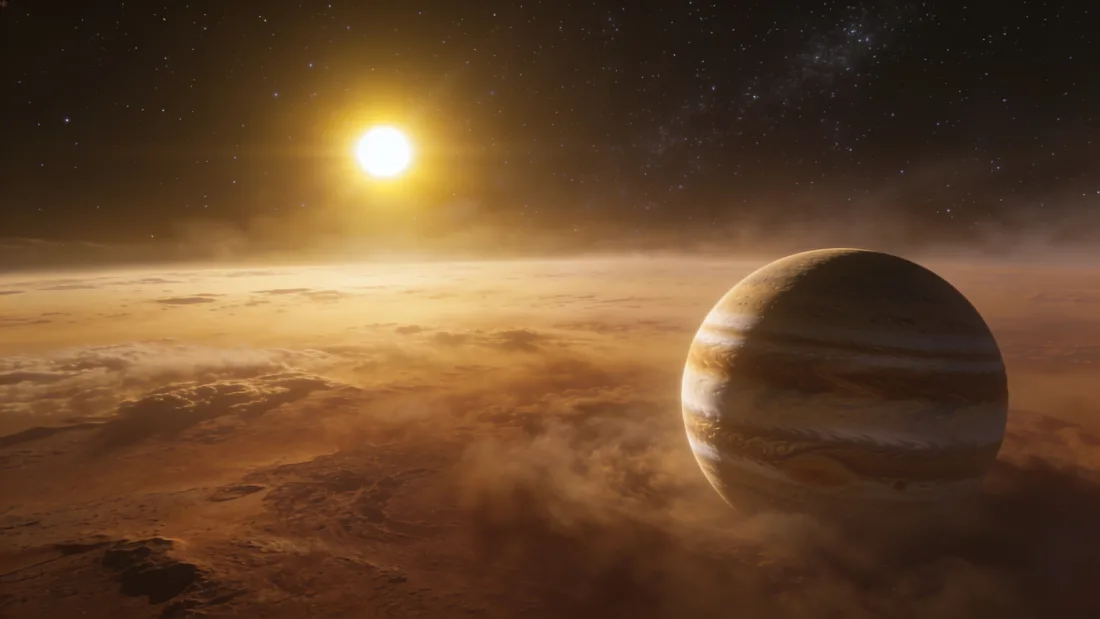
About 276 light-years away — a light-year is the distance light travels in one full year — a star called TOI-1136 has six planets circling around it. One of those planets, TOI-1136 f, has caught the attention of scientists studying how planetary families are built. This system is a fascinating place to look if you want to understand how worlds arrange themselves around a star.
A Star with Six Worlds
TOI-1136 is the name of a star that sits in our galaxy, the Milky Way. Six planets are known to travel around it. That makes it a busy, crowded system — much more packed than many other star systems scientists have found so far.
All six planets were discovered in 2022. That was a busy year for this particular star. Scientists used a space telescope to watch the star carefully, and one by one, the signals of planets started showing up in the data. We will get to exactly how that works in a moment.
Having six planets around one star is not unheard of. Our own Solar System has eight. But finding a system with this many confirmed worlds is still a special thing. It gives scientists a rare chance to compare planets that all formed from the same material, around the same star, at roughly the same time.
Meet TOI-1136 f
Among the six planets, TOI-1136 f stands out as one of the larger members of the family. Its radius — that is, the distance from the center of the planet to its surface — is about 3.74 times the radius of Earth. To picture that, imagine stacking almost four Earths side by side. That is roughly how wide TOI-1136 f is.
Its mass, meaning how much matter is packed into it, is about 9.7 times the mass of Earth. That is quite a bit heavier than our home planet, though still far lighter than the giant planets in our Solar System like Jupiter or Saturn.
TOI-1136 f travels around its star once every 26.3 Earth days. So its year is less than one Earth month long. It sits much closer to its star than Earth sits to the Sun.
Because it is so close to its star, TOI-1136 f is a warm world. Scientists estimate its temperature is around 658 Kelvin — that works out to about 385 degrees Celsius. That is far too hot for liquid water as we know it, and well outside what scientists call the habitable zone, which is the region around a star where temperatures might allow liquid water to exist on a planet’s surface.
What TOI-1136 f Is Made Of (Probably)
When scientists know a planet’s radius and its mass, they can start to figure out what it might be made of. This is called working out the planet’s bulk density — how tightly its material is packed together.
A planet 3.74 times wider than Earth but only about 9.7 times more massive is not a dense, rocky world like our own. The numbers suggest TOI-1136 f is probably a sub-Neptune — a type of planet that does not exist in our Solar System. Sub-Neptunes are thought to have a rocky or icy core wrapped in a thick layer of gas, likely hydrogen and helium. They are smaller than Neptune but much bigger than Earth.
Scientists are still working to understand sub-Neptunes. They seem to be one of the most common types of planet in the galaxy, yet we have none nearby to study up close. Systems like TOI-1136 give researchers a set of sub-Neptunes to compare, which is a real help.
A Very Busy Orbit — Six Planets Packed Together
One of the most interesting things about TOI-1136 is how its six planets are arranged. All of them appear to orbit quite close to their star. The year lengths — scientists call these orbital periods — are short, which tells us the planets are not spread out over vast distances the way our own Solar System’s planets are.
When planets are packed in close together like this, they can tug on each other with gravity. Scientists can sometimes measure those gentle tugs. This effect is called transit timing variations, or TTVs. The gravity of one planet slightly changes the timing of a neighboring planet’s orbit. By measuring those tiny shifts, researchers can learn about the masses of the planets even when direct measurements are hard to make.
TOI-1136 is thought to be a good candidate for this kind of careful study. The planets are close enough to each other that their gravitational conversations might be detectable. You can explore systems like this one in our system explorer.
How Scientists Found Them — The Transit Method
All six planets in the TOI-1136 system were found using the transit method. Here is how it works. When a planet passes in front of its star — as seen from our point of view — it blocks a tiny bit of the star’s light. The star appears to dim very slightly for a short time. Scientists watch for these regular dips in brightness. If the same dip happens over and over, on a steady schedule, it is likely a planet making repeated trips around the star.
The transit method works especially well when planets orbit close to their stars, because those planets complete their orbits quickly. That means scientists do not have to wait years to see a planet pass by more than once. TOI-1136’s planets, with their short year lengths, would have been relatively straightforward to confirm this way.
The Star at the Heart of It All
TOI-1136 is the anchor for this whole family of worlds. Its surface temperature is about 5,770 Kelvin. That is very close to the surface temperature of our own Sun, which makes TOI-1136 what astronomers call a solar-type star. It belongs to a category known as G-type stars, or yellow dwarfs.
Having a star so similar to our Sun makes TOI-1136 an interesting comparison point. Scientists can ask: if a solar-type star forms with six planets close in, how does that compare to our own system, where the inner planets are smaller and rockier? The differences — and the similarities — help build a bigger picture of how planetary systems come to be.
What This System Teaches Us About Planet Formation
TOI-1136 is young enough, and its planets are close enough together, that scientists think the system may still show signs of how it formed. When a star is born, it is surrounded by a spinning disk of gas and dust. Planets grow inside that disk. The way they end up arranged — how many there are, how far apart, how big — is shaped by the conditions in that early disk.
Finding six planets around a solar-type star, many of them in the sub-Neptune size range, adds one more example to a growing collection. Each new system helps scientists test their ideas about planet formation against real data. TOI-1136 f and its five siblings are not just interesting worlds on their own. Together, they are a record of how one corner of the galaxy built itself, written in orbits and gravity, 276 light-years away.