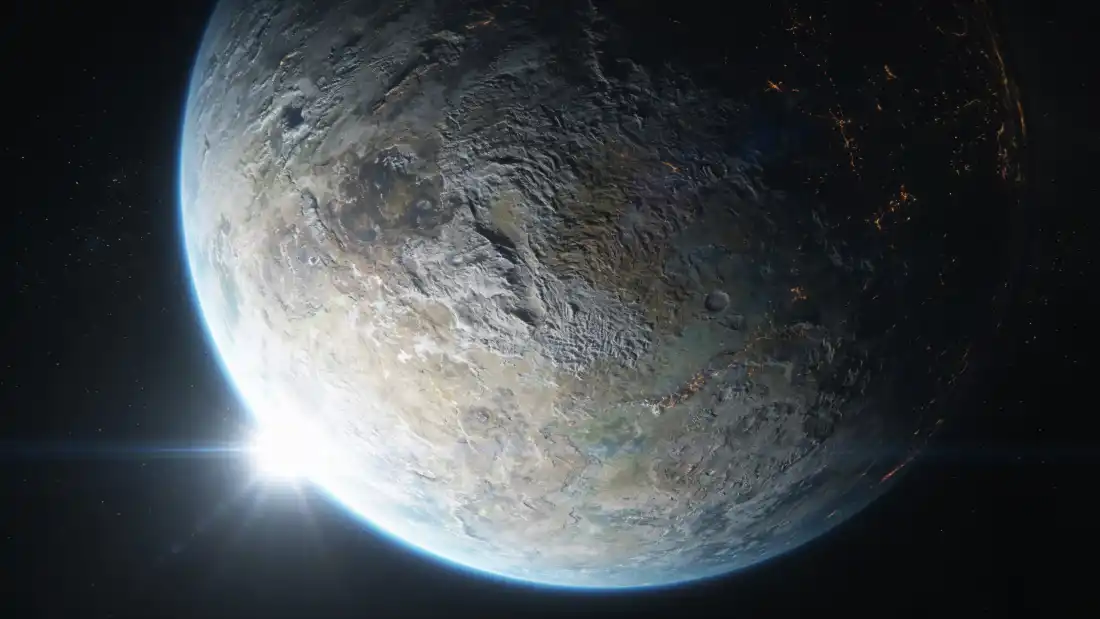
Astronomers confirmed a new world in 2026, and it sits 178 light-years from Earth. It is called DMPP-6 b, and it belongs to a class of planets that does not exist anywhere in our own solar system. Learning about worlds like this one helps scientists understand how planets form and how common different types really are.
Where DMPP-6 b Lives
DMPP-6 b orbits a star called DMPP-6. That star sits 178 light-years away from us. A light-year is the distance light travels in one year — about 9.5 trillion kilometers. So 178 light-years is an enormous distance, but in the scale of our galaxy, it is actually a fairly nearby neighbor.
The star DMPP-6 has a surface temperature of 6,182 K. The “K” stands for Kelvin, which is a unit scientists use to measure temperature in space. For comparison, our own Sun has a surface temperature of about 5,778 K, so DMPP-6 runs a little hotter than the Sun. That makes it what astronomers call a slightly hotter, somewhat brighter star — though the two stars are broadly similar in type.
You can explore other confirmed worlds and their host stars in the Extremetica Atlas.
Size, Mass, and the Mini-Neptune Class
DMPP-6 b has a radius — that is, a measurement from its center to its surface — of 2.28 times Earth’s radius. Its mass is 5.8 times Earth’s mass. Those two numbers together put it firmly in a category called a mini-Neptune.
A mini-Neptune is a planet bigger than Earth but smaller than Neptune, our solar system’s fourth-largest planet. Scientists think mini-Neptunes probably have thick layers of gas or water surrounding a rocky or icy core. We do not have any planet like this in our own solar system — the gap between Earth and Neptune in our neighborhood is quite large. But around other stars, mini-Neptunes turn out to be one of the most common types of planet we find.
The combination of DMPP-6 b’s size and mass gives scientists what is called a bulk density — a rough idea of how heavy the planet is for its size. Based on these two measurements, DMPP-6 b is likely not a solid rocky world like Earth. It probably holds a significant envelope of gas or other lighter materials. Scientists will need more observations to say anything more precise about what that envelope is made of.
A Year in Just 7.6 Days

One of the most striking things about DMPP-6 b is how fast it completes one orbit around its star. Where Earth takes 365 days to go around the Sun, DMPP-6 b finishes its year in just 7.6 Earth days. That means it is orbiting very close to its star.
A planet that sits so close to its star receives a great deal of heat and radiation. Scientists haven’t measured DMPP-6 b’s temperature directly yet, but a world this close to a star hotter than our Sun is almost certainly very hot — far too hot for liquid water to exist on any surface, as far as we know. It does not sit in the habitable zone, which is the region around a star where conditions might allow liquid water to exist. DMPP-6 b is well inside that zone, much closer in.
Close-in orbits like this also raise interesting questions about how the planet formed. Many scientists think planets with such tight orbits either formed much farther out and then drifted inward, or that they formed under unusual conditions close to the star. This is still an active area of research, and no single explanation fits all cases.
How Scientists Found It
DMPP-6 b was discovered using the radial velocity method. Here is how it works. As a planet orbits its star, its gravity gives the star a tiny tug. That tug causes the star to wobble very slightly toward and away from Earth. When the star moves toward us, the light it sends reaches us at slightly shorter wavelengths. When it moves away, the light stretches to slightly longer wavelengths. Scientists can measure these tiny shifts in light very precisely, and from them they can work out that a planet is there — and estimate its mass.
The radial velocity method is one of the oldest and most reliable ways to find exoplanets — planets around other stars. It works especially well for planets that orbit close to their stars, because those planets produce stronger, more frequent tugs. DMPP-6 b’s short 7.6-day orbit made its signal easier to detect.
You can see how DMPP-6 b fits into the broader story of planet hunting on the Extremetica Discovery Timeline.
A Two-Planet System
So far, astronomers know of two planets in the DMPP-6 system. DMPP-6 b is the one we have solid data on. The second planet in the system has not been described in detail in current records, and scientists haven’t released full measurements for it yet. Finding more than one planet around a star is not unusual — many stars host several planets — but each new system gives researchers a slightly different puzzle to study.
Open Questions
There is a lot we still do not know about DMPP-6 b. Scientists haven’t measured its atmospheric composition — what gases, if any, surround it. They haven’t confirmed its exact temperature. The nature of that second planet in the system remains unclear. And the question of how DMPP-6 b ended up so close to its star is still open.
That is not unusual for a newly confirmed world. Discovery is really just the first step. Each new measurement, each careful observation, adds one more piece to a very large picture — a picture of how many kinds of worlds exist out there, and what they are really like. DMPP-6 b is one small, interesting piece of that picture.