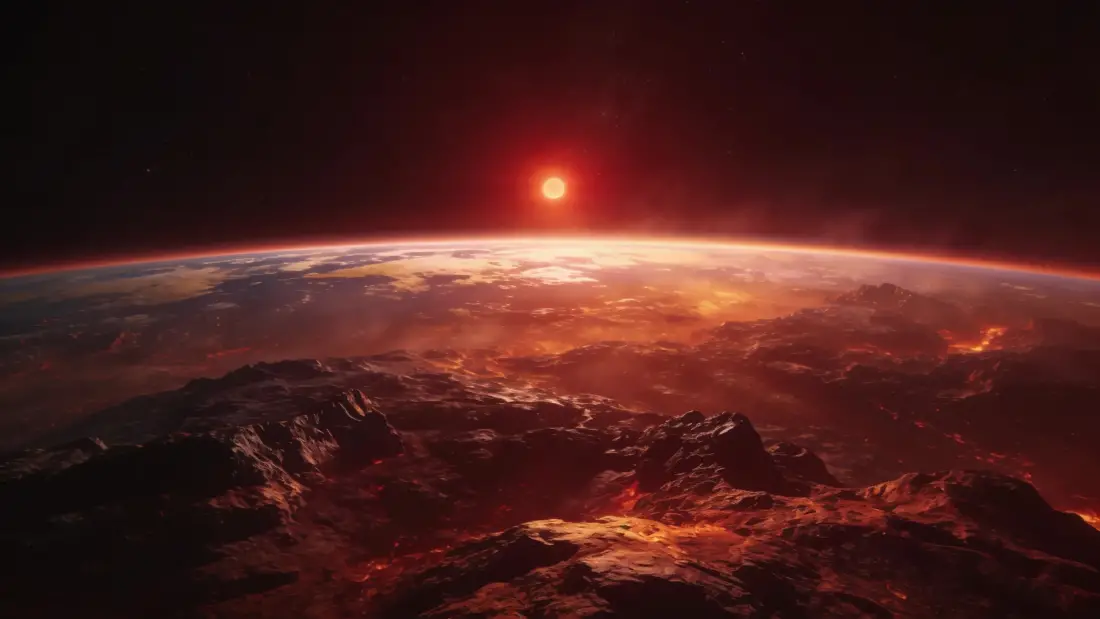
In 2026, astronomers confirmed a new world orbiting a distant star about 88.9 light-years from Earth. That star is called TOI-4552, and its planet is known as TOI-4552 b. It is a rocky world in some ways similar to Earth, but in other ways almost nothing like home.
How TOI-4552 b Was Found
Scientists discovered TOI-4552 b using the transit method. This means they watched the star and waited for a tiny dip in its brightness. When a planet passes in front of its star, it blocks a small amount of light. That brief dimming tells astronomers a planet is there. It is a bit like watching a small coin slide across the face of a lamp.
The transit method does not just reveal that a planet exists. It also helps scientists measure how big the planet is and how long it takes to orbit the star. You can explore many worlds found this way in our discovery timeline.
TOI-4552 b is one confirmed planet in this system so far. Scientists have not announced any other planets around TOI-4552 yet.
The Size and Mass of TOI-4552 b
TOI-4552 b is only slightly larger than Earth. Its radius — that is, the distance from its centre to its surface — is about 1.11 times Earth’s radius. That makes it just a little wider than our planet, but not by much.
Its mass — how much matter it contains — is about 1.83 times Earth’s mass. So while it is only a little bigger in size, it is noticeably heavier. That tells scientists the planet is probably made of rock, or perhaps rock mixed with some denser material. However, we do not yet know its exact composition for certain.
Planets in this size and mass range are sometimes called super-Earths. That just means they are bigger and heavier than Earth but smaller than the giant ice worlds, like Uranus or Neptune, in our own solar system. They are one of the most common types of planet scientists find around other stars, and they are interesting because we do not have a perfect example of one right here in our solar system to study up close.
You can compare TOI-4552 b with other known worlds in the atlas of exoplanets.
A World of Extreme Heat
One of the most striking things about TOI-4552 b is its temperature. Scientists estimate the planet’s surface temperature is around 1,122 K, which is about 849 degrees Celsius. That is far hotter than an oven, far hotter than molten lava, and hotter than many metals can withstand without melting.
At that kind of heat, any liquid water would be gone in an instant. Any atmosphere the planet once had may have been stripped away, or it may never have formed in the first place. Scientists think a world this hot is very unlikely to have life as we know it. TOI-4552 b sits far inside what is called the habitable zone — the region around a star where temperatures might allow liquid water to exist on a planet’s surface. TOI-4552 b is nowhere near that zone.
It is worth noting that these temperature figures are estimates. The true surface conditions depend on many things scientists haven’t measured yet, such as whether the planet has an atmosphere and what that atmosphere is made of.
An Orbit Faster Than a Week

TOI-4552 b completes one full orbit around its star in just 0.3 Earth days. That is less than one third of a single day on Earth. A “year” on this planet — the time it takes to go once around its star — is over in a matter of hours.
To orbit so quickly, the planet must be extremely close to its star. The closer a planet is to its star, the faster it has to travel to stay in orbit. This closeness also explains the intense heat. The planet is being blasted with energy from a nearby star at close range, day after day, with no relief.
Scientists sometimes call worlds like this ultra-short-period planets. They are interesting to study because they push our understanding of how planets form and how they survive such a harsh environment for potentially billions of years.
The Star at the Centre: TOI-4552
TOI-4552 is the star that TOI-4552 b orbits. Its surface temperature is about 3,258 K. To put that in perspective, our own Sun has a surface temperature of around 5,778 K. TOI-4552 is considerably cooler than the Sun.
A star this cool is likely a red dwarf — a type of star that is smaller, dimmer, and longer-lived than our Sun. Red dwarfs are the most common type of star in our galaxy. They burn their fuel slowly, meaning they can live for an extraordinarily long time. Many of the exoplanets scientists have discovered orbit red dwarf stars, partly because red dwarfs are so common and partly because their small size makes the transit signal from an orbiting planet easier to detect.
What Scientists Can Learn From This Planet
Even though TOI-4552 b is not a place where life is likely, it is still a valuable world to study. Extreme planets teach scientists about the outer edges of what is possible. How does a rocky planet behave when it is cooked by its star at close range? Does it hold on to any atmosphere? How does its interior change over time? These are questions researchers are working to answer.
TOI-4552 b also adds one more data point to the growing catalogue of planets scientists know about. The more examples we have, the better we understand what makes a planet what it is — and what rare conditions might eventually lead to a world where something like life could take hold.