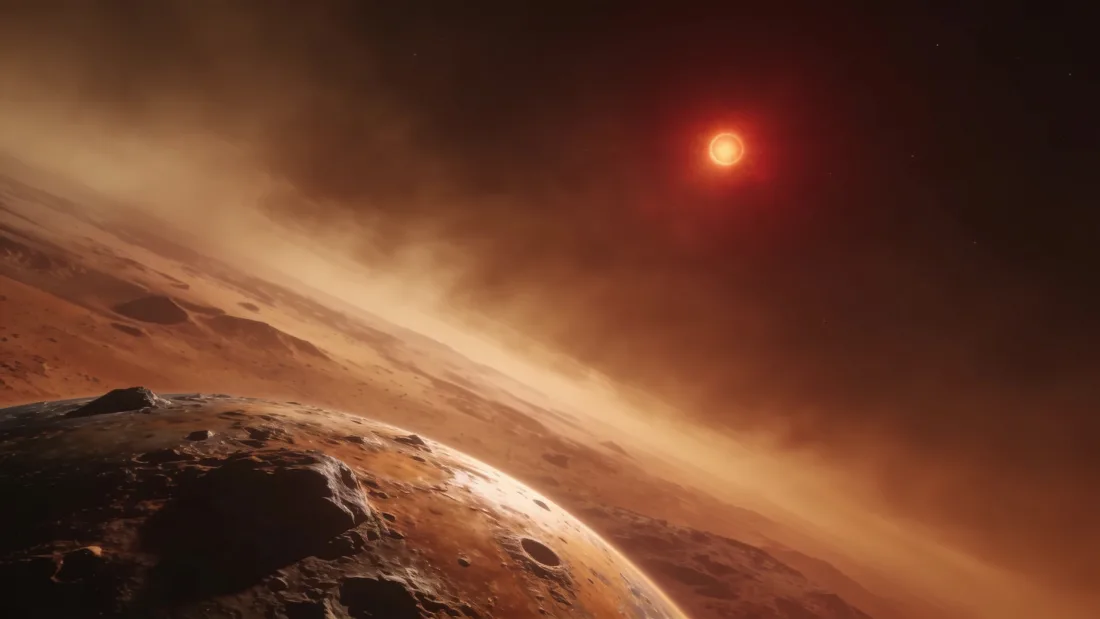
Barnard b is a small planet orbiting one of the closest stars to our Sun. It was confirmed in 2024, making it one of the most nearby exoplanets — that is, planets outside our solar system — that scientists have ever found. Its distance from Earth is remarkable, both for how close it is on a cosmic scale and for how far it still is in any human sense.
Our Nearest Stellar Neighbor (Almost)
Barnard’s star, the star that Barnard b orbits, sits just 5.96 light-years from Earth. A light-year is the distance that light travels in one year — about 9.46 trillion kilometers, or roughly 5.88 trillion miles. That is an almost impossible number to picture, but it helps to compare it to other stars.
The only star system closer to us is Alpha Centauri, a group of three stars about 4.2 to 4.4 light-years away. After that, Barnard’s star is the next nearest single star. In the full map of our galaxy — which stretches roughly 100,000 light-years across — 5.96 light-years is practically next door. You can explore how these nearby stars relate to one another using the Cosmic Map.
Even so, “close” in space is a very different thing from close in everyday life. The light reaching your eyes right now from Barnard’s star left that star almost six years ago. That is how long light, the fastest thing in the universe, takes to cross that gap.
What 5.96 Light-Years Actually Means

Let’s try to make the number feel real. Light travels at about 300,000 kilometers every second. In one year, it covers roughly 9.46 trillion kilometers. Multiply that by 5.96 and you get the distance to Barnard b’s star: somewhere around 56 trillion kilometers.
Compare that to something closer to home. The Voyager 1 spacecraft, launched in 1977, is the farthest human-made object from Earth. After more than 45 years of travel, it has covered only about 0.002 light-years. At that rate, it would take Voyager 1 roughly 70,000 years just to reach Barnard’s star — if it were heading in that direction, which it isn’t.
Radio signals, which travel at the speed of light, would take almost six years to arrive at Barnard’s star. If you sent a message today and someone there replied immediately, you wouldn’t get the answer for nearly twelve years. That kind of delay makes the distance feel very concrete.
How Long Would a Trip Take?
No spacecraft we have today could come close to reaching Barnard’s star in a human lifetime. Our fastest probes travel at roughly 60,000 to 70,000 kilometers per hour. At that speed, the journey to Barnard b’s star would take somewhere around 90,000 to 100,000 years. Scientists haven’t found a way to travel anywhere near the speed of light, so those timescales are the honest reality right now.
Some researchers have proposed ideas for faster probes — tiny spacecraft pushed by powerful lasers, for example. In theory, such a probe might reach a small fraction of light speed. Even at one-tenth the speed of light, the trip would still take about 60 years. These ideas are early-stage concepts, not missions that are being built.
If you want to see just how travel time changes depending on your speed, the Distance and Travel Time tool lets you explore that for yourself.
What We Know About Barnard b Itself

Barnard b is a small world. Scientists have measured its radius at 0.72 times the size of Earth, which means it is actually smaller than our planet. Its mass comes in at 0.3 times Earth’s mass, so it is lighter too. For comparison, a planet that small and light is closer in size to Mars than to Earth, though it is not the same kind of world as Mars.
The planet completes one full orbit around Barnard’s star in just 3.15 Earth days. That is an incredibly short year. It means Barnard b is hugging its star very closely. Because of that closeness, scientists estimate its likely surface temperature at around 438 Kelvin, which is roughly 165 degrees Celsius. That is hotter than boiling water. At that temperature, liquid water on the surface seems very unlikely, and the planet almost certainly does not sit in what astronomers call the habitable zone — the range of distances where liquid water could exist on a rocky surface.
Barnard’s star itself is what scientists call a red dwarf — a type of star that is smaller, cooler, and dimmer than our Sun. Its surface temperature is about 3,195 Kelvin, compared to roughly 5,778 Kelvin for our Sun. Red dwarfs are the most common kind of star in our galaxy, and they burn their fuel very slowly, meaning they can live far longer than stars like the Sun.
The System Around Barnard’s Star
Barnard b is not alone. Scientists have found a total of four planets in the Barnard’s star system so far. Barnard b is simply the one closest to the star, with that very short 3.15-day orbit. The details of the other three planets — their sizes, temperatures, and orbital periods — have not all been fully pinned down yet, and scientists are still studying this system carefully.
Finding four planets around the nearest single star to our Sun is a reminder that planetary systems are probably very common throughout the galaxy. Even the most ordinary, quiet stars seem to host worlds of their own. Whether any of those worlds in this system sit in more temperate conditions is something researchers are working to find out.
How Scientists Found Barnard b
Barnard b was confirmed in 2024, using a technique called the radial velocity method. Here is how it works: when a planet orbits a star, its gravity gives the star a tiny wobble. That wobble causes the star’s light to shift very slightly — stretching toward redder colors when the star moves away, and toward bluer colors when it moves closer. By measuring those tiny shifts very precisely, scientists can figure out that a planet is there, and estimate its mass.
This method has been used to find many exoplanets, but it is especially useful for nearby stars like Barnard’s star, where the signals are a little easier to detect. The planet’s small mass — just 0.3 times Earth’s — means the wobble it causes is extremely subtle, so confirming it took careful, patient observation.
Barnard b may not be a place where life could thrive, and reaching it remains far beyond anything we can do today. But its discovery reminds us that the nearest stars are not empty — and that the universe, even in our own small corner of it, is full of worlds waiting to be understood.