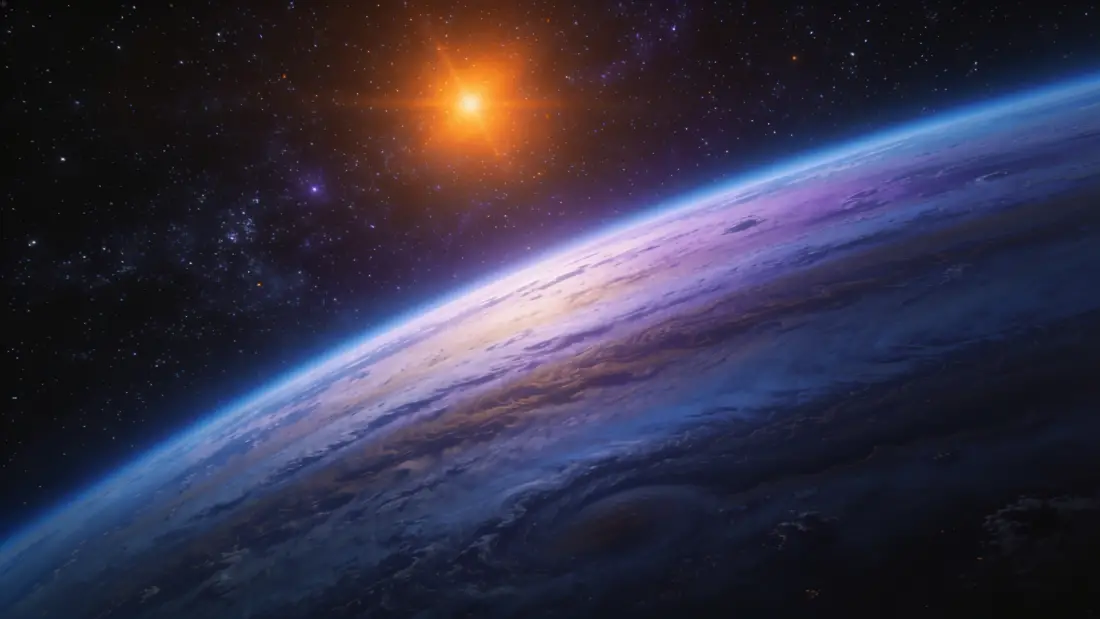
About 374 light-years away, a small world called TIC 390586021 b is racing around its star in less than three Earth days. Scientists spotted it in 2026, and even though it looks unremarkable at first glance, it belongs to one of the most interesting and common types of planet we have found beyond our solar system.
Where in the Sky Do We Find It?
TIC 390586021 b orbits a star called TIC 390586021. That name comes from a catalog — a long numbered list — used by the TESS space telescope to keep track of millions of stars. The star is what astronomers call a K-type star, meaning it is cooler and a bit smaller than our own Sun. We can tell this partly from its surface temperature, which scientists have measured at 4,435 Kelvin. Kelvin is a temperature scale used in science; for comparison, our Sun’s surface runs at about 5,778 Kelvin, so this star runs noticeably cooler and likely glows with a faint orange-yellow light rather than the bright white-yellow of our Sun.
The whole system sits about 374 light-years from Earth. A light-year is the distance light travels in one year — roughly 9.5 trillion kilometres. At that distance, no spacecraft we have today could reach TIC 390586021 b in any reasonable time. We study it purely from the light that travels across that huge gap to our telescopes.
So far, scientists have found only one planet in this system. That does not mean others do not exist — it simply means none have been detected yet.
Size and Mass: What the Numbers Tell Us
TIC 390586021 b has a radius — that is, the distance from its center to its surface — of about 2.86 times Earth’s radius. Its mass is about 8.55 times Earth’s mass. Those two numbers together are very useful. When you know how big something is and how heavy it is, you can work out its density. Density tells you how tightly packed the material inside a planet is.
If you picture a planet with the same size as TIC 390586021 b but made entirely of solid rock, it would be much heavier than 8.55 Earth masses. The fact that this planet is not that heavy suggests a large part of its bulk is made of lighter stuff — probably a thick atmosphere of hydrogen and helium gas, or possibly a deep layer of water or ice underneath a gas envelope. This profile is exactly what gives a planet the label mini-Neptune.
A mini-Neptune is a planet bigger than Earth but smaller than the planet Neptune in our own solar system. Neptune is about 3.9 times Earth’s radius, so TIC 390586021 b, at 2.86 times Earth’s radius, fits comfortably into that group. You can explore how this planet compares visually to Earth and Neptune using the size comparison tool.
A Very Busy Year

One of the most striking things about TIC 390586021 b is how fast it orbits its star. One full orbit takes only about 2.75 Earth days. On this planet, a “year” is shorter than a long weekend here on Earth.
To move that quickly, the planet must be orbiting very close to its star. Scientists haven’t published a precise orbital distance in the data available so far, but a 2.75-day orbit around a star like this one almost certainly places the planet far inside what we would call the habitable zone — the region around a star where temperatures could allow liquid water to exist on a rocky surface. TIC 390586021 b is likely baked by intense heat and radiation from being so near its star.
Because of that closeness and its likely thick gas envelope, this is not considered a place where life as we know it could thrive. Scientists have not measured TIC 390586021 b’s actual temperature yet, so we can’t give you a number — but the picture painted by a tight orbit around a warm star is not a gentle one.
What Could Be Inside?
Here is where things get genuinely interesting to scientists. Knowing the radius and mass lets researchers plot the planet on what is called a mass-radius diagram, a chart that shows how size and weight relate for many different planets. Where a planet falls on that diagram hints at what it is made of.
For TIC 390586021 b, the numbers suggest it is not a pure rock ball — it is too light for that. But it is also denser than a world made almost entirely of hydrogen gas. Scientists think it likely has a rocky or icy core surrounded by a thick layer of gas, or possibly a deep water layer, though we cannot be certain. The words “water world” can be misleading here: at the temperatures and pressures inside a planet like this, water would not look like the oceans we know. It might exist as a strange, super-compressed fluid.
Working out the true interior of a planet from size and mass alone is a bit like guessing what is inside a sealed box just by weighing it and measuring its outside. You can make an educated guess, but there are several possible answers that would fit the numbers. Scientists call this the “interior degeneracy problem,” and it is one reason astronomers keep searching for more clues.
How Do We Weigh a World We Cannot See?
TIC 390586021 b was discovered in 2026 using the transit method. This works because when a planet passes in front of its star, it blocks a tiny slice of the star’s light. Sensitive telescopes can detect that small dip. The size of the dip tells us the planet’s radius.
But the transit method on its own does not give us mass. For that, scientists use a separate technique called radial velocity. As a planet orbits, its gravity gives the star a tiny tug. That tug makes the star wobble very slightly toward and away from us, shifting its light in measurable ways. By tracking those shifts, scientists can estimate how massive the planet must be to cause them.
Mini-Neptunes in the Bigger Picture
Mini-Neptunes are not rare at all. They are actually among the most common types of planet found so far around other stars — and yet we have none in our own solar system. Earth and Venus are rocky. Uranus and Neptune are much larger. There is a notable gap where mini-Neptunes would sit, and it is only through exoplanet surveys that we have learned how common this size of world really is.
Scientists have found that many mini-Neptunes sit right at an interesting boundary. Some appear to be losing their atmospheres slowly over time, blown away by starlight. Whether TIC 390586021 b is doing the same, given how close it sits to its star, is an open question. Worlds like this one help researchers piece together how planets form, grow, and change across billions of years — and that is a question worth asking carefully.