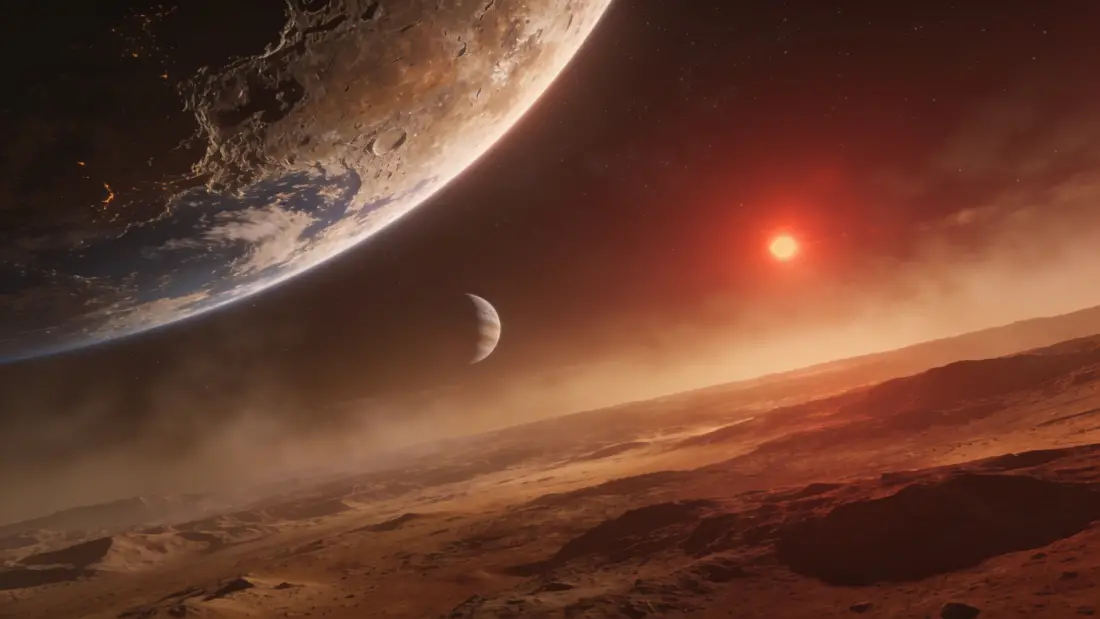
TOI-4336 A c is a planet outside our solar system, orbiting a star about 73.5 light-years from Earth. A light-year is the distance light travels in one whole year — so 73.5 light-years is a very long way, but also close enough to study with good telescopes. Scientists found this world in 2026, and it is already teaching us something interesting about what planets can look like.
A World Not Too Far Away
Astronomers discovered TOI-4336 A c using the transit method. This means they watched the star TOI-4336 A carefully and noticed its light dimmed a tiny bit at regular intervals. That dip in brightness happens when a planet passes in front of the star, blocking a small amount of starlight. It is a little like watching a bug crawl across a lamp — you can see the lamp dim just slightly.
At 73.5 light-years away, TOI-4336 A c is a neighbor by cosmic standards. The Milky Way galaxy is about 100,000 light-years across, so this planet sits very close to us on that enormous scale. That makes it a useful world to study, because closer objects are generally easier to observe in detail.
The system has two known planets so far. TOI-4336 A c is one of them. Scientists may find more as they keep looking, but for now, two is what the data shows.
How Big Is TOI-4336 A c, Really?
TOI-4336 A c has a radius — that is, the distance from its center to its surface — about 1.25 times the radius of Earth. In other words, if you could set the two planets side by side, TOI-4336 A c would be noticeably bigger, but not dramatically so. It would look like a slightly puffed-up version of our home planet.
Planets in this size range are called super-Earths. A super-Earth is simply a planet larger than Earth but smaller than the ice giants in our own solar system, like Neptune. The name does not mean the planet is like Earth in any other way — it is purely about size.
Size alone cannot tell us what a planet is made of, though. A planet 1.25 times Earth’s radius could be a larger rocky world, or it could have a thick layer of water or gas around a rocky core. To figure that out, scientists also need to know the planet’s mass. You can compare planet sizes visually to get a feel for how these worlds stack up against each other.
Mass and Density — Clues About What Is Inside
TOI-4336 A c has a mass of about 1.55 times Earth’s mass. Mass is how much matter an object contains. When you combine mass with radius, you can calculate density — how tightly that matter is packed together. Dense materials like rock pack a lot of mass into a small space. Less dense materials like gas or water spread the same mass over a bigger volume.
With a radius of 1.25 times Earth and a mass of 1.55 times Earth, TOI-4336 A c has a density that scientists think is roughly consistent with a rocky composition — but there is real uncertainty here. Some models suggest it could also have a thin layer of water or a light atmosphere sitting on top of a rocky interior. Scientists haven’t been able to measure its exact composition yet.
This size and mass combination places TOI-4336 A c in an interesting part of the mass-radius diagram, a chart that helps researchers figure out what planets might be made of based on those two measurements. Worlds in this region of the chart are often described as likely rocky, but they could also be what some researchers call water worlds — planets where a large fraction of the interior or surface is water in some form.
The honest answer is that scientists are still working it out. The data we have points toward a rocky or mixed-composition world, but more observations are needed to be sure.
A Very Fast Year
One year on TOI-4336 A c lasts just 7.59 Earth days. That means this planet completes one full orbit around its star in less than two weeks. To someone used to Earth’s 365-day year, that feels almost impossible to imagine.
The reason for such a short year is distance — or rather, the lack of it. TOI-4336 A c orbits very close to its star. The closer a planet is to its star, the faster it has to travel to stay in orbit, and the shorter its year becomes. Scientists haven’t published a precise orbital distance in the data available yet, but the short orbit period tells us this planet is much closer to TOI-4336 A than Earth is to the Sun.
A Dim, Cool Star
The star TOI-4336 A has a surface temperature of 3,307 K. (K stands for Kelvin, a temperature scale scientists use. Zero Kelvin is the coldest anything can be, and our Sun’s surface is about 5,778 K for comparison.) That makes TOI-4336 A a much cooler, dimmer star than our Sun.
Stars this cool are called red dwarfs — small stars that glow with a reddish or orange light. Red dwarfs are actually the most common type of star in the Milky Way. Because they are so much dimmer than the Sun, a planet would need to orbit quite close to one in order to receive enough warmth. That explains why TOI-4336 A c can orbit so quickly and still sit in a range where temperatures are not completely extreme.
Temperature and the Question of Habitability
The estimated temperature of TOI-4336 A c is about 400 K, which is roughly 126 degrees Celsius. That is hotter than boiling water at normal Earth air pressure. This measurement is what scientists call an equilibrium temperature — an estimate of how warm a planet would be based only on starlight, with no atmosphere taken into account.
If TOI-4336 A c has a thick atmosphere, the actual surface temperature could be very different. Greenhouses gases can trap heat and push temperatures much higher, as we see on Venus. On the other hand, some atmospheres can reflect starlight and keep a planet cooler. Scientists haven’t measured whether TOI-4336 A c has an atmosphere at all, so all of this remains uncertain.
At 400 K with no atmosphere adjustment, the planet does not sit in what astronomers call the habitable zone — the range of distances from a star where liquid water could exist on a surface. It appears to be a bit too warm for that. But the picture could change as better data comes in.
What Scientists Still Don’t Know
For a world discovered in 2026, TOI-4336 A c has given us a good amount to work with already. We know its size, its mass, its orbit, and its estimated temperature. But many questions remain open. Scientists haven’t confirmed its atmosphere, its surface conditions, or its exact interior structure. The composition — whether it is mostly rock, a mix of rock and water, or something else — is still being debated.
That is the normal state of things in exoplanet science. Most of what we know about planets like this comes from careful estimates, not direct measurements. TOI-4336 A c is a real world 73.5 light-years away, and with each new observation, the picture gets a little clearer.