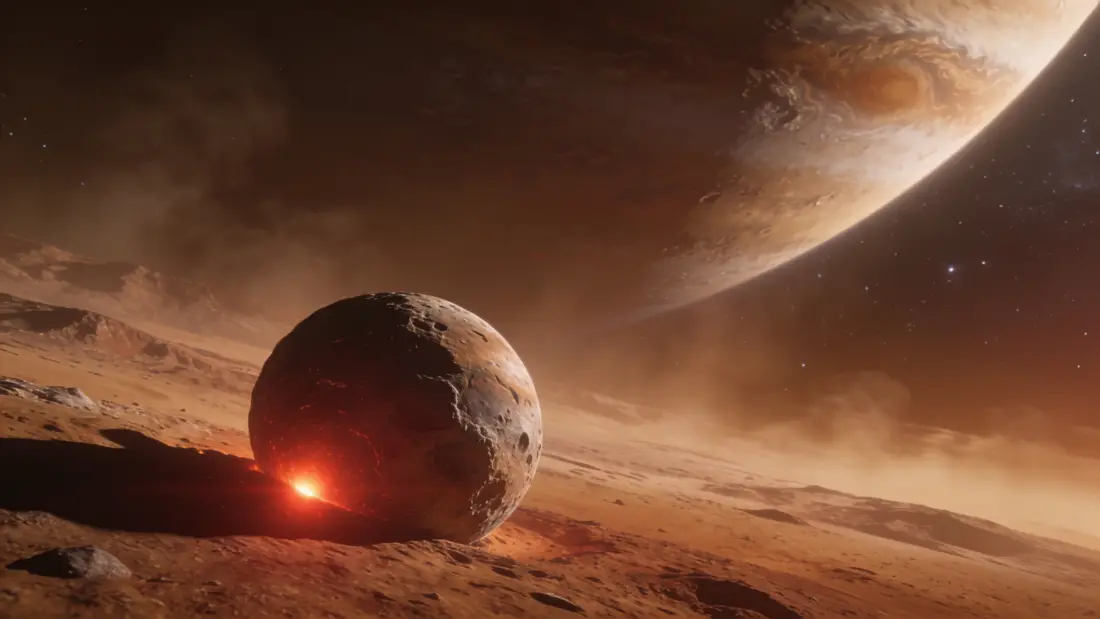
Barnard c is one of the closest exoplanets — planets outside our solar system — that scientists have ever found. It orbits a dim star just under 6 light-years from Earth. That makes it one of our nearest planetary neighbors in the entire galaxy.
Our Nearest Stellar Neighbor
Barnard’s Star is the host star — the star that Barnard c orbits. It sits about 5.96 light-years away from Earth. Only the three stars of the Alpha Centauri system are closer to us than Barnard’s Star, so this system has a very special place on any map of our cosmic neighborhood.
Barnard’s Star is what astronomers call a red dwarf. That means it is much smaller and cooler than our Sun. Its surface temperature is 3,195 K (the K stands for Kelvin, a scientific temperature scale where 0 K is the coldest anything can be). To put that in everyday terms, our Sun’s surface is around 5,778 K, so Barnard’s Star is almost half as hot at the surface. It glows with a faint reddish light, and it gives off far less energy than our Sun does.
Even so, Barnard’s Star is one of the most studied stars in the sky. Because it is so close, scientists have watched it carefully for a long time. You can explore where it sits relative to other stars using the Cosmic Map.
A World Smaller Than Earth

Barnard c is a small world. Its radius — the measurement from its center to its surface — is about 0.74 times the radius of Earth. That means it is noticeably smaller than our planet. Think of Earth as a tennis ball; Barnard c would be closer in size to a large marble.
Its mass — how much matter it contains — is about 0.34 times the mass of Earth. So it is not just physically smaller; it also has less material packed into it. A person who weighs 45 kilograms on Earth would weigh much less standing on Barnard c, because lower mass usually means weaker surface gravity. Scientists haven’t directly measured the surface gravity yet, but it would follow from these numbers that it is considerably lower than Earth’s.
We don’t know yet what Barnard c is made of. Scientists haven’t been able to measure its composition. It could be a rocky world like Earth or Mars, or it might have a different makeup. With a radius and mass both well below Earth’s, many researchers would lean toward a rocky body, but that is not confirmed.
A Very Short Year
One of the most striking things about Barnard c is how quickly it completes one orbit. It travels all the way around Barnard’s Star in just 4.12 Earth days. In the time it takes you to go from Sunday to Thursday, Barnard c has completed an entire year.
This happens because the planet orbits very close to its star. The closer a planet is to its star, the faster it needs to travel to stay in orbit. Scientists haven’t published the exact orbital distance in Earth-Sun units yet, but a 4-day orbit around any star means the planet is hugging that star tightly.
Being so close to the star affects temperature. Scientists estimate the likely temperature of Barnard c is around 400 K, which works out to about 127 degrees Celsius. That is hotter than the boiling point of water (100 degrees Celsius), so liquid water on the surface seems very unlikely. This puts Barnard c well inside what scientists call the habitable zone — the range of distances from a star where temperatures could allow liquid water to exist on a planet’s surface. Barnard c appears to be too close and too warm for that zone. Even so, scientists are careful to say “likely temperature” because calculating exact temperatures involves many uncertainties about a planet’s atmosphere, which we haven’t detected here.
How Scientists Found It

Barnard c was discovered in 2025 using the radial velocity method. Here is how that works. When a planet orbits a star, it doesn’t just circle silently. Its gravity gently tugs the star back and forth in a tiny wobble. As the star wobbles toward Earth, the light it sends us gets slightly compressed — its color shifts a little toward the blue end of the spectrum. When it wobbles away, the light stretches toward the red end. Scientists can measure these tiny color shifts very precisely and use them to figure out that a planet must be pulling on the star. From the timing and size of the wobbles, they can work out the planet’s orbit and estimate its mass.
The radial velocity method is particularly good at finding planets that orbit close to their stars and complete orbits quickly, which fits Barnard c perfectly. A 4-day orbit means the wobble pattern repeats every 4 days, making it easier to spot and confirm.
A Busy Little System
Barnard c is not alone around its star. As of 2025, scientists have found four planets in the Barnard’s Star system. That makes it a surprisingly full neighborhood for such a small, faint star. We don’t have complete details published for all four planets yet, so scientists are still building up their picture of how this system is arranged.
Finding multiple planets around Barnard’s Star tells us something important: planetary systems are common around red dwarfs. These dim stars are the most numerous kind of star in the Milky Way. If most of them host several planets, the galaxy contains a staggering number of worlds.
What “6 Light-Years Away” Really Means
A light-year is the distance light travels in one year — about 9.46 trillion kilometers. Barnard c sits 5.96 light-years away, which means light from that planet takes almost 6 years to reach us. Any photo or signal we received from there today would show us what the planet looked like 6 years ago.
Now imagine traveling there. The fastest spacecraft humans have ever launched move at roughly tens of kilometers per second. At those speeds, reaching Barnard’s Star would take tens of thousands of years. Even at a far future speed of one percent of the speed of light — far beyond anything we can build today — the trip would still take about 600 years. Distance, not technology, is the great challenge of exploring worlds like Barnard c.
If you want to see just how enormous that gap is, the Distance and Travel Time tool lets you plug in different speeds and see what the journey would really take.
Barnard c reminds us that “nearby” in space is a relative word. At under 6 light-years, this small, warm world is practically next door by cosmic standards — and yet it remains, for now, far beyond our reach. That tension between closeness and distance is part of what makes it such a fascinating place to study from afar.