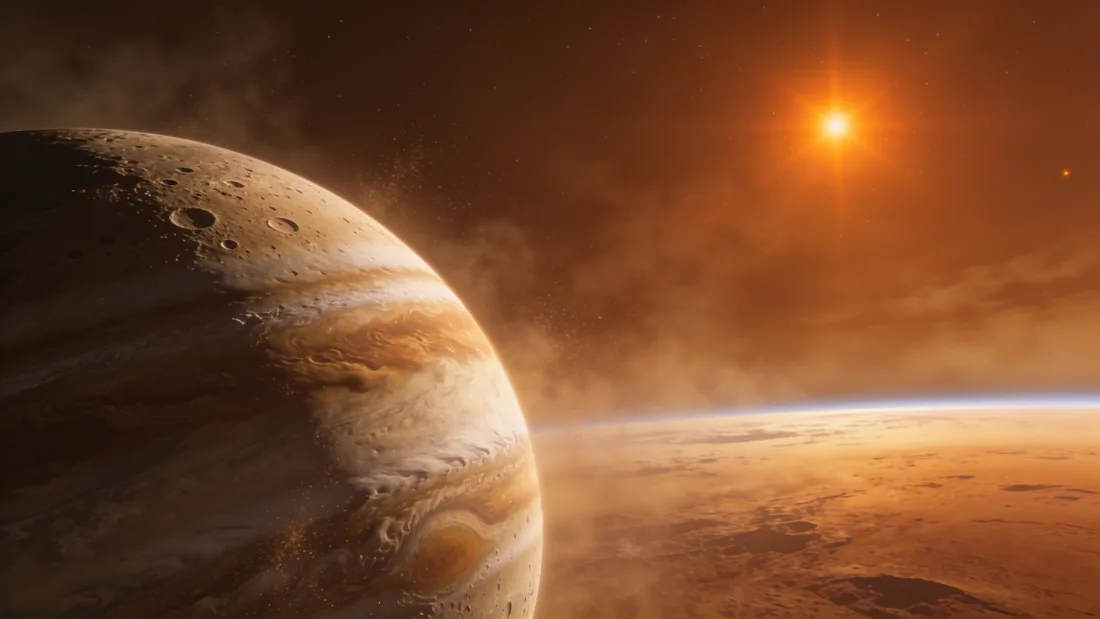
About 66.7 light-years away, a planet called TOI-5789 e is quietly orbiting its star. Scientists confirmed it in 2026, and it belongs to one of the most common types of planet we know of. Here is what we have learned so far.
Where in Space Is TOI-5789 e?
TOI-5789 e lives in our galactic neighborhood. Its host star is called TOI-5789, and that star sits 66.7 light-years from Earth. A light-year is the distance light travels in one year — about 9.5 trillion kilometers. So even at the speed of light, you would need nearly 67 years just to get there.
That sounds far, but in terms of our galaxy, it is actually quite close. The Milky Way is roughly 100,000 light-years across. TOI-5789 is practically next door by cosmic standards.
The host star TOI-5789 has a surface temperature of 5,185 K (K stands for Kelvin, a unit scientists use to measure very high temperatures). Our own Sun’s surface is about 5,778 K, so TOI-5789 is a little cooler and probably a little dimmer than the Sun. It is still a Sun-like star, though, which makes this system interesting to study.
What Kind of World Is a Mini-Neptune?
TOI-5789 e is classed as a mini-Neptune. That term describes a planet larger than Earth but smaller than Neptune, our solar system’s fourth-largest planet. Mini-Neptunes are fascinating because nothing like them exists in our own solar system — there is a big gap between Earth and Neptune in terms of size, with nothing in between at home. Yet out among the stars, planets of this middle size seem to be very common.
Scientists think most mini-Neptunes have thick atmospheres made of hydrogen and helium, or possibly water vapor and other gases. Deep below that atmosphere, there might be a rocky or icy core. We can’t see through a planet’s atmosphere from this distance, so the exact makeup of TOI-5789 e is still unknown. What we can do is measure its size and mass, and from those two numbers, we can make careful guesses about what it might be made of.
You can explore other worlds of this type in the atlas of known exoplanets to get a sense of how varied they can be.
Size, Mass, and What That Tells Us
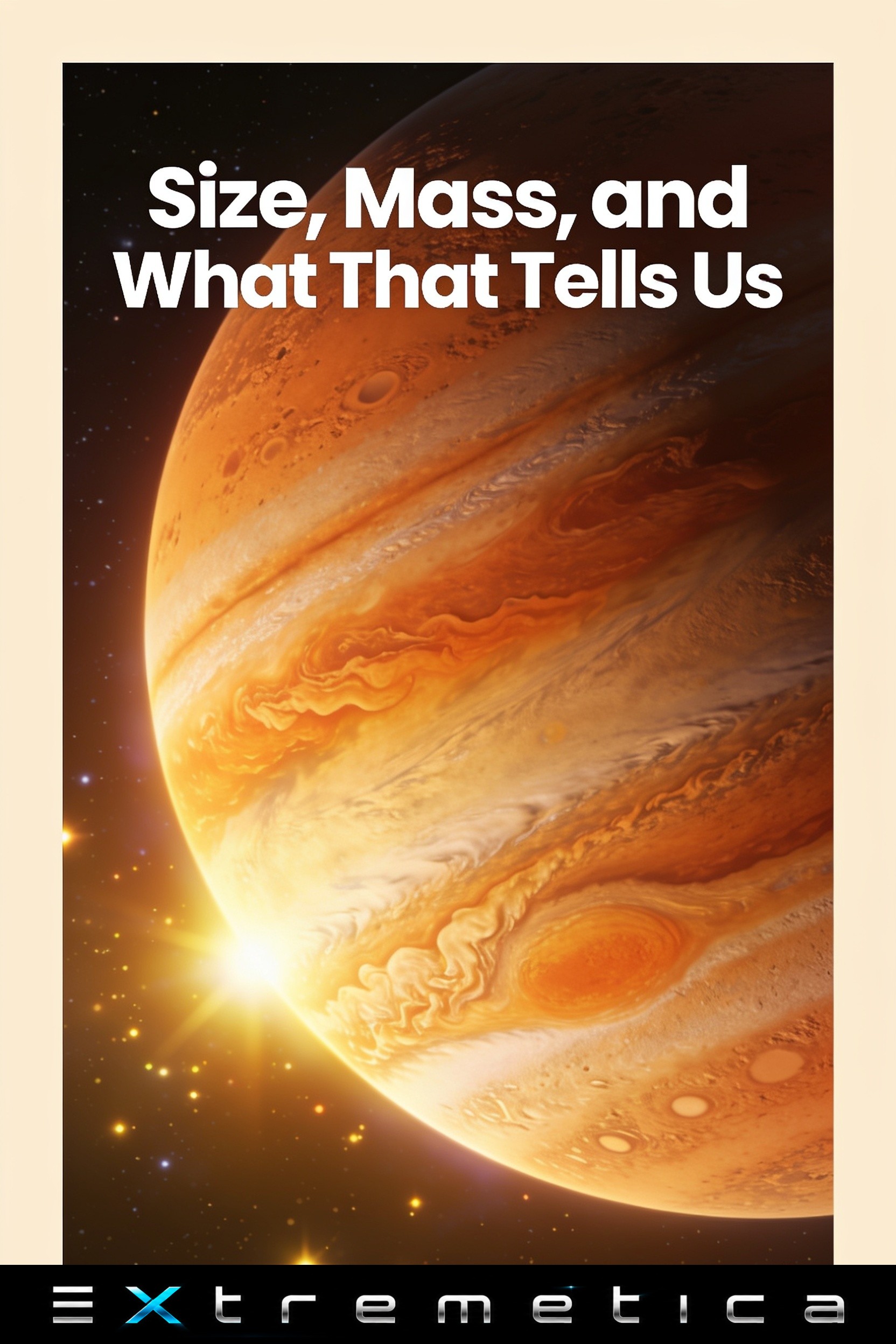
TOI-5789 e has a radius of 3.43 times Earth’s radius. Picture Earth as a marble. TOI-5789 e would be a marble that is more than three times as wide. Its mass — how much stuff is packed inside it — is 11.6 times Earth’s mass.
When scientists compare size and mass, they can estimate how dense a planet is. Density tells us roughly what a planet is made of. A very dense planet is probably mostly rock and metal, like Earth. A less dense planet likely has a thick layer of lighter gas or ice on top of a smaller solid core.
TOI-5789 e’s numbers suggest it is not super dense. That points toward a planet with a significant atmosphere or an envelope of lighter material, rather than a pure rock ball. Scientists call this kind of interior model a “gas-rich” or “volatile-rich” world. But these are estimates, and the real picture could be different. Scientists haven’t made a direct measurement of its atmosphere yet.
Its estimated temperature is about 424 K, or roughly 151 degrees Celsius. That is hotter than boiling water. This is called the equilibrium temperature — meaning the temperature you would expect if the planet absorbed and released heat evenly, based on how much light it gets from its star. The actual temperature at any surface, if one exists, could be different depending on greenhouse effects in the atmosphere.
A Year That Lasts 63 Days

One year on TOI-5789 e — one full orbit around its star — takes just 63 Earth days. That is about two of our months. This means the planet is much closer to its star than Earth is to the Sun.
Being that close to a star usually means more heat and radiation. It is one reason scientists estimate the temperature is as high as it is. It also means TOI-5789 e is almost certainly not in the habitable zone — that is the range of distances from a star where liquid water could potentially exist on a planet’s surface. TOI-5789 e orbits too tightly and too warmly for that, as far as we can tell.
How Scientists Found It: the Radial Velocity Method
TOI-5789 e was discovered in 2026 using a technique called the radial velocity method. Here is how it works: a planet’s gravity gives its star a tiny tug as it orbits. That tug makes the star wobble very slightly toward and away from Earth. When the star moves toward us, its light shifts to a slightly bluer color. When it moves away, the light shifts redder. Scientists can measure these tiny color shifts very precisely, and from the pattern, they can work out that a planet is there — and estimate its mass.
The radial velocity method is one of the oldest and most trusted tools in exoplanet science. It works especially well for planets that are close to their stars and have enough mass to cause a noticeable wobble. TOI-5789 e fits both conditions.
A Busy Neighborhood: Four Planets Around One Star
TOI-5789 e is not alone. Scientists have confirmed four planets in the TOI-5789 system so far. That makes it a multi-planet system, which is actually quite common. Many stars we have studied turn out to host several planets at once, not just one. Each planet in the system follows its own orbit, its own pace, and may have its own character.
We do not yet have full details on the other three planets in this system — their sizes, masses, and orbits are something scientists continue to work on. You can check back on the discovery timeline as more data comes in.
TOI-5789 e is one small piece of a larger puzzle. Every planet like it helps scientists understand why some worlds end up large and gassy while others stay small and rocky — and what shapes a solar system over billions of years. That question does not have a complete answer yet, and that is exactly what makes it worth asking.