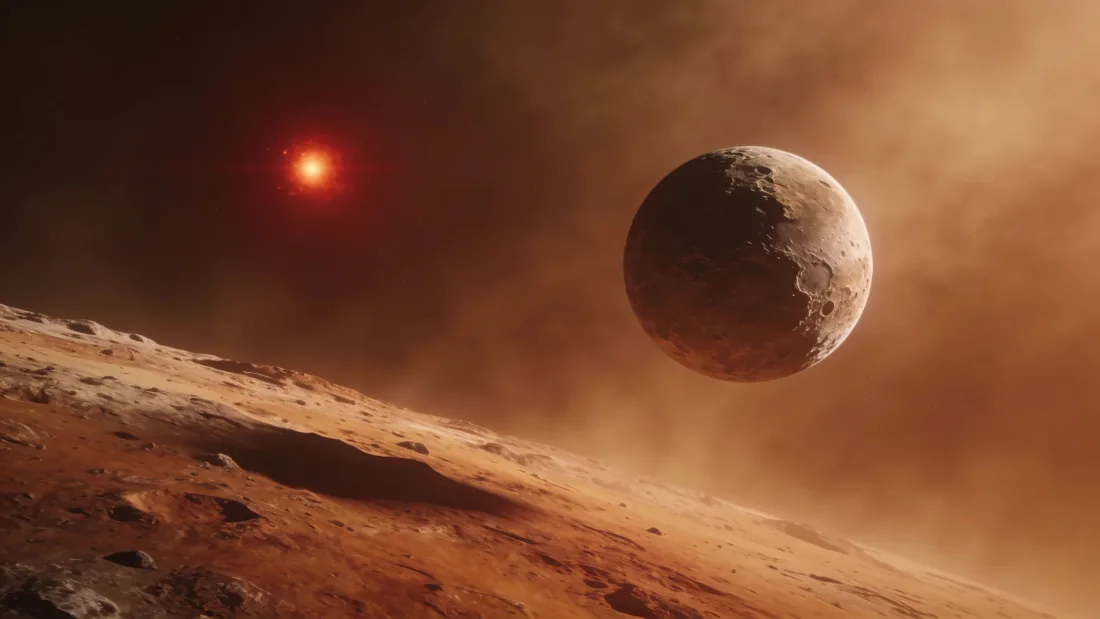
Barnard d is one of the closest known exoplanets — planets that orbit stars other than our Sun — to Earth. It sits just under six light-years away, which sounds close on a cosmic scale, yet the journey there would challenge everything human technology can do. Understanding that distance is a good way to feel just how vast space really is.
What Is Barnard d?
Barnard d was discovered in 2025 using the radial velocity method. That method works by watching a star very carefully. When a planet orbits a star, its gravity gives the star a tiny wobble. Scientists can detect that wobble in the star’s light and use it to work out facts about the planet. It is one of the main tools astronomers use when a planet does not pass directly in front of its star from our point of view.
The planet orbits Barnard’s Star, one of our nearest stellar neighbors. Scientists now know of four planets in that system. Barnard d is one of the smaller ones, as you will see below.
Barnard’s Star — A Small, Cool Neighbor
Barnard’s Star is what astronomers call a red dwarf — a star that is much smaller and cooler than our Sun. Its surface temperature is 3,195 K (K stands for Kelvin, a temperature scale scientists use; 3,195 K is very roughly 2,900 degrees Celsius). Our Sun’s surface sits closer to 5,800 K, so Barnard’s Star is noticeably cooler and gives off a dimmer, more reddish light.
Red dwarfs are the most common type of star in our galaxy, the Milky Way. They burn their fuel very slowly, which means they can last far longer than stars like our Sun. Barnard’s Star has been around for a long time, and it sits remarkably close to us in space — just 5.96 light-years away. Only the three stars of the Alpha Centauri system are closer.
Making Sense of 5.96 Light-Years
A light-year is the distance light travels in one year. Light moves at about 300,000 kilometres every single second. In one year, it covers roughly 9.46 trillion kilometres. So 5.96 light-years is about 56 trillion kilometres. That number is so large it is almost impossible to picture directly.
Here is one way to feel it. If you shrank the solar system — everything from the Sun out to the edge of Neptune’s orbit — down to the size of a large dinner plate (about 30 centimetres across), Barnard’s Star would sit roughly 170 metres away from that plate. It is close compared to most of the galaxy, but it is still a very long walk on this shrunken model.
You can explore distances like this interactively using the Cosmic Map on this site, which helps put nearby stars in perspective.
Travel Times at Real Speeds
How long would it actually take to reach Barnard d? The answer depends entirely on how fast you travel, and the honest answer is: a very long time.
- By car at highway speed (about 100 km/h): roughly 640 million years. You would arrive long after the Sun has changed dramatically.
- By the fastest crewed spacecraft ever (Apollo 10 reached about 39,897 km/h on its return to Earth): still around 1.6 million years.
- By the fastest uncrewed probe humanity has launched (the Parker Solar Probe has reached speeds of around 690,000 km/h near the Sun): scientists estimate it would still take well over 90,000 years to cover a distance like this.
These numbers are humbling. Even our fastest machines, built with decades of engineering, would take longer than all of recorded human history — many times over — just to reach our nearest stellar neighbors.
If you want to play with these numbers yourself, the Distance and Travel Time tool on this site lets you choose a speed and see how long any cosmic journey would take.
Could We Ever Get There Faster?

Scientists and engineers do think about this question seriously. A few ideas have been studied, though none are ready to build yet.
One concept is called laser sail propulsion. The idea is to build an extremely thin, light sail and push it with a powerful laser beam from Earth or from orbit. A small probe — much smaller than a smartphone — could in theory be pushed to a few percent of the speed of light. At one percent of light speed, the trip to Barnard’s Star would take about 600 years. At ten percent, it would be about 60 years. That is still a long mission, but it is a human timescale.
However, these ideas face enormous challenges. A laser powerful enough to do this has not been built. The tiny probe would need to survive being hit by dust particles at enormous speed. Slowing down at the other end is another unsolved problem. Scientists are honest that these are ideas being studied, not plans ready to carry out.
For now, reaching Barnard d in any reasonable human lifetime remains well beyond what technology can do.
A Small, Hot World in a Four-Planet Family
Even if we could get to Barnard d, it would not be a welcoming place. The planet has a radius of just 0.69 times Earth’s — meaning it is a smaller, more compact world. Its mass is about 0.26 times Earth’s mass, which makes it quite light compared to our planet. Scientists haven’t measured the exact composition yet, so we don’t know if it is rocky, icy, or something in between.
What we do know is that it is hot. Its likely temperature is around 483 K, which works out to about 210 degrees Celsius. That is well above the boiling point of water. Barnard d also moves around its star very quickly — its year lasts only 2.34 Earth days. It orbits so close to Barnard’s Star that a complete trip around the star takes less than three of our days. At that distance, even a cool red dwarf delivers a lot of heat.
Scientists think Barnard d sits far too close to its star to be in the habitable zone — the range of distances where liquid water could exist on a planet’s surface. This is a warm, fast-moving little world, not a place that looks promising for life as we know it.
Barnard d reminds us that even our closest cosmic neighbors are both achingly far away and full of surprises. The fact that we can detect a planet smaller and lighter than Earth, circling a dim star nearly six light-years distant, using nothing but a careful watch on starlight, is a quiet kind of wonder all on its own.