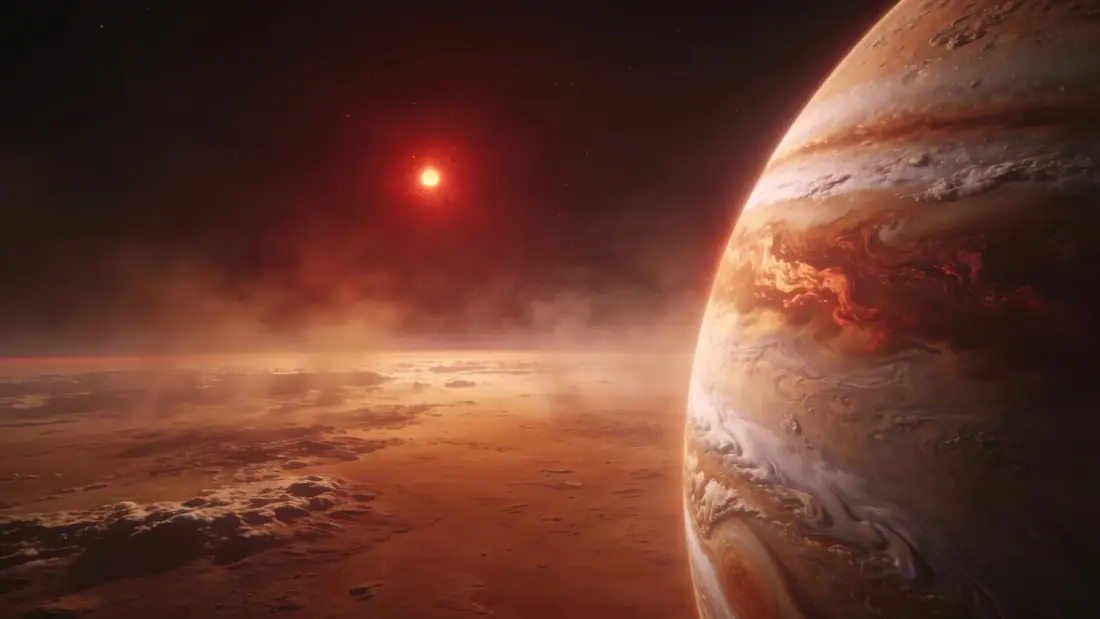
Out in the constellation Microscopium, about 73.3 light-years from Earth, a small orange-red star holds at least two planets in its grip. One of those worlds, GJ 3090 c, was confirmed in 2026, and it gives us a good chance to learn about a type of planet that does not exist in our own solar system.
What Kind of Star Does GJ 3090 c Orbit?
The host star is called GJ 3090. It is a red dwarf, which means a star that is cooler, smaller, and dimmer than our Sun. Red dwarfs are the most common kind of star in the Milky Way. Because they are so plentiful, studying planets around them helps scientists understand planet-forming in the universe overall.
GJ 3090 has a surface temperature of about 3,707 K — that is degrees on the Kelvin scale, where 0 K is absolute zero, the coldest anything can ever be. By comparison, our Sun’s surface sits at around 5,778 K. So GJ 3090 runs noticeably cooler than the Sun. That lower temperature is part of why the star glows with a reddish-orange tint rather than the pale yellow-white light we see from the Sun.
Red dwarfs are interesting hosts because they can be very active when they are young, sending out bursts of radiation. That matters when scientists think about whether planets around them could hold on to their atmospheres over time.
How Scientists Found GJ 3090 c
GJ 3090 c was discovered using the radial velocity method. Here is how it works. A planet does not just orbit its star — both the planet and the star actually tug on each other. As a planet circles, it pulls the star into a tiny wobble. That wobble causes the star’s light to shift very slightly in color as the star rocks toward us and then away. Scientists measure those color shifts carefully and use them to figure out that a planet must be there.
The radial velocity method is especially good at measuring a planet’s mass — that is, how much matter is packed into the planet. It does not directly measure size, so scientists need other observations, or careful calculations, to work out the radius. In the case of GJ 3090 c, both the mass and the radius have been measured, which puts this world in a well-studied category, as you will read below.
Size, Mass, and What “Mini-Neptune” Really Means
GJ 3090 c has a radius of 3.14 times Earth’s radius and a mass of 10.0 times Earth’s mass. Those two numbers together tell scientists a great deal. The planet is larger and heavier than Earth, but not nearly as big as our solar system’s Neptune, which is about 3.9 times Earth’s radius. So GJ 3090 c sits right in a size range that astronomers call a mini-Neptune — a planet bigger than Earth but smaller than Neptune, likely wrapped in a thick layer of gas, water, or ices.
Mini-Neptunes are some of the most common types of planet found around other stars. Yet we have nothing like them in our own solar system. Earth is rocky and relatively small. Neptune is an ice giant far out in the cold. Mini-Neptunes fall in between, and understanding them could reveal a lot about how planets form and grow. You can explore more worlds like this in the Atlas of known exoplanets.
Scientists use the mass and radius together to estimate a planet’s density — how tightly packed its material is. GJ 3090 c’s numbers are consistent with a planet that has a rocky core surrounded by a deep atmosphere or a thick envelope of lighter material, such as water in a high-pressure form. Scientists haven’t confirmed the exact interior structure yet.
A Scorching Fast Orbit
One of the most striking things about GJ 3090 c is how quickly it completes one orbit. Its year is only 15.9 Earth days long. That is fast — faster than even Mercury, which takes about 88 days to circle the Sun. GJ 3090 c sits very close to its star to zip around that quickly.
Being that close means the planet receives a lot of energy from GJ 3090. Scientists estimate that its likely temperature is around 407 K, which works out to roughly 134 degrees Celsius. That is far too hot for liquid water on the surface. The planet sits well outside what we call the habitable zone — the range of distances from a star where liquid water could possibly exist on a rocky surface.
A Two-Planet System
So far, astronomers know of two planets in the GJ 3090 system. GJ 3090 c is the second. The first, GJ 3090 b, was confirmed earlier. Multi-planet systems are very common around red dwarfs. Finding more than one planet in a system helps scientists study how the planets interact and what the system as a whole is like. It also raises the question of whether more planets might be hiding there, waiting to be found with future observations.
What We Still Don’t Know
There is quite a bit we are still unsure about. Scientists haven’t measured the composition of GJ 3090 c’s atmosphere, or confirmed whether it has one at all. We don’t know what its surface — if it has a solid one beneath all that gas and pressure — looks like. Its exact interior structure is still a careful estimate. Those are normal gaps for a world 73.3 light-years away. Filling them in takes time, more observations, and often new telescopes.
GJ 3090 c is a good example of the careful, step-by-step nature of exoplanet science. Each confirmed world adds a data point to a much larger picture. If you want to see how many worlds have been added over time, the discovery timeline puts it in perspective. For now, this mini-Neptune sits in its tight orbit, keeping its deeper secrets to itself.