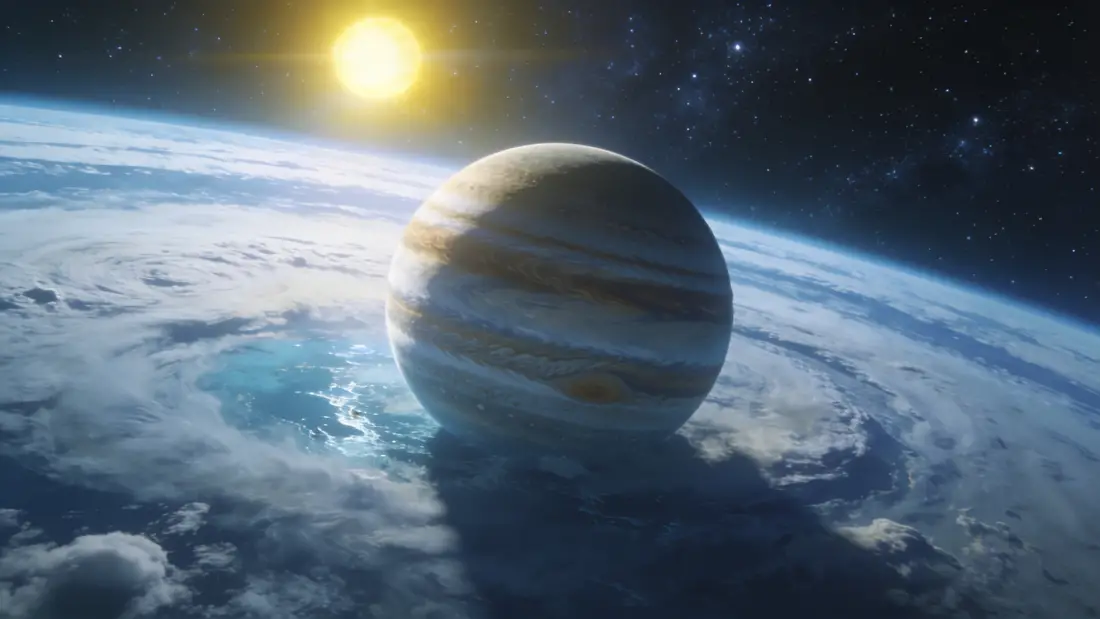
Kepler-1704 b is a distant world that sits in a very interesting part of space — and scientists have been taking a careful look at it. It is far bigger than Earth, and its orbit raises some curious questions about where life could, or could not, exist. Let’s take a slow, close look at what we know.
Meet Kepler-1704 b
Kepler-1704 b is a giant planet. Its radius — that is, the distance from its center to its surface — is about 11.9 times the radius of Earth. To picture that, imagine lining up nearly twelve Earths side by side across the planet’s middle. It is roughly the same size as Jupiter, our solar system’s largest planet.
Its mass is even more striking. Mass means how much matter is packed into something. Kepler-1704 b has a mass of about 1,322 times Earth’s mass. That puts it well above Jupiter’s mass too. A planet this massive is most likely what scientists call a gas giant — a world made mostly of thick gases rather than solid rock and dirt.
It lives very far from us. Kepler-1704 b is about 2,725 light-years away. A light-year is the distance light travels in one full year — roughly 9.5 trillion kilometers. At that distance, even our fastest spacecraft would take millions of years to reach it.
So far, Kepler-1704 b is the only known planet in its system.
How Scientists Found It

Kepler-1704 b was discovered in 2021 using something called the transit method. Here is how that works. When a planet passes in front of its star, it blocks a tiny bit of the star’s light. Telescopes watching the star notice that small dip in brightness. By measuring how often that dip happens and how deep it goes, scientists can figure out how big the planet is and how long its year is.
Think of it like watching a lamp across a dark room. If a moth flies in front of it, the light dims just a little for a moment. The transit method works the same way — just across trillions of kilometers of space.
This technique has helped scientists find thousands of planets they could never have spotted directly. It is one of the most powerful tools we have for exploring distant solar systems.
The Habitable Zone — The “Goldilocks” Band
You may have heard the term habitable zone before. Scientists sometimes call it the Goldilocks Zone because, like the porridge in the old story, conditions there are “just right” — not too hot, not too cold — for liquid water to exist on a planet’s surface.
Liquid water matters because, as far as we know, every living thing needs it. Without liquid water, life as we understand it cannot get started. A planet too close to its star gets scorched. A planet too far away freezes solid. The habitable zone is the band in between, where a planet could — in the right conditions — hold liquid water.
It is really important to say what “habitable zone” does not mean. It does not mean a planet has water. It does not mean it has life. It simply means the distance is right for water to be liquid if other conditions work out. Many things — like the planet’s atmosphere, its size, and its chemistry — also have to cooperate. If you want to explore how this band is calculated around different stars, you can visit our habitable zone explorer.
Where Kepler-1704 b Sits in Its System
One orbit of Kepler-1704 b around its star takes about 989 Earth days — roughly two and three-quarter Earth years. That is a long year. In our own solar system, a year that long would put a planet somewhere around the distance of Mars or a little beyond.
Scientists estimate the planet’s likely temperature at about 254 K, which is around -19 degrees Celsius. That is cold — well below the freezing point of water. For comparison, the average temperature on Mars is roughly similar. At first glance, that sounds like it rules out liquid water entirely.
However, temperature estimates like this one are calculated for the top of a planet’s atmosphere, or for a simple bare surface with no atmosphere at all. If a planet has a thick atmosphere, the greenhouse effect — where gases trap heat like a blanket — can warm the surface considerably. So scientists are careful not to say a planet is definitely too cold just from this number alone. That said, nothing confirms this planet is warm enough for liquid water either.
A Giant in the Zone — Why Size Changes Everything
Even if Kepler-1704 b were sitting at the perfect temperature, its enormous size would raise serious questions about habitability. A world with 1,322 times Earth’s mass almost certainly does not have a solid surface. Gas giants in our own solar system — Jupiter and Saturn — are crushing worlds of swirling gas, with pressures deep inside that are almost impossible to imagine.
Life as we know it needs a surface, or at least a stable environment. A gas giant might have moons, and those moons could sometimes be interesting worlds in their own right. But scientists haven’t found any moons around Kepler-1704 b yet, and measuring small moons at this distance is very hard with current tools.
If you are curious about smaller, rockier worlds that sit in the habitable zone, our most Earth-like worlds list is a good place to explore.
The Star Behind the Planet
Kepler-1704 b orbits a star called Kepler-1704. The star’s surface temperature is about 5,746 K (K stands for Kelvin, a scale scientists use for very high temperatures). For comparison, our own Sun has a surface temperature of around 5,778 K. That makes Kepler-1704 quite similar to the Sun — a little cooler, but in the same broad family of stars called yellow dwarfs.
This is useful context. Because the star is Sun-like, the habitable zone around it sits at a broadly similar distance to our own Sun’s habitable zone. That is partly why a planet with a nearly three-Earth-year orbit ends up with a temperature in that general range.
What We Still Don’t Know
There is quite a lot scientists haven’t measured yet about Kepler-1704 b. We don’t have a confirmed picture of its atmosphere, its exact composition, or whether it has any moons. The temperature figure is an estimate, not a direct reading. The planet’s exact distance from its star has not been listed in the verified data available to us.
These gaps are normal. Planets 2,725 light-years away are genuinely hard to study in detail. Future telescopes may be able to study the light passing through the atmospheres of distant giants, which would tell us far more about what is actually going on there.
For now, Kepler-1704 b sits in a region where liquid water is not ruled out by temperature alone — but its great size, its likely gas giant nature, and several unknowns mean we are very far from calling it a friendly place for life. It is, above all, a reminder of how much variety the universe holds, and how carefully we need to think before drawing conclusions about worlds we can barely see.