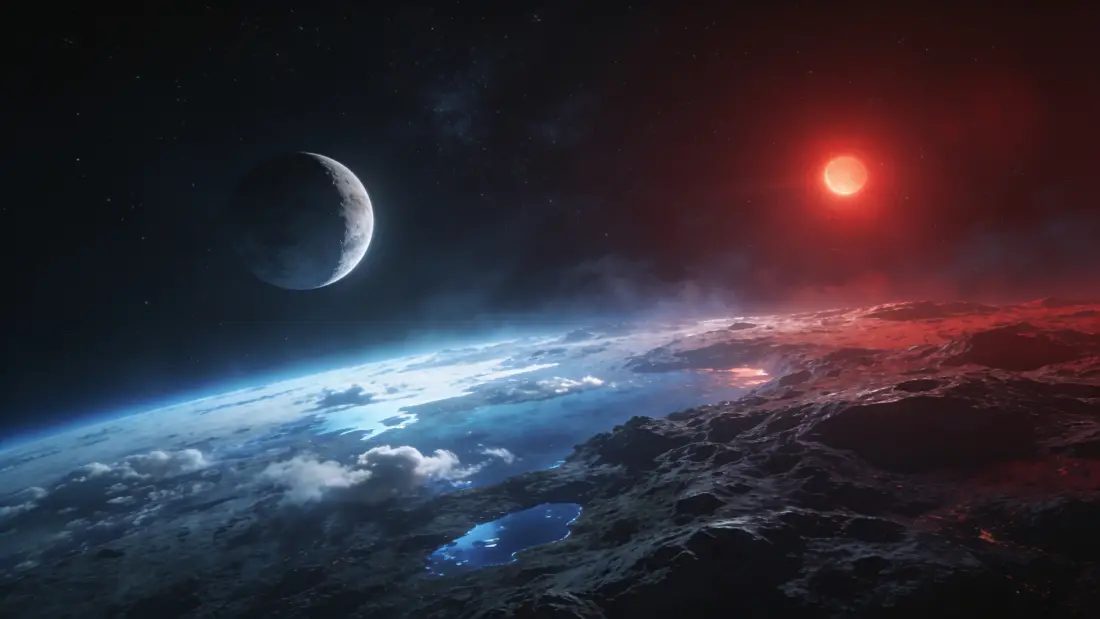
Of all the worlds discovered beyond our solar system, few sit as close to home as Proxima Cen d. This small planet orbits Proxima Centauri, the nearest star to our Sun. At just 4.24 light-years away, it is practically on our cosmic doorstep — and yet reaching it remains far beyond anything we can do today.
Our Nearest Stellar Neighbor
Proxima Centauri is a red dwarf — a type of star that is much smaller, dimmer, and cooler than our Sun. It belongs to the Alpha Centauri system, a group of stars that sits closer to Earth than any other star system. Even so, “close” in space means something very different from close on Earth. A single light-year is the distance light travels in one year, which works out to about 9.5 trillion kilometers. Proxima Centauri sits 4.24 light-years away. That is roughly 40 trillion kilometers.
Proxima Cen d is one of at least two known planets orbiting this star. Scientists are still studying this system, and there may be more worlds yet to find.
How Scientists Found Proxima Cen d
Proxima Cen d was discovered in 2025 using a technique called the radial velocity method. Here is how it works. When a planet orbits a star, its gravity gives the star a tiny tug. That tug makes the star wobble — moving very slightly toward us and then away from us as the planet goes around. Scientists can detect this wobble by watching how the star’s light changes. When the star moves toward us, its light gets compressed into slightly shorter waves. When it moves away, the waves stretch out. By measuring these tiny shifts in light very carefully, scientists can work out that a planet is there, even when they cannot see the planet itself.
Detecting Proxima Cen d this way was not easy. The planet is very small and light, so its gravitational pull on its star is extremely gentle. It took careful, precise measurements to pick out that faint signal.
A Small, Light World
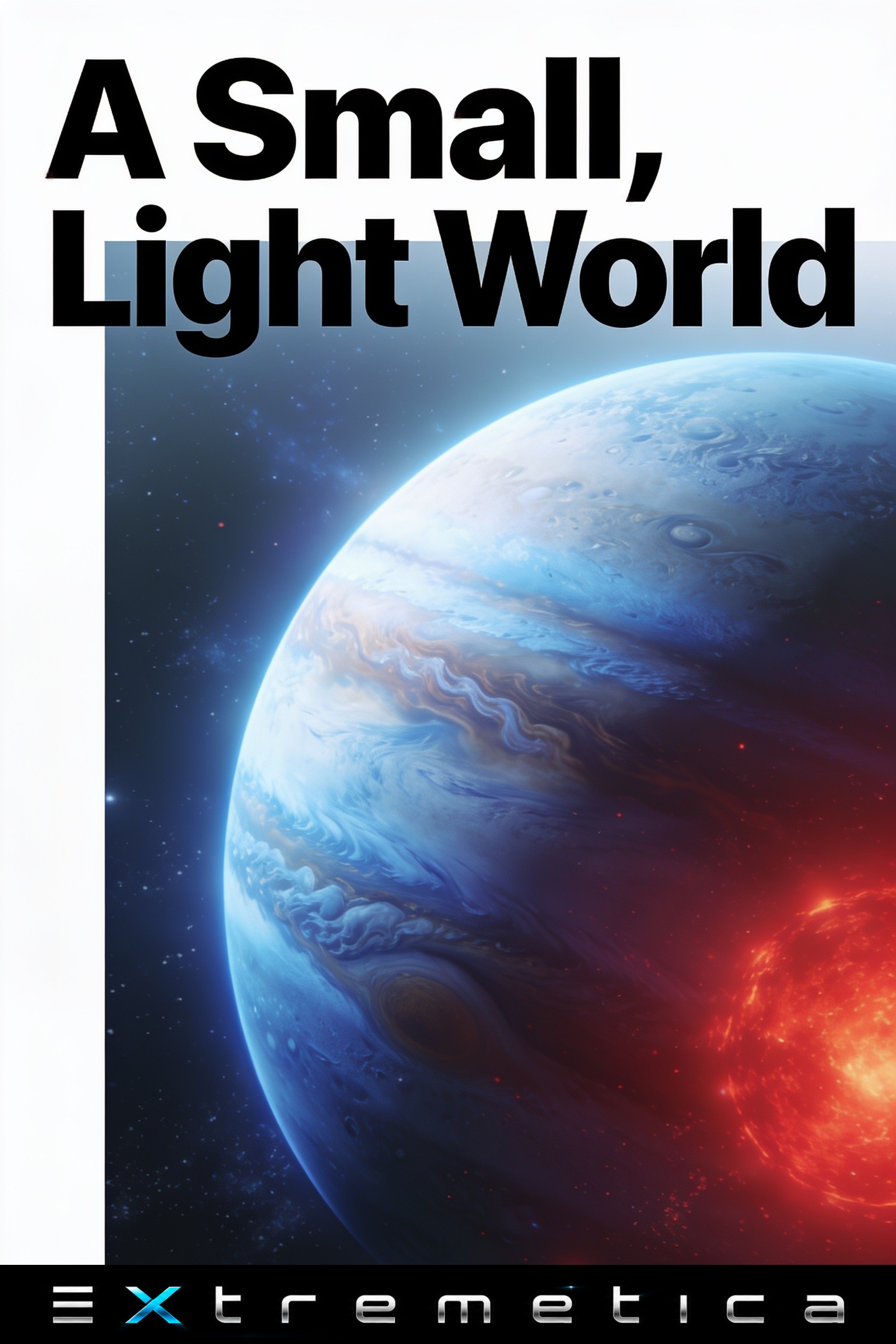
Proxima Cen d is notably smaller and less massive than Earth. Its radius is about 0.69 times Earth’s, meaning it is roughly two-thirds as wide. Its mass is about 0.26 times Earth’s — so it is less than a quarter of Earth’s mass. That makes it one of the lighter exoplanets — planets orbiting stars other than our Sun — known so far.
Because it is so low in mass, scientists think its gravity at the surface would be noticeably weaker than what we feel on Earth. Whether it has a solid surface, an atmosphere, or any kind of geology, scientists haven’t determined yet. The radial velocity method tells us a planet is there and gives us its mass, but it does not show us what the planet looks like up close.
Its estimated temperature is about 282 K, which works out to roughly 9 degrees Celsius. That might sound pleasant, but this figure comes from calculations about how much energy the star sends out and how far away the planet is. It does not account for whether the planet has an atmosphere, clouds, or anything that might change the actual surface conditions. The real temperature, if we could measure it, might be quite different.
Five-Day Years and a Frozen Star
One orbit around Proxima Centauri takes Proxima Cen d just 5.12 Earth days. That means a full year on this world passes in about the time it takes us to get through one school week. The planet moves fast because it orbits very close to its star.
Proxima Centauri is a red dwarf with a surface temperature of about 2,900 K. To compare, our Sun’s surface is around 5,800 K — nearly twice as hot. Proxima Centauri glows with a deep reddish-orange light, much dimmer than our Sun. It puts out far less energy overall.
Because the planet orbits so close to such a dim star, scientists have calculated its estimated temperature as described above. But red dwarfs are also known for sending out powerful flares — sudden bursts of energy and radiation. These flares can be strong enough to strip away a planet’s atmosphere over time. Whether Proxima Cen d has held on to any atmosphere at all is one of the big open questions about this world.
How Far Is 4.24 Light-Years, Really?
It is worth sitting with that distance for a moment. Light, the fastest thing in the universe, takes 4.24 years to make the journey from Proxima Centauri to Earth. Nothing we have ever built travels anywhere close to the speed of light.
The fastest spacecraft humanity has launched so far travel at roughly tens of kilometers per second. At that kind of speed, a trip to Proxima Centauri would take tens of thousands of years. Even the most ambitious ideas researchers have proposed for faster probes — tiny laser-pushed sails, for example — would take somewhere around 20 years at the very best, and those designs have not been built yet.
You can get a feel for these numbers yourself using the Distance and Travel Time tool, which lets you explore how long a journey to various worlds would actually take at different speeds.
In terms of our cosmic neighborhood, 4.24 light-years is genuinely the shortest hop between our Sun and any other star. And yet it is still an almost unimaginable distance by human standards. The Cosmic Map can help put Proxima Centauri’s position in context alongside other nearby stars and star systems.
Could This World Support Life?
The estimated temperature of Proxima Cen d — around 9 degrees Celsius — sits in a range that might allow liquid water to exist on a surface, depending on what that surface is actually like. Scientists sometimes call this range the habitable zone, the region around a star where conditions might allow liquid water. Whether any actual water is present on Proxima Cen d, and whether the planet has a surface or atmosphere at all, is not known.
The threat of stellar flares, the planet’s very low mass, and the many unknowns about its atmosphere all mean scientists are careful not to draw strong conclusions. This world is interesting and worth studying further. But calling it a place that could support life would go well beyond what the evidence shows right now.
Proxima Cen d is a reminder of how much we can learn about a world we will almost certainly never visit. A faint wobble in starlight, measured carefully across 4.24 light-years of empty space, was enough to reveal that this small world exists. What it is truly like remains one of the many quiet mysteries waiting at the edge of our cosmic neighborhood.