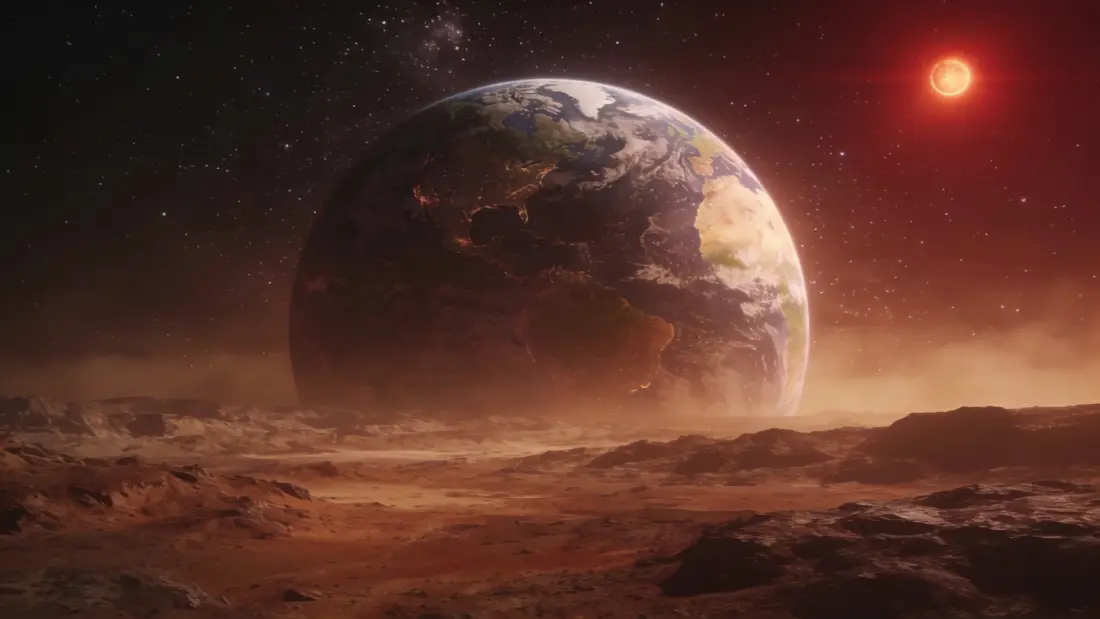
In 2026, astronomers confirmed a new rocky world orbiting a star just 10.7 light-years from Earth. That makes GJ 887 e one of the closest known exoplanets — a planet outside our solar system — to our own neighborhood. It is a fascinating find, even if it is not a place you would ever want to visit.
A Star That Is Practically Next Door
GJ 887 is what scientists call a red dwarf. A red dwarf is a star that is smaller, cooler, and dimmer than our Sun. Most stars in the Milky Way are red dwarfs, and GJ 887 is one of the closest examples to us.
The surface temperature of GJ 887 is 3,688 K. To put that in context, our Sun burns at around 5,778 K, so GJ 887 is noticeably cooler. That also means it gives off less light and heat than the Sun does.
At just 10.7 light-years away, GJ 887 is almost on our cosmic doorstep. A light-year is the distance light travels in one year — about 9.5 trillion kilometers. Even so, no spacecraft we have today could reach it in a human lifetime. But in astronomy terms, 10.7 light-years is a very short distance. That closeness makes the whole GJ 887 system especially interesting to study, because nearby stars are much easier to observe in detail than ones far across the galaxy.
What Scientists Know About GJ 887 e
GJ 887 e is a rocky world, and the numbers we have so far paint a pretty clear picture of its size and weight. Its radius — the distance from its center to its surface — is 1.12 times that of Earth. Its mass is 1.46 times Earth’s mass. So it is slightly bigger and noticeably heavier than our planet, but not by a huge amount.
A planet with this kind of size and mass is often called a super-Earth. That just means a rocky planet larger than Earth but smaller than the ice giants like Neptune. Scientists think GJ 887 e is most likely made of rock and possibly metal at its core, much like Earth — though we haven’t been able to confirm its interior composition directly.
You can explore more confirmed worlds like this one in the Atlas, where each entry brings together what we know so far.
How the Planet Was Found: The Radial Velocity Method
GJ 887 e was discovered using something called the radial velocity method. Here is how it works. A planet does not just orbit its star — both the star and the planet gently pull on each other. As a planet moves around its star, it causes the star to wobble very slightly. When the star wobbles toward us, its light shifts a tiny bit toward the blue end of the spectrum. When it wobbles away, the light shifts toward the red. Scientists measure these tiny shifts very carefully, and from the pattern they can work out that a planet is there, and estimate how massive it is.
This method is one of the most reliable tools astronomers have. It does not give us a perfect image of the planet, but it tells us a great deal — including the planet’s mass and how long its year is. GJ 887 e was pinned down this way in 2026.
A World That Is Way Too Hot

One of the most striking things about GJ 887 e is how hot it is estimated to be. Scientists calculate a likely surface temperature of 544 K, which is about 271 degrees Celsius. That is well above the boiling point of water, and hot enough to melt some metals over time.
Why is it so hot if its star is so cool? The answer is distance — or rather, the lack of it. GJ 887 e completes one full orbit around its star in just 4.42 Earth days. That means it is orbiting extremely close to GJ 887. Even though the star is dim compared to the Sun, being that close bakes the planet thoroughly.
This also puts GJ 887 e well inside what scientists call the habitable zone — the range of distances from a star where liquid water could exist on a planet’s surface. GJ 887 e is far too close, and far too hot, to sit in that zone. There is no reason to think it hosts liquid water or life as we know it.
Three Neighbors: The Rest of the GJ 887 System
GJ 887 e is not alone. Scientists currently know of four planets in the GJ 887 system. That makes it a multi-planet system, which is something astronomers find very useful. Studying several planets around the same star lets scientists compare worlds that formed from the same raw material and have the same parent star — but may have turned out very differently from each other.
The other three planets in the system have not been discussed here because our verified data covers only GJ 887 e. As scientists observe the system further, more details about its neighbors may come into focus. You can follow how our picture of systems like this one has grown over time through the Discovery Timeline.
Why Nearby Systems Like This One Matter
Finding a planet like GJ 887 e so close to Earth is genuinely useful for science. The nearer a star system is, the more we can learn from it. Future telescopes may be able to study the light passing through — or bouncing off — nearby planets in far more detail than distant ones. Even if GJ 887 e itself is too hot to be a place we would search for life, understanding its atmosphere, if it has one, could teach us about how rocky planets form and evolve around red dwarfs. And since red dwarfs are the most common stars in our galaxy, that knowledge goes a long way.
GJ 887 e is a reminder that even in our own cosmic corner, there is still a great deal left to find and understand.