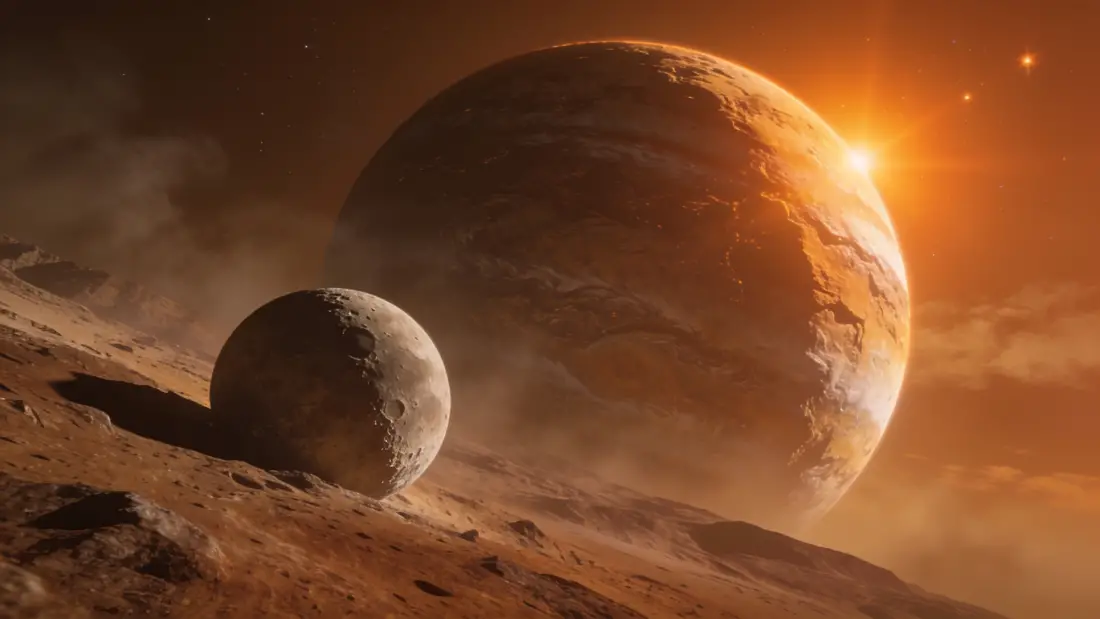
TOI-5789 d is a world a little bigger than Earth, circling an orange star not too far from our own solar system. It was discovered in 2026, and it gives scientists a useful chance to study what we call a super-Earth — a planet larger than Earth but smaller than the ice giants of our own solar system. There is still a lot to learn about it, but what we already know is genuinely interesting.
Where TOI-5789 d Lives
The star TOI-5789 sits about 66.7 light-years away from Earth. A light-year is the distance light travels in one year — roughly 9.5 trillion kilometres. That is far by everyday standards, but in the big picture of our galaxy, it is actually a fairly nearby neighbourhood.
The star itself is what astronomers call a K-type star, or orange dwarf. A K-type star is cooler and a little smaller than our Sun. Its surface temperature is 5,185 K (K stands for kelvin, a scale scientists use to measure temperature, where 0 K is the coldest anything can ever get). Our Sun’s surface is about 5,778 K, so TOI-5789 runs somewhat cooler. That difference in heat matters when we think about the planets around it.
Orange dwarf stars are considered interesting hosts for planets because they are long-lived and fairly stable. They burn through their fuel more slowly than bright, hot stars, which means planets in their systems get a long, steady supply of starlight.
How Big and Heavy Is TOI-5789 d?
TOI-5789 d has a radius — the distance from its centre to its surface — of 1.91 times Earth’s radius. Picture Earth, then imagine a world that is nearly twice as wide. That puts it firmly in the super-Earth category.
Its mass is 4.29 times Earth’s mass. Mass is a measure of how much matter is packed into an object. So TOI-5789 d is not only wider than Earth, it is noticeably heavier too.
Having both a radius and a mass measurement is really useful. Many exoplanets — planets outside our solar system — only have one of those numbers, which limits what scientists can work out. With both, researchers can calculate something called bulk density, which tells us roughly how tightly packed the planet’s material is. That, in turn, gives hints about what the planet might be made of inside. If you’d like to see how TOI-5789 d’s size stacks up against other known worlds, you can explore the size comparison tool on this site.
What Size and Mass Together Tell Us
This is where things get interesting from a science point of view. When a planet has a radius of about 1.91 times Earth and a mass of about 4.29 times Earth, scientists can use those two numbers together to estimate its density — how much mass fits into a given volume.
Planets come in different flavours. Rocky planets, like Earth or Mars, are dense. They are made mostly of rock and metal. Gas giants, like Jupiter, are much less dense because they are mostly hydrogen and helium gas. Between those extremes you have worlds that might be rocky but with a thick layer of water, ice, or gas on top.
For TOI-5789 d, the numbers suggest a planet denser than what you would expect from a mostly gaseous world. Scientists think it is likely a rocky planet, possibly with a thick atmosphere or a layer of volatile material — things like water or lighter gases — on top. But this is an estimate. Without more detailed observations, we cannot say for certain what is going on beneath the surface. The mass-radius diagram shows how planets like TOI-5789 d compare to different interior models.
One useful way to think about it: if TOI-5789 d were made entirely of rock, like Earth, its radius would be slightly smaller for that mass. The fact that it is nearly two Earths wide for about four Earth masses hints that it may have some lighter material — perhaps water, gas, or both — making it a bit puffier than a pure rock ball would be. Scientists call this region of planet sizes the super-Earth to sub-Neptune transition, and it is one of the most studied puzzles in planet science right now.
How Hot Is TOI-5789 d, and Why?

The estimated temperature of TOI-5789 d is 545 K, which works out to about 272 degrees Celsius. That is well above the boiling point of water at normal pressure, and far too hot to be comfortable by any standard we know of.
This temperature is called an equilibrium temperature — it is a calculated estimate of how warm the planet’s surface would be if it absorbed and released starlight in a simple, even way. Real temperatures depend on many things we don’t know yet, like whether the planet has an atmosphere and what that atmosphere is made of. An atmosphere can trap heat the way a blanket does, pushing actual surface temperatures much higher. Or certain kinds of thick, reflective clouds could bounce starlight away and keep things cooler. Scientists haven’t measured those details for TOI-5789 d yet.
What we can say is that at this distance from its star — completing one orbit every 29.7 Earth days — TOI-5789 d is well inside what we’d call the habitable zone for this star. The habitable zone is the range of distances where liquid water could, in theory, exist on a planet’s surface. TOI-5789 d appears to be closer to its star than that zone, making it too warm for liquid water as far as we can currently estimate.
The Four-Planet System
TOI-5789 d is the third planet out in a system of four known worlds. Systems with multiple planets are valuable to scientists because comparing planets that all formed around the same star helps reveal how planets grow and change over time. The other three planets in the TOI-5789 system haven’t received as much public attention yet, and detailed data on them is still limited. As telescopes gather more observations, a fuller picture of this system will slowly come together.
How Scientists Found TOI-5789 d
TOI-5789 d was discovered in 2026 using a technique called the radial velocity method. Here is how it works: as a planet orbits a star, it pulls on that star with its gravity, causing the star to wobble very slightly. When the star moves toward Earth, its light shifts toward the blue end of the spectrum. When it moves away, the light shifts toward red. Scientists can detect these tiny shifts and use them to work out the planet’s mass and orbit. The radial velocity method is especially good at measuring mass, which is why we have a reliable mass figure for TOI-5789 d.
TOI-5789 d is one of thousands of super-Earths that telescopes have now catalogued. Each one adds a data point to a growing picture of what kinds of worlds are out there. The fact that planets like this — bigger than Earth, smaller than Neptune, possibly rocky with something extra on top — seem to be so common in our galaxy is one of the more thought-provoking findings of modern astronomy.