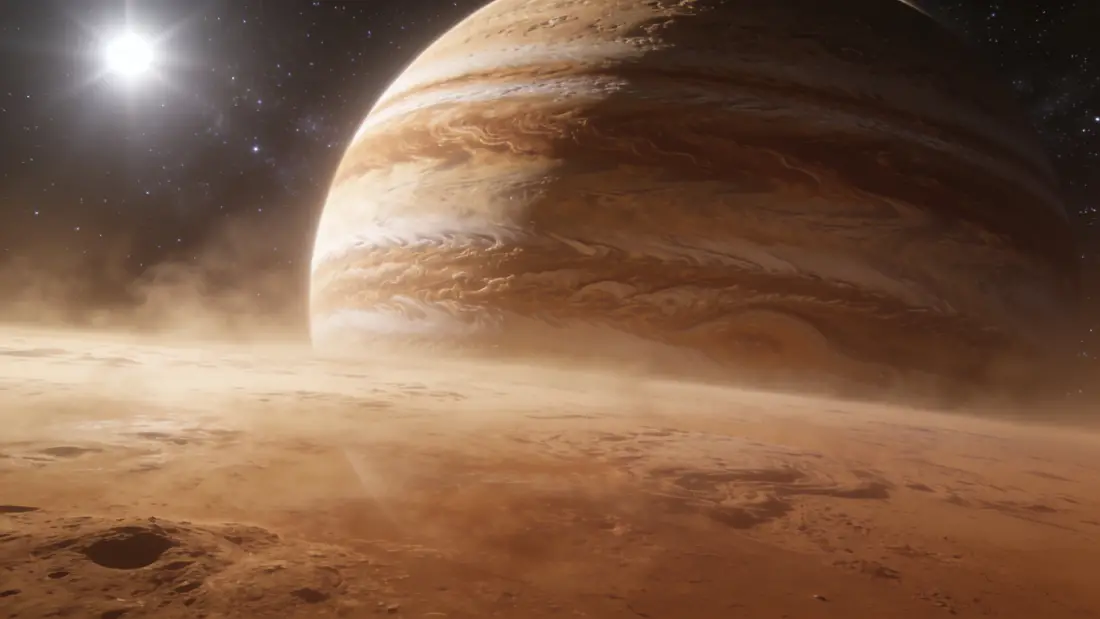
Far across the Milky Way, a star called KOI-351 holds a large family of planets in orbit around it. Among them is a world called KOI-351 g, which has given scientists some useful clues about how planetary systems can be built. With eight planets known so far, this system is one of the more crowded ones ever found beyond our Sun.
Where KOI-351 Lives in the Galaxy
KOI-351 sits about 2,767 light-years from Earth. A light-year is the distance light travels in one year — roughly 9.5 trillion kilometers. That means the light reaching our telescopes from KOI-351 today left that star long before most of recorded human history.
At that distance, we cannot visit, and we cannot take close-up pictures. Everything scientists know about this system comes from careful study of the light the star sends our way. That might sound limiting, but it is actually quite remarkable how much information is hidden inside starlight.
KOI-351 sits in the direction of the constellation Cygnus, the same patch of sky the Kepler space telescope watched for years. Many of the most interesting planetary systems we know come from that same region, simply because Kepler stared at it so steadily for so long.
The Star at the Center of It All
Before understanding the planets, it helps to understand the star they orbit. KOI-351 has a surface temperature of 6,031 K. The K here stands for Kelvin, a temperature scale scientists use — 0 K is absolute zero, the coldest anything can be. For comparison, our own Sun has a surface temperature of about 5,778 K, so KOI-351 runs just a little warmer than our Sun.
That small difference matters. A slightly hotter star puts out a bit more energy. That shifts the habitable zone — the band of distances around a star where liquid water could exist on a planet’s surface — slightly farther out compared to our Solar System. Scientists take a star’s temperature into account every time they try to figure out conditions on an orbiting planet.
Because KOI-351 is so similar in temperature to the Sun, it is often called a Sun-like star. That makes it an interesting comparison point. If our own Sun has eight planets, what does a similar star elsewhere in the galaxy end up with?
Meet KOI-351 g — the Planet We Know Best
Of the eight planets in the KOI-351 system, KOI-351 g is one of the best studied in terms of measured values. Here is what the data tells us.
Its radius — that is, the distance from its center to its surface — is about 7.72 times Earth’s radius. That makes it considerably larger than our planet, though it is smaller than the giant planets in our Solar System like Jupiter or Saturn. Planets in this size range are sometimes called sub-Saturns or large super-Earths, depending on exactly how scientists classify them. A super-Earth is simply a planet larger than Earth but smaller than the ice giant Neptune.
Its mass has been measured at about 15 times Earth’s mass. When you combine that with its size, you get a sense of what it might be made of. Scientists think a planet this size and mass is probably not a rocky world like Earth. It likely holds a thick envelope of gas or a deep layer of water or ice around a denser core. But scientists haven’t been able to confirm the details of its interior yet.
KOI-351 g takes 211 Earth days to complete one orbit around its star — so a year there lasts about seven of our months. Its estimated temperature is around 342 K, which works out to roughly 69 degrees Celsius. That is hotter than the boiling point of water at sea level on Earth. Whether that temperature reading applies to a solid surface, an atmosphere, or something else entirely depends on details scientists haven’t yet pinned down.
Eight Worlds in One System
Eight confirmed planets orbiting a single star is a notable count. Our own Solar System also has eight planets, so the match is striking. But the arrangement can be very different from one system to the next.
In our Solar System, the four inner planets are small and rocky, while the four outer planets are large and gassy. In other systems, scientists have found large planets packed in close to their star, or many planets bunched into orbits that would fit inside the orbit of Mercury. Each system tells a slightly different story about how planets form and move over time.
For KOI-351, scientists haven’t published full confirmed measurements for all eight planets in the same way they have for KOI-351 g. Some planets in a system are easier to detect and measure than others, depending on their size and how often they pass in front of their star. The full picture of how the eight worlds are arranged — which are closest in, which are farthest out, how their sizes compare — is still being filled in as more observations are made.
What is clear is that having eight planets in one system gives researchers a rare chance to study how a whole planetary family behaves together, rather than looking at just one or two worlds in isolation. You can explore systems like this one using the System Explorer.
How Scientists Found Them

The planets of KOI-351 were discovered in 2013 using the transit method. A transit happens when a planet passes in front of its star from our point of view, blocking a tiny fraction of the star’s light. Telescopes can detect that small dip in brightness. By watching how often the dip repeats, scientists can figure out how long the planet’s year is. By measuring how deep the dip goes, they can estimate the planet’s size.
The transit method works best for planets that orbit close to their star, because those planets transit more often and are easier to catch. Planets farther out may only pass in front of their star once every several Earth years, so confirming them takes much longer.
KOI stands for Kepler Object of Interest — a label given to stars and planet candidates identified during the Kepler mission’s survey of the sky. The number 351 simply places KOI-351 in that long catalog.
What Makes This System Worth Studying
A family of eight planets around a Sun-like star is rare enough to deserve careful attention. Systems like KOI-351 help scientists test their ideas about how planets form in the first place. Do planets tend to form in groups? Why do some stars end up with many planets while others seem to have just one or two? Does having eight planets mean they influence each other’s orbits over time?
These are questions that don’t have firm answers yet. But every new measurement of a planet like KOI-351 g adds one more data point to the growing picture. The more systems we understand in detail, the better chance we have of figuring out how our own Solar System — and the eight planets it holds — came to be.