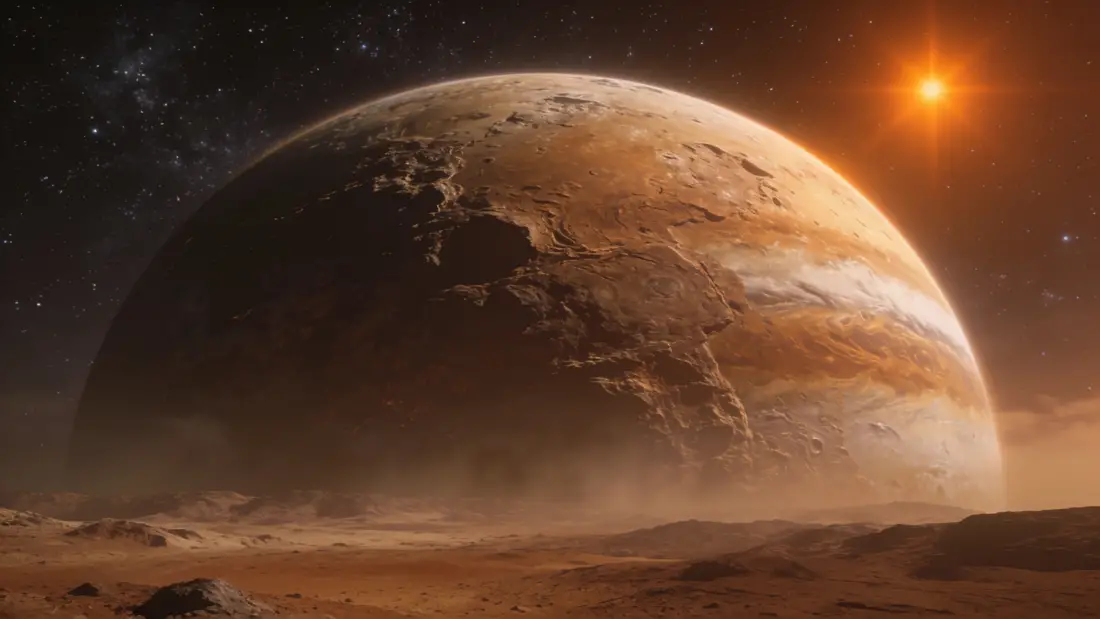
About 90.6 light-years from Earth, a star called HD 176986 hosts a small but fascinating family of worlds. One of them, HD 176986 d, is a planet scientists describe as a mini-Neptune — something bigger than Earth but smaller than the giant Neptune in our own solar system. Studying it helps us understand the many kinds of planets that fill our galaxy.
A Star 90.6 Light-Years Away
HD 176986 is an orange star. Astronomers call this type a K-type star, which means it is a little cooler and smaller than our own Sun. Its surface temperature is 4,931 K — where K stands for Kelvin, a temperature scale scientists use that starts at absolute zero, the coldest anything can be. For comparison, our Sun’s surface sits around 5,778 K, so HD 176986 runs noticeably cooler.
Orange stars like this one burn their fuel more slowly than stars like the Sun, which means they tend to live a very long time. Scientists think that could be important for planets, because a long-lived star gives more time for interesting things to happen on the worlds around it.
At 90.6 light-years away, HD 176986 is not our nearest neighbor, but it is not impossibly far either. A light-year is the distance light travels in one year — about 9.5 trillion kilometers. So 90.6 light-years is a very long journey by any rocket we have today, but it is still within the part of the galaxy astronomers can study quite well with modern telescopes.
How HD 176986 d Was Found
HD 176986 d was discovered in 2026 using a technique called the radial velocity method. Here is how it works. When a planet orbits a star, its gravity gives the star a tiny tug. That tug makes the star wobble very slightly toward and away from us. As the star wobbles toward Earth, its light gets squished to slightly shorter wavelengths — we say it becomes bluer. As it wobbles away, the light stretches to longer wavelengths and becomes redder. Sensitive instruments can measure these tiny shifts in color, and from that, scientists can work out that a planet must be there causing the wobble.
The radial velocity method is especially good at measuring a planet’s mass, because a heavier planet causes a stronger tug. It does not directly tell us how big around the planet is, but when scientists have both mass and radius, they can learn a great deal more. Luckily, in this case, both values have been measured.
Size and Mass — What the Numbers Tell Us
HD 176986 d has a radius of 2.49 times Earth’s radius. To get a feel for that, imagine lining up about two and a half copies of Earth side by side. That gives you roughly the width of this planet. You can explore how sizes like this compare visually using the size comparison tool.
Its mass is 6.76 times Earth’s mass. Mass tells us how much material the planet is made of. When you put radius and mass together, you can work out density — how tightly packed the material inside is. A planet that is only 2.49 times wider than Earth but has 6.76 times as much mass is fairly hefty for its size. That gives scientists a useful clue about what is inside.
A pure rock planet at this size would need to be even denser. A world made mostly of gas would be much lighter for its size. HD 176986 d sits in an interesting middle zone. Scientists think worlds like this are likely a mix — perhaps a rocky or icy core wrapped in a thick envelope of lighter gases or water. But the exact recipe is still uncertain. If you enjoy looking at how mass and radius relate across many planets, the mass-radius diagram puts this planet in context alongside hundreds of others.
What Kind of World Is This?
HD 176986 d belongs to a class of planets astronomers call mini-Neptunes. These are planets with a radius somewhere between about 2 and 4 times Earth’s, and they seem to be very common in our galaxy — perhaps more common than planets like Earth or planets like Jupiter. Our own solar system has no mini-Neptune, which makes studying them from afar especially important.
Inside a mini-Neptune, there are a few possibilities. The planet might have a rocky or metallic core, surrounded by a layer of water or ice, with a thick atmosphere of hydrogen and helium on top. Or it might be what some scientists call a water world — a planet where a large fraction of the mass is water, possibly as a deep, high-pressure ocean or as steam in the atmosphere. We don’t yet know which description fits HD 176986 d best. More observations would be needed to say with confidence.
What we do know is that its density points toward something denser than a pure gas ball but lighter than solid rock throughout. That middle ground is consistent with a layered world — but for now, scientists are still working out the details.
Temperature and Orbit
One orbit around HD 176986 takes just 61.4 Earth days. That is less than three of our months. Because it travels around its star so quickly, it sits much closer to the star than Earth sits to the Sun.
Scientists estimate its likely temperature at about 363 K, which is roughly 90 degrees Celsius — hotter than boiling water on Earth. This is an equilibrium temperature, meaning it is the temperature you would expect from starlight alone, without thinking about any greenhouse effect the atmosphere might add. If HD 176986 d has a thick atmosphere trapping heat, the actual surface temperature could be higher. We are not sure.
At this temperature and this distance from its star, HD 176986 d almost certainly sits outside the habitable zone — the region where liquid water could exist on a planet’s surface under the right conditions. Scientists have no evidence of life or liquid water there, and the temperature alone suggests it would be a harsh environment.
Two More Planets Next Door
HD 176986 d is not alone. Scientists know of three planets in the HD 176986 system so far. The other two — HD 176986 b and HD 176986 c — are siblings discovered around the same star. Multi-planet systems like this are common findings in modern exoplanet research, and they are especially useful because comparing planets around the same star helps scientists control for variables. All three planets formed from the same original cloud of gas and dust, orbiting the same star, so differences between them are meaningful clues about how planets grow and change.
Why Mini-Neptunes Matter
Mini-Neptunes are in some ways the most puzzling members of the planetary family. They are too small to be gas giants like Jupiter, yet too big and puffy to be solid worlds like Earth or Mars. Understanding what they are made of — and how they got that way — is one of the central questions in planet science right now. HD 176986 d, with both its mass and radius measured, is exactly the kind of planet that helps scientists test their models. Every new world we study adds one more data point to a growing picture of how planets form across the galaxy.