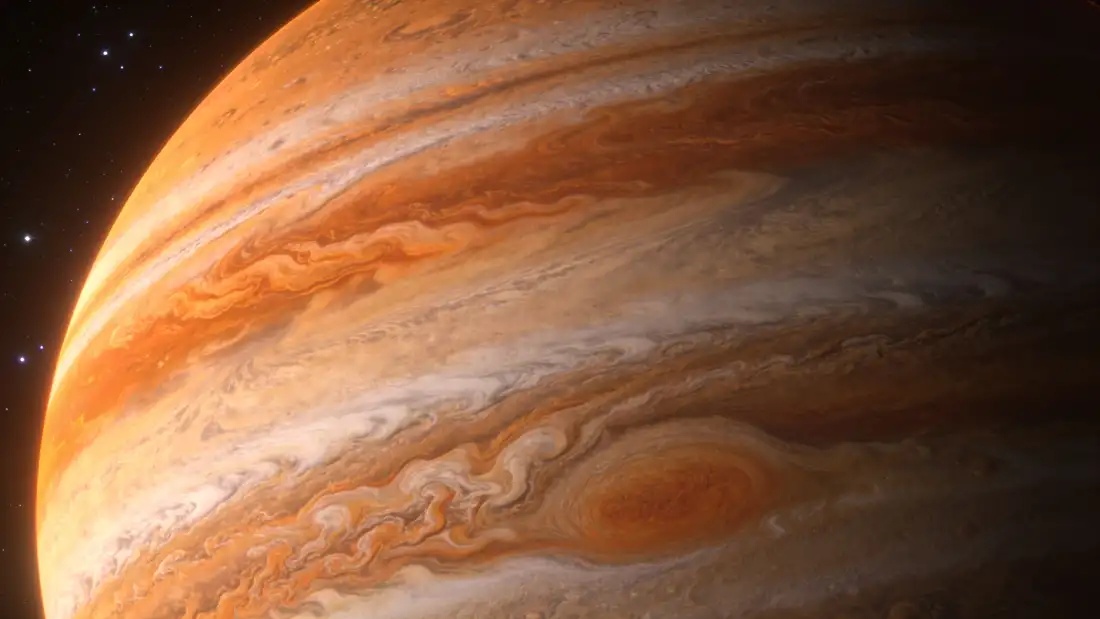
About 41 light-years away — a light-year is the distance light travels in one year, which works out to nearly 6 trillion miles — a star called 55 Cancri sits quietly in the constellation Cancer. Around it orbits a whole family of planets, including a giant world called 55 Cnc d. This system is one of the most studied multi-planet systems we know of, and it has a lot to teach us about how planetary families can form.
A Star Close Enough to Notice
55 Cancri, sometimes written as 55 Cnc, is what astronomers call a G-type star — a type of star fairly similar to our own Sun. It is not identical to the Sun, though. Its surface temperature is measured at 5,198 Kelvin, which is a unit scientists use for temperature that starts at absolute zero, the coldest anything can ever be. For comparison, our Sun’s surface runs at about 5,778 Kelvin. That makes 55 Cnc a little cooler and somewhat dimmer than the Sun, though not by a huge amount.
At 41.1 light-years from Earth, 55 Cnc is actually fairly close in the grand scheme of the galaxy. The Milky Way stretches roughly 100,000 light-years across, so 41 light-years is practically next door. That closeness is part of why astronomers have been able to study this system in such detail.
55 Cnc is also part of a double star system. It has a faint companion star much farther away. The planets in this family orbit the main star, 55 Cnc, rather than its distant companion.
Meet 55 Cnc d
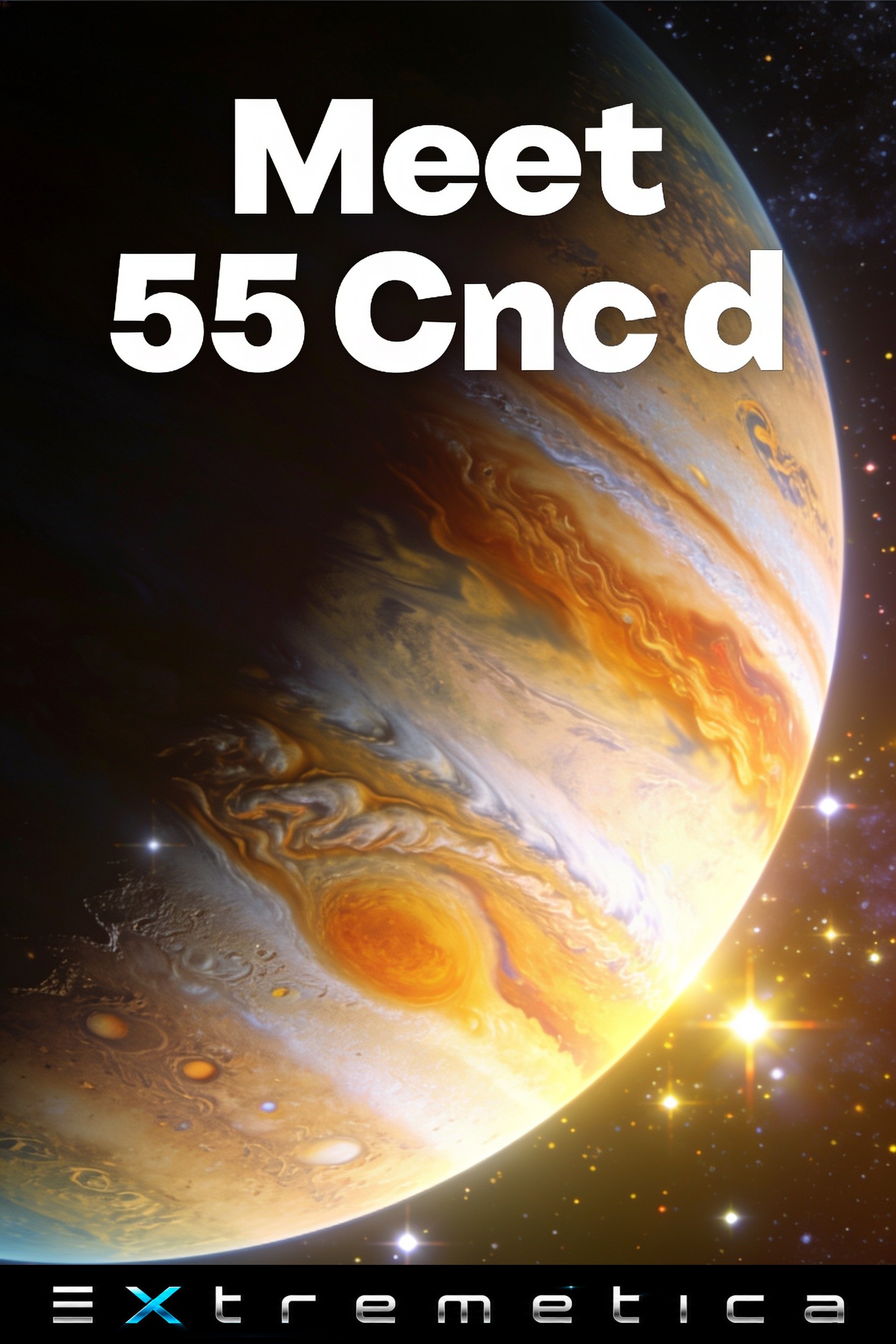
The standout member of this planetary family is 55 Cnc d, a truly enormous world. Its mass — the amount of matter it contains — is about 1,232 times the mass of Earth. To put that another way, you would need to stack more than 1,200 Earths together to match what this planet weighs. Its radius, meaning how wide it is from center to edge, is about 13 times Earth’s radius.
Numbers like these tell scientists that 55 Cnc d is almost certainly a gas giant — a planet made mostly of gas and liquid rather than solid rock, much like Jupiter or Saturn in our own Solar System. You could not stand on its surface, because there is probably no solid surface to stand on.
One orbit around its star takes 55 Cnc d about 4,799 Earth days. That is more than 13 Earth years for a single year on this planet. It sits far out from its host star, which is part of why its year is so long — the farther a planet is from its star, the longer its orbit takes.
How Scientists Discovered This Family
55 Cnc d was discovered in 2002 using a technique called the radial velocity method. Here is how that works. When a planet orbits a star, its gravity gives the star a tiny tug. That tug makes the star wobble very slightly toward and away from Earth. Scientists can detect this wobble by watching how the star’s light shifts. When the star moves toward us, its light looks slightly more blue. When it moves away, the light looks slightly more red. By measuring these tiny shifts very carefully, scientists can figure out that a planet is pulling on the star — and roughly how massive that planet must be.
The radial velocity method is especially good at finding large planets. A bigger, heavier planet creates a stronger pull and a bigger wobble, which is easier to spot. That is partly why giant planets like 55 Cnc d were among the first exoplanets — planets around other stars — to be found. Smaller, Earth-sized planets create much tinier wobbles and are harder to detect with this approach.
The Whole Family: Seven Worlds
55 Cnc d is just one member of a surprisingly large planetary family. So far, scientists have confirmed seven planets orbiting 55 Cnc, making it one of the richest multi-planet systems known outside our Solar System.
This family includes a wide range of planet types, from worlds that zip around the star in just a few days to 55 Cnc d out on its long, slow path. One planet in the system, 55 Cnc e, is known to be much smaller and rockier, completing its orbit in less than a single Earth day. Scientists haven’t measured every detail about all seven planets yet — things like the exact sizes or temperatures of some of them are still being worked out.
One planet in the system sits in what scientists call the habitable zone — the region around a star where temperatures might allow liquid water to exist on a planet’s surface. Whether any planet in this family actually has liquid water, or anything like an atmosphere that could support it, is something scientists are still trying to understand. Finding a world in the right zone is just the first step.
You can explore the layout of this system and others like it using the system explorer, which lets you compare how planets are arranged around different stars.
How This System Compares to Our Solar System
Our Solar System has eight planets, so a seven-planet system around 55 Cnc is not far off in terms of sheer numbers. The arrangement, though, looks quite different. In our Solar System, the rocky planets — Mercury, Venus, Earth, Mars — sit closer to the Sun, and the gas giants — Jupiter, Saturn, Uranus, Neptune — live farther out. The 55 Cnc system seems to mix things up more, with some larger planets and some smaller ones packed in at various distances in ways that do not match our familiar pattern quite so neatly.
The presence of a gas giant as massive as 55 Cnc d in a long outer orbit does have something in common with Jupiter’s role in our Solar System. Jupiter is also a heavy giant on a slow, wide orbit. Whether 55 Cnc d plays a similar role — perhaps shielding inner planets from incoming space debris — is something scientists think about but haven’t confirmed.
What Scientists Are Still Trying to Learn
Even a well-studied system like this one has plenty of mysteries left. For several of the seven planets, scientists have not yet measured key details like exact radius or surface temperature. The radial velocity method gives a good estimate of mass, but working out a planet’s size requires catching it as it passes in front of its star — a technique called the transit method — and not all of the 55 Cnc planets have been seen doing that.
Scientists are also curious about the atmospheres of planets in this system, especially 55 Cnc e, the small inner world. Newer telescopes are beginning to help with this kind of research, though it remains very difficult.
For now, the family of worlds around 55 Cnc stands as a good reminder that planetary systems come in all shapes and sizes. Our own Solar System is just one example of what a star and its planets can look like — and 41 light-years away, a very different family is quietly going about its own slow orbits around a slightly cooler sun.