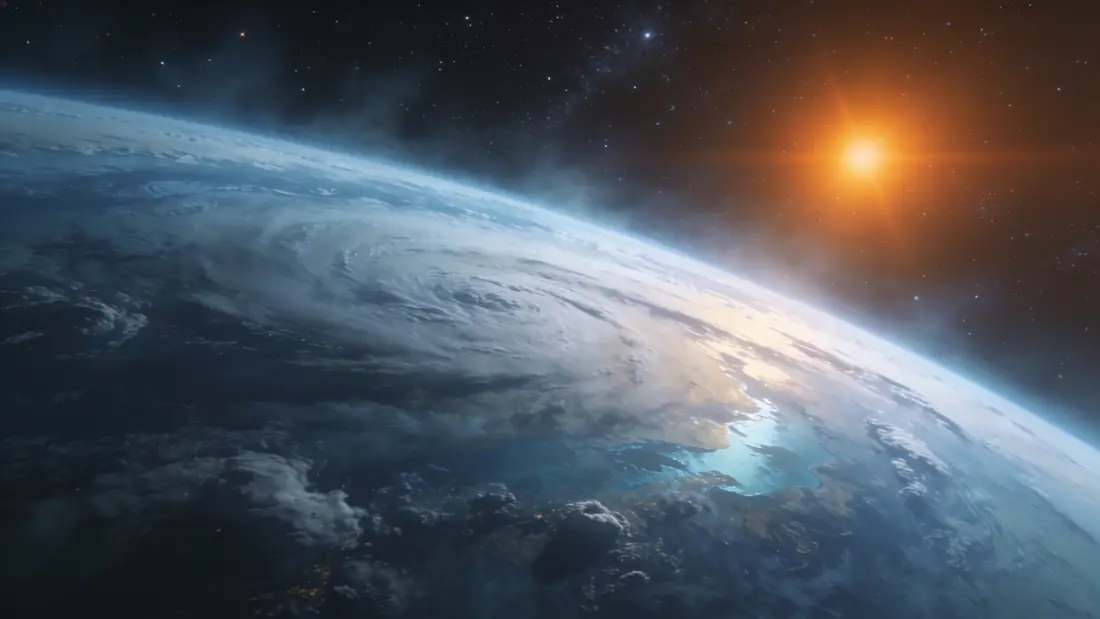
About 42 light-years away — a light-year is the distance light travels in one year, roughly 9.5 trillion kilometres — there is a planet called HD 40307 g. Scientists think it sits in a region around its star where liquid water could exist. That makes it one of the worlds worth looking at carefully when we ask: could life find a home there?
A Star Worth Knowing
HD 40307 g travels around a star called HD 40307. This star is 42.2 light-years from Earth, which is fairly close in cosmic terms, even though no spacecraft we have today could reach it in a human lifetime.
The star’s surface temperature is about 4,956 K (the letter K stands for Kelvin, a scale scientists use to measure temperature — 0 K is the coldest anything can be, and 4,956 K is very hot by everyday standards). For comparison, our own Sun’s surface sits around 5,778 K. That means HD 40307 is a little cooler and a little dimmer than the Sun. Stars like this are sometimes called K-type stars — orange-ish stars that are smaller and cooler than the Sun but still burn steadily for a very long time.
The system is a busy one. Scientists have found at least five planets orbiting HD 40307. HD 40307 g is the outermost of the known planets in this family.
What Kind of World Is HD 40307 g?
HD 40307 g is significantly bigger than Earth. Its radius — the distance from its centre to its surface — is about 2.56 times Earth’s radius. Its mass, meaning how much matter it contains, is about 7.1 times Earth’s mass.
A planet in this size and mass range is called a super-Earth. That is simply a label for rocky or partly rocky planets that are bigger than Earth but smaller than the ice giants in our own solar system, like Neptune. The name does not mean the planet is like Earth in any other way.
What would the inside of HD 40307 g actually be like? Scientists are not sure. A planet with 7.1 times Earth’s mass could be mostly rock, or it could have a thick layer of water or gas surrounding a rocky core. Without more detailed measurements, we cannot say which. What we do know is that the gravity on the surface would feel much stronger than what we experience on Earth — strong enough that moving around would be very hard work for a human.
If you are curious how HD 40307 g compares to other large rocky worlds, the Most Earth-Like Worlds list gives a useful sense of where different planets sit on the spectrum from Earth-sized to much larger.
Sitting in the Right Place
One of the most interesting things about HD 40307 g is where it orbits. It takes about 198 Earth days to complete one trip around its star — so one year on HD 40307 g is roughly half an Earth year.
That orbit puts the planet inside what scientists call the habitable zone. The habitable zone is the band of distances around a star where the temperature could allow liquid water to sit on a planet’s surface — not boiling away, and not frozen solid. It is sometimes called the “Goldilocks zone” because the conditions there are not too hot and not too cold.
It is very important to be clear about what this means. Being in the habitable zone does not mean a planet has liquid water. It does not mean a planet has life. It simply means the distance and starlight are in a range where those things could be possible, depending on many other factors — especially whether the planet has an atmosphere, and what that atmosphere is made of. An atmosphere is the layer of gases that surrounds a planet. Without one, a planet cannot hold heat or support liquid water at the surface, even in the right zone.
You can explore how the habitable zone works for different kinds of stars using the habitable zone explorer, which shows how the zone shifts depending on a star’s size and temperature.
A Chilly Thermometer
Scientists estimate the temperature of HD 40307 g at about 255 K, which is roughly -18 degrees Celsius. That is below the freezing point of water. So even sitting in the habitable zone, this world sounds cold.
But this estimated temperature assumes the planet has no atmosphere. An atmosphere can act like a blanket, trapping heat close to the surface. This is called the greenhouse effect. On Earth, the greenhouse effect raises our average surface temperature by many degrees compared to what it would be without our atmosphere. Mars, which has almost no atmosphere, is bitterly cold even though it also orbits in a zone that could theoretically support liquid water.
If HD 40307 g has a thick enough atmosphere with the right mix of gases, its true surface temperature could be warmer than 255 K. Scientists haven’t been able to measure the planet’s atmosphere yet, so we simply don’t know. That single unknown changes everything.
How We Found It
HD 40307 g was discovered in 2013 using a method called radial velocity. This technique works by measuring tiny wobbles in a star’s movement. When a planet orbits a star, the planet’s gravity gently tugs the star back and forth. By watching how the star’s light shifts slightly as it wobbles toward us and then away, scientists can calculate that a planet must be there — and estimate its mass and orbit.
The radial velocity method is very good at detecting a planet’s mass and orbit, but it does not directly measure the planet’s size. The radius of HD 40307 g comes from a separate analysis. This is why measurements from radial velocity studies often have some uncertainty built in — they are careful estimates, not direct photographs.
Big Questions We Can’t Yet Answer
Even with what we know, HD 40307 g leaves many questions open. Scientists haven’t measured its atmosphere, its surface conditions, or whether it has any water at all. We don’t know if it spins like Earth, with days and nights spread across its surface, or whether one side always faces its star. We don’t know if it is rocky, watery, or wrapped in deep layers of gas.
Each of those unknowns matters enormously for the question of life. The honest answer today is that HD 40307 g is an interesting candidate — a planet of the right rough size, in a location where liquid water could exist, around a stable and long-lived star. That combination is not common, and it is worth paying attention to. But “worth paying attention to” is very different from “likely to have life.” The universe is patient, and so is good science.