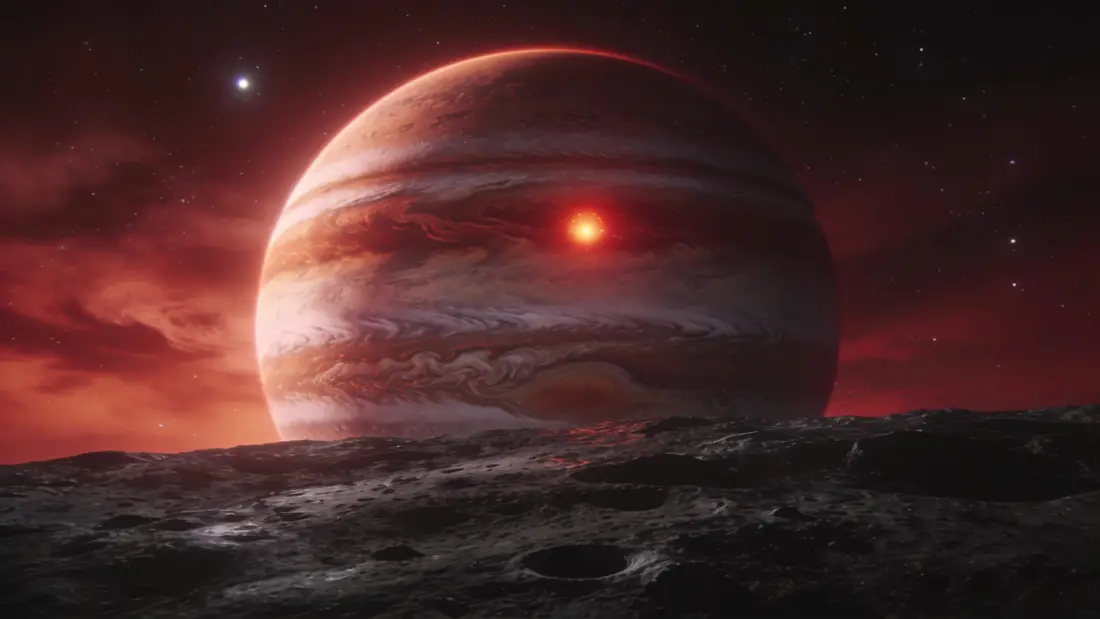
In 2026, astronomers added a new world to our growing list of known exoplanets — planets that orbit stars other than our Sun. That world is GJ 4274 c, a planet sitting just 23.6 light-years from Earth. In cosmic terms, that is practically next door, and what scientists found there is genuinely interesting.
Where in the Sky Do We Find GJ 4274 c?
GJ 4274 c orbits a star called GJ 4274, which lies 23.6 light-years away from us. A light-year is the distance light travels in one year — about 9.5 trillion kilometres. So while 23.6 light-years sounds far, it places GJ 4274 among the relatively nearby stars in our part of the Milky Way galaxy.
For comparison, the closest star system to our Sun, Alpha Centauri, is just over 4 light-years away. GJ 4274 is a bit farther, but it is still well within the neighbourhood of stars that scientists can study in good detail. You can find GJ 4274 and other nearby systems in our atlas of explored worlds.
What Kind of Star Does GJ 4274 Orbit?
The star GJ 4274 is what astronomers call a red dwarf — a small, cool star that burns much more slowly than our Sun. We can tell it is a red dwarf from its surface temperature. The surface temperature of GJ 4274 is 3,228 Kelvin. Kelvin is a way scientists measure temperature; for a rough sense, our Sun’s surface sits at around 5,778 Kelvin. So GJ 4274 runs considerably cooler.
Red dwarfs are the most common type of star in the Milky Way. They put out less light and heat than our Sun, which means the habitable zone — the band of distances around a star where liquid water could exist on a planet’s surface — sits much closer in than it does in our own solar system. That fact matters a lot when we think about what life on any nearby planets might look like.
Red dwarfs also tend to be very old and very long-lived, sometimes burning for hundreds of billions of years. That is far longer than our Sun’s expected lifespan.
How Was GJ 4274 c Discovered?
GJ 4274 c was found using the radial velocity method. Here is how that works. When a planet orbits a star, its gravity gives the star a tiny tug. That tug makes the star wobble ever so slightly toward us, then away from us, then back again, over and over. Scientists can detect that wobble by watching how the star’s light shifts. When a star moves toward us, its light stretches slightly to bluer colours. When it moves away, the light shifts toward red. By measuring those tiny shifts very carefully, scientists can figure out that a planet is there — and work out some of its properties.
The radial velocity method is one of the most reliable tools we have for finding planets around nearby stars. It cannot tell us everything, but it gives scientists a good measure of a planet’s mass and the length of its year. You can read about how discoveries like this one fit into the bigger story on our discovery timeline.
Size, Mass, and What “Mini-Neptune” Really Means
GJ 4274 c has a radius — that is, its width from centre to edge — of 2.83 times Earth’s radius. Its mass is 8.39 times Earth’s mass. That makes it noticeably bigger and heavier than our planet, but still much smaller than the giant planets in our solar system like Neptune or Jupiter.
Planets in this size range are often called mini-Neptunes. Neptune itself is about 3.9 times Earth’s radius, so a planet around 2 to 3.5 times Earth’s size falls in between — bigger than a rocky world like Earth, but nowhere near a full-sized ice giant. Scientists think mini-Neptunes probably have thick, gassy outer layers wrapped around a denser core, though the exact makeup of GJ 4274 c is not yet known. We do not have a measurement of its density that would settle the question firmly.
Mini-Neptunes are actually one of the most common types of planet astronomers have found so far. Interestingly, there are no mini-Neptunes in our own solar system. The gap between Earth and Neptune in our home system is a bit of a puzzle, which makes studying planets like GJ 4274 c all the more useful.
A Year That Lasts About 70 Days
One orbit of GJ 4274 c around its star takes just 69.6 Earth days. That is its year — less than a quarter of our own year. This short orbit tells us the planet travels on a path that keeps it quite close to its star.
Because GJ 4274 is a cool, dim red dwarf, being close to it does not necessarily mean scorching heat. Even so, scientists have not yet measured the surface temperature of GJ 4274 c directly, so we do not know exactly what conditions there feel like.
Could This World Support Life?
This is a question scientists are careful about. GJ 4274 c might sit in or near the habitable zone of its cool star — the region where liquid water could exist on a surface — but we honestly do not know yet. Even if the distance is right, a mini-Neptune’s thick, gassy atmosphere would make the surface very different from Earth’s. Whether any kind of life could exist there is something scientists can only guess at with the information we currently have. No measurement of its atmosphere has been made so far.
It is also worth noting that red dwarf stars can be prone to strong bursts of energy called flares. Those flares can be harsh on any nearby planet’s atmosphere. Scientists think about this carefully when they consider whether red dwarf planets could be friendly to life.
A Two-Planet System Worth Watching
GJ 4274 c is one of two known planets in the GJ 4274 system. The other planet, GJ 4274 b, shares the same host star. Having two planets confirmed around a single nearby star gives scientists a small system they can study and compare over time. As telescope technology improves, nearby systems like this one become even more valuable, because the closer a star is, the easier it is to gather detailed light from its planets.
At just 23.6 light-years away, GJ 4274 c is among the closer exoplanets we know of. It will not answer every question scientists have about mini-Neptunes or red dwarf systems, but each confirmed world adds one more piece to the puzzle of how planets form, what shapes them, and what variety the universe holds. GJ 4274 c is a quiet but worthwhile addition to that growing picture.