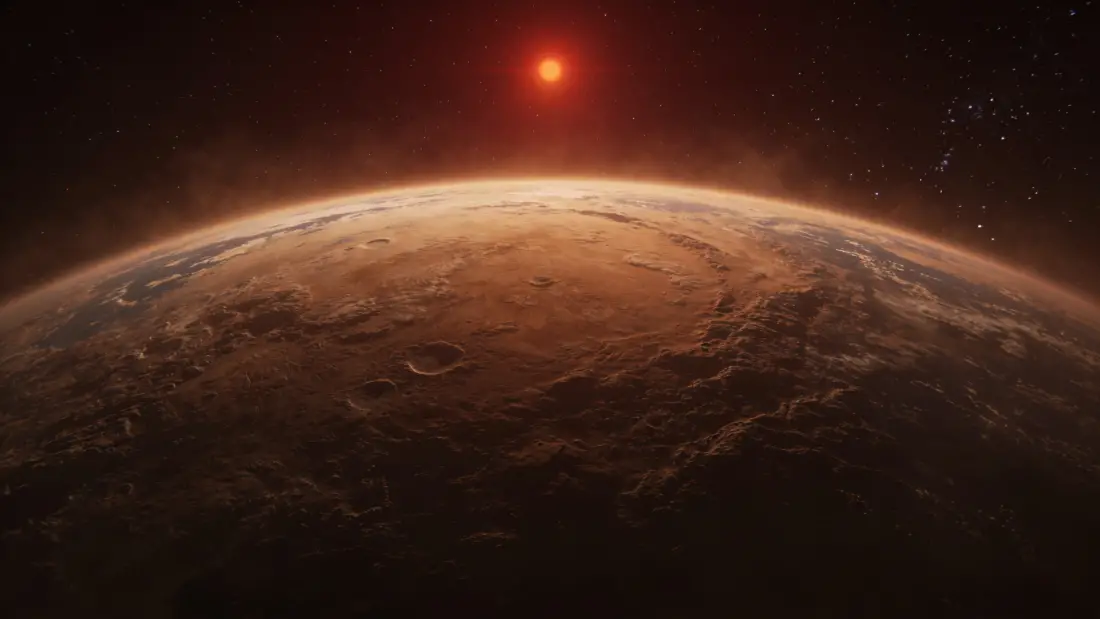
Most planets are too far away and too dim for us to photograph directly. So astronomers use clever tricks to find them — watching for the faint signals a hidden planet leaves behind. TOI-1080 b is one of those worlds, found in 2026 using a method that has discovered thousands of planets before it.
A Star 83.4 Light-Years Away
TOI-1080 b orbits a star called TOI-1080. That star sits about 83.4 light-years from Earth. A light-year is the distance light travels in one year — roughly 9.5 trillion kilometres. So 83.4 light-years is an almost unimaginable distance, yet in cosmic terms it is still our cosmic neighbourhood.
TOI-1080 is what astronomers call a red dwarf — a type of star that is smaller, dimmer, and cooler than our Sun. We know its surface is quite cool for a star: just 3,065 K. (K stands for kelvin, a temperature scale scientists use. For comparison, our Sun’s surface runs around 5,778 K.) Because red dwarfs are dim, any planet-finding signal stands out a little more clearly against their quieter light.
So far, only one planet is known in this system. That planet is TOI-1080 b.
The Transit Method — How a Tiny Shadow Gives a Planet Away
The transit method is the main way TOI-1080 b was discovered. Here is how it works, step by step.
- Astronomers point a telescope at a star and measure its brightness very carefully, over and over again.
- If a planet happens to orbit between us and that star, the planet blocks a tiny bit of the star’s light as it passes in front.
- This causes a small, regular dip in the brightness measurements — like a fly walking briefly in front of a lamp.
- If the dip repeats at steady intervals, that is a strong sign a planet is looping around the star on a fixed path.
The dip is very small. For a planet like TOI-1080 b, it might block only a fraction of one percent of the star’s light. Sensitive space telescopes can detect changes that small. This kind of careful watching — logging tiny brightness changes across thousands of stars — has turned out to be one of the most powerful planet-hunting tools we have. You can explore how it works yourself with our interactive planet-finding simulator.
What the Transit Told Us About Size

When a planet transits — crosses in front of its star — the depth of the brightness dip tells astronomers how big the planet is compared to the star. A bigger planet blocks more light, making a deeper dip. A smaller planet makes a shallower one.
From its transit signal, scientists worked out that TOI-1080 b has a radius about 1.2 times the radius of Earth. That makes it only slightly wider than our planet — not dramatically larger. On its own, though, size only tells part of the story. To understand what a planet is really like, you also need to know its mass. That requires a different method entirely.
The Wobble Method — Feeling a Planet’s Tug
The second key tool is called the radial velocity method, often nicknamed the wobble method. It works because gravity pulls in both directions.
We often say a planet orbits a star, but that is a small simplification. Really, the star and the planet each pull on the other. A massive planet tugs its star gently from side to side as it orbits. The star does not sit perfectly still — it wobbles a little.
Astronomers can detect this wobble by studying the star’s spectrum — the rainbow of colours in its light. When the star moves slightly toward us, its light shifts very faintly toward the blue end of the spectrum. When it moves slightly away, the light shifts toward the red end. This is called the Doppler effect, the same reason a siren sounds higher as it comes toward you and lower as it moves away.
By measuring those tiny colour shifts precisely, scientists can figure out how hard the planet is tugging — which tells them the planet’s mass.
What the Wobble Told Us About TOI-1080 b’s Mass
Combining the transit signal with radial velocity measurements, scientists found that TOI-1080 b has a mass about 10.7 times the mass of Earth. That is a significant number. The planet is only 1.2 times wider than Earth, yet it is more than ten times heavier.
When a planet is much heavier than its size alone would suggest, that usually means it is made of dense material — likely a lot of rock, and possibly a large iron core. Scientists sometimes call worlds in this size and mass range super-Earths or dense super-Earths. They are bigger and heavier than Earth, but probably still rocky rather than gassy. We don’t know for certain what TOI-1080 b is made of, but its density points strongly toward a rocky interior.
A Strange, Fast World
One of the most striking things about TOI-1080 b is how quickly it orbits its star. One full orbit takes only about 3.97 Earth days. Our own year is 365 days. TOI-1080 b completes its entire year in under four of ours.
This happens because the planet is orbiting very close to TOI-1080. The closer a planet sits to its star, the faster it must travel to stay in orbit — and the shorter its year becomes. Being so close to the star also means the planet receives a lot of heat. Scientists estimate its likely temperature is around 368 K, which works out to about 95 degrees Celsius. That is close to the boiling point of water.
TOI-1080 b sits well inside what astronomers call the habitable zone — the range of distances from a star where liquid water could exist on a planet’s surface. At 95 C, any surface water would most likely boil away. So while this world is fascinating, it does not appear to be a comfortable place for life as we know it.
What We Still Don’t Know
There is a great deal we haven’t measured yet. Scientists don’t have data on TOI-1080 b’s atmosphere — whether it has one at all, and what it might contain. We don’t know its exact surface conditions in detail, and we haven’t confirmed what its interior is made of. These are hard questions to answer from 83.4 light-years away.
Only one planet has been found in the TOI-1080 system so far, but that doesn’t mean others aren’t there. Many systems have yielded more planets as astronomers looked more carefully over time.
TOI-1080 b is a reminder of how much we can learn from a tiny dip in starlight and a subtle wobble in a distant sun. Two elegant methods, carefully applied, turned a faint star in the sky into a world with a measured size, a mass, a temperature, and a year — even if that year lasts less than four of our days.