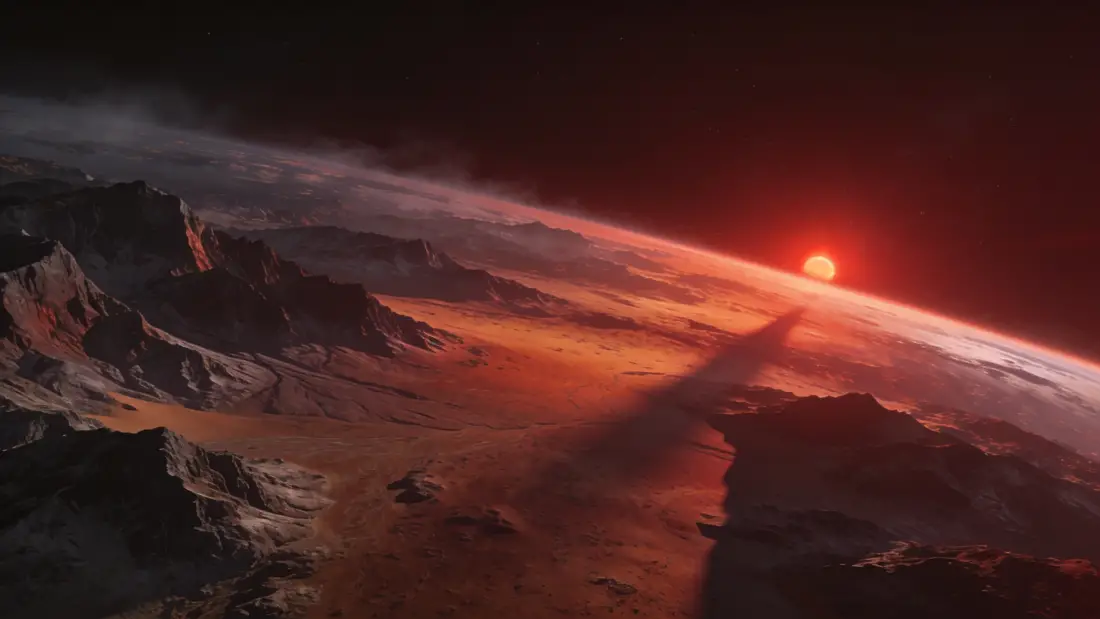
Just 23.6 light-years away — that’s close in cosmic terms — there is a small, dim star called GJ 4274. In 2026, astronomers confirmed that at least two planets travel around it. One of those worlds is GJ 4274 b, and the way scientists found it is a great example of some very careful detective work.
A Nearby Star with a Secret
When we say GJ 4274 is 23.6 light-years away, that sounds far. And it is, by everyday standards. But our galaxy is about 100,000 light-years across. In that sense, GJ 4274 is practically a neighbor. Even so, the planets around it are far too tiny and too dim to photograph directly with today’s telescopes. So how did scientists find GJ 4274 b?
The answer is that they watched the star, not the planet. Astronomers have two main tools for spotting planets they cannot see with their own eyes. One is called the transit method. The other is the radial velocity method, which is sometimes called the wobble method. GJ 4274 b was found using the wobble method. Understanding why takes a little explanation.
How the Wobble Method Works
Here is the key idea. We usually say a planet orbits a star, as if the star just sits perfectly still in the middle. But that is not quite right. The planet’s gravity — the force that pulls objects toward each other — actually tugs on the star too. A very massive planet tugs hard. A smaller planet tugs gently. Either way, the star moves a little. It wobbles.
That wobble is tiny. For a small planet like GJ 4274 b, the star shifts by only a few meters per second. That is about walking pace for a human. From 23.6 light-years away, there is no chance of seeing that motion through a telescope. But scientists can measure it in a clever way.
They use something called the Doppler effect — the same reason an ambulance siren sounds higher as it comes toward you and lower as it drives away. Light works the same way. When a star moves slightly toward Earth, its light gets compressed and shifts a little toward the blue end of the rainbow of colors. When the star moves slightly away, the light stretches and shifts toward the red end. By measuring these tiny color shifts very precisely, astronomers can figure out how fast the star is wobbling back and forth.
From that wobble, they can calculate the planet’s mass — how much matter it contains — and how long one orbit takes. It takes patient observation, repeated measurements, and careful analysis. But it works.
What the Wobble Told Us About GJ 4274 b
The measurements for GJ 4274 b came together to paint a clear picture. The planet has a mass of 2.97 times the mass of Earth. That makes it what scientists call a super-Earth — a rocky or part-rocky world bigger and heavier than our planet, but lighter than the ice giants like Neptune. Its radius, meaning how wide it is from its center to its surface, is 1.53 times Earth’s radius. So it is noticeably larger than our home planet, though not enormously so.
Those two numbers together — mass and radius — let scientists estimate how dense the planet is. Scientists think GJ 4274 b is probably rocky, though we don’t yet have enough detail to be fully certain about its inner structure. It could have a thin atmosphere, but that hasn’t been measured yet.
Why the Transit Method Wasn’t Used Here
The transit method works differently. In that approach, astronomers wait for a planet to pass directly in front of its star from our point of view. When it does, it blocks a small fraction of the star’s light, causing a tiny, regular dip in brightness. By measuring how much the light dips and how often, scientists can find a planet and learn its size.
The transit method is powerful, but it only works if the planet’s orbit lines up just right with Earth. Imagine looking at a spinning top from the side — you might see a small ball passing in front of it. But if you were looking at it from above, you would never see the ball cross in front at all. Most planets, seen from Earth, simply don’t line up that way. Their orbits are tilted at the wrong angle.
For GJ 4274 b, astronomers used the wobble method instead. This is useful because it doesn’t need that special alignment. As long as there is some movement along the line of sight between the star and Earth, the Doppler shifts are detectable. You can explore how both methods work side by side with the How We Find Them simulator.
A Very Short Year

One of the most striking things about GJ 4274 b is how fast it travels around its star. One full orbit — what we would call a year on that world — takes just 1.63 Earth days. That is less than two days. To complete an orbit that quickly, the planet must be orbiting very close to GJ 4274. Much, much closer than Earth is to our Sun.
Being that close to a star usually means being very hot. Whether that heat makes GJ 4274 b too harsh for life as we know it, scientists can’t say for certain yet. What we do know is that it sits well inside what is normally considered the habitable zone — the range of distances where liquid water could exist on a planet’s surface. So as far as we know, GJ 4274 b is likely a very warm world.
A Cool, Dim Star
The star GJ 4274 is what astronomers call a red dwarf — a small, cool star that burns much more dimly than our Sun. Its surface temperature is 3,228 Kelvin. Kelvin is a temperature scale used in science; for comparison, our Sun’s surface is about 5,778 Kelvin. So GJ 4274 is significantly cooler and dimmer. Red dwarfs are the most common type of star in our galaxy, and many of them have planets. Because they are dim, a planet has to orbit very closely to receive enough warmth — which is exactly the situation with GJ 4274 b.
Two Planets, One System
So far, astronomers have confirmed two planets in the GJ 4274 system. GJ 4274 b is one of them. The second planet hasn’t been the focus of as much published detail yet. Finding two planets around the same nearby star is a reminder that planetary systems are common. Most stars, it seems, are not alone — they carry worlds with them. The more carefully we look, even at our closest stellar neighbors, the more we find.
GJ 4274 b is a good example of how much patient science goes into a single discovery. No dramatic photograph, no direct image — just careful measurements of shifting starlight, repeated over time, slowly revealing a world 23.6 light-years away.