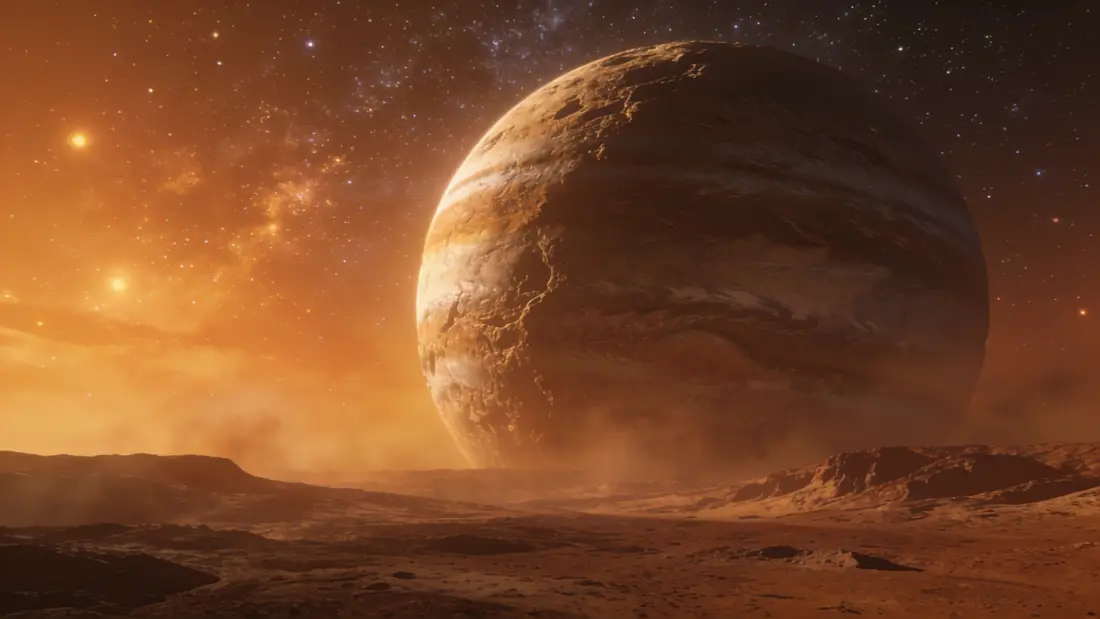
About 205 light-years from Earth, a small orange star hosts one of the most carefully arranged families of planets astronomers have ever found. The system is called TOI-178, and one of its members — TOI-178 e — is a world quite unlike anything in our own Solar System. Together, the six planets of TOI-178 tell a fascinating story about how planetary families can form and stay in step with each other across deep time.
A Star 205 Light-Years Away
TOI-178 is the name of both the star and the system around it. The star sits about 205 light-years from Earth. A light-year is the distance light travels in one full year — roughly 9.5 trillion kilometres — so 205 light-years is an almost unimaginably large gap. And yet, in the scale of our galaxy, it is actually a fairly close neighbour.
The star itself is cooler and smaller than our Sun. We know this because its surface temperature has been measured at 4,316 K. (K stands for Kelvin — a scale scientists use to measure temperature. To get a rough Celsius value, you can subtract 273.) Our Sun’s surface sits at around 5,778 K, so TOI-178 runs noticeably cooler. Stars like this are often called orange dwarfs or K-type stars. They burn steadily and can last far longer than our Sun, which makes them interesting places to look for stable planetary systems.
TOI-178 was studied closely because a space telescope spotted signs of planets passing in front of it. That survey gave scientists a first look at something surprising: not just one planet, but a whole crowd of them, moving in a pattern that seemed almost too tidy to be real.
Meet TOI-178 e
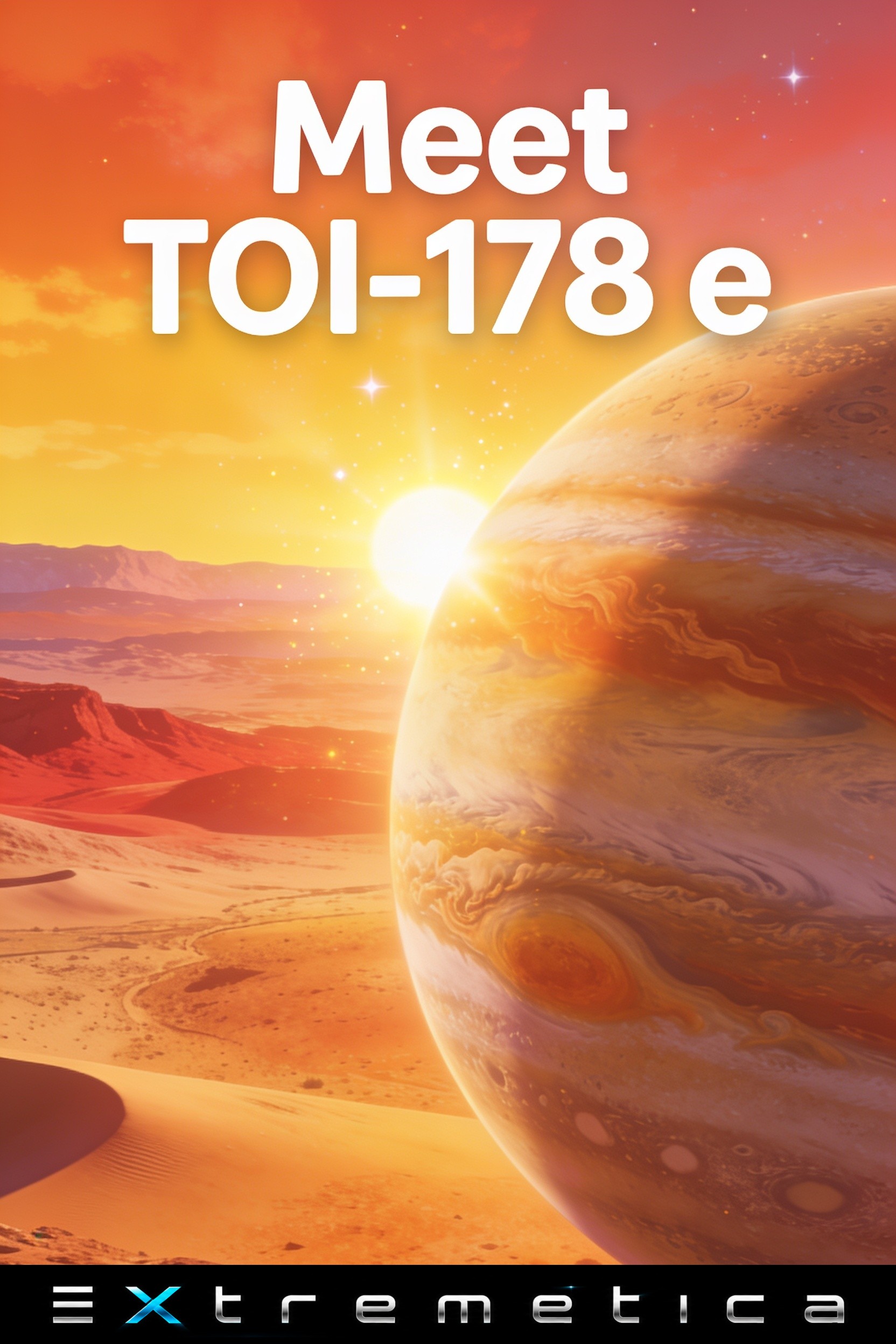
Of the six known planets in this system, TOI-178 e is one of the most closely studied. It was confirmed in 2021, found using a technique called the transit method — more on that shortly.
TOI-178 e has a radius about 2.3 times that of Earth. That makes it a type of world called a sub-Neptune — bigger than Earth but smaller than the planet Neptune in our Solar System. Its mass is about 3.48 times Earth’s mass. Knowing both the size and the mass lets scientists estimate how dense a planet is. TOI-178 e appears to be less dense than a rocky world like Earth, which hints that it probably has a thick atmosphere or a large amount of water or gas making up a good portion of its bulk. Scientists are still working out exactly what it is made of.
One orbit around its star takes TOI-178 e just 9.96 Earth days. That is a very short year. The planet sits much closer to its star than Earth does to the Sun, which has a direct effect on temperature. The estimated temperature of TOI-178 e is around 600 K — that is roughly 327 degrees Celsius. At that heat, liquid water as we know it would not survive on the surface. Scientists have not claimed any sign of life or habitable conditions here, and given what we know, none would be expected.
The Full Family of Six

TOI-178 e is one of six planets confirmed around this star, all announced together in 2021. The planets range in size and character, and they are all packed into a region that — if placed in our Solar System — would fit entirely inside the orbit of Venus.
The six planets are labelled b, c, d, e, f, and g, moving from closest to the star outward. The innermost planet, TOI-178 b, appears to orbit fastest of all, zipping around the star in just a few days. Specific measurements for some of the other planets — such as detailed masses or confirmed radii for all of them — are still being refined, and scientists have not yet released final confirmed values for every world. What is clear is that the planets vary quite a bit. Some seem denser and more rocky; others appear puffier, with lighter compositions, much like TOI-178 e. It is a genuinely mixed family living very close together.
This kind of crowded arrangement is not unusual for the universe, but it stands in sharp contrast to our own Solar System, where the inner planets are spread out much more widely.
A Cosmic Rhythm Called Resonance
What truly sets TOI-178 apart is something called orbital resonance. This is when two or more planets have year-lengths that form a simple mathematical ratio — like 1 to 2, or 2 to 3. When that happens, the planets nudge each other with gravity at regular, repeating intervals. Over millions of years, those nudges can lock the planets into a stable pattern, almost like gears that mesh together perfectly.
In TOI-178, five of the six outer planets appear to be locked into a resonance chain. Their orbits relate to each other in a sequence of simple ratios, which is rare and quite striking. Scientists think this kind of chain can only survive if the planets formed and settled into their orbits gently, without major collisions or large gravitational disturbances knocking them out of step. In a way, the neat resonance chain is a record of the system’s calm early history.
What makes TOI-178 even more unusual is that while the planets’ orbital timing is very regular, their sizes and likely compositions are not — they alternate between denser and fluffier worlds in a way that does not match the simple pattern astronomers might expect. Our own Solar System has rocky inner planets and gassy outer ones, a broad trend that makes sense with how planets form. TOI-178 does not follow that same neat rule, and that is genuinely puzzling to scientists.
How Scientists Found Them
All six planets in this system were identified using the transit method. The idea is straightforward: when a planet passes in front of its star from our point of view, it blocks a tiny fraction of the star’s light. Sensitive instruments can detect that small dip. By watching how often the dips repeat, scientists can figure out how long each planet’s year is. By measuring how deep the dip is, they can estimate the planet’s size.
Mass is harder to measure. For that, scientists often use a separate technique that looks at tiny wobbles in the star’s motion caused by the gravitational pull of its planets. Combining the two methods gave astronomers the radius and mass values we have for TOI-178 e. You can explore systems like this one in our system explorer, where confirmed planets are laid out alongside their key measurements.
What This System Teaches Us
TOI-178 is a reminder that planetary systems come in shapes and arrangements our Solar System never prepared us for. A tightly packed family of six, locked in a gravitational rhythm, orbiting a cool orange star — none of that matches home. Yet it obeys the same physics. The same forces of gravity, heat, and chemistry that shaped our worlds shaped these too, just in a different order and at a different pace.
Scientists hope that studying systems like TOI-178 will help them understand the many paths a young cloud of gas and dust can take as it collapses into a star and its family of planets. Each new system is, in its own quiet way, another data point in one of the biggest questions we have: how common are worlds like ours, and how many other kinds of worlds are out there waiting to be understood?