When scientists find a new planet far away, the first thing people want to know is simple: could anything live there? It sounds like an easy question. It isn’t. Let’s look at how scientists really decide if a planet might be a good home — and why the answer is almost never a clear “yes.”
The “just right” zone
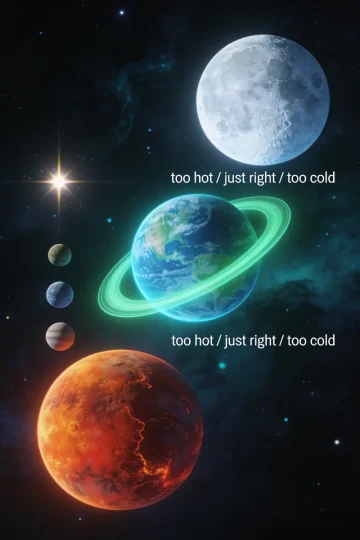
Think about the story of Goldilocks. One bowl of porridge was too hot. One was too cold. One was just right. Planets work a little like that.
Every star gives off heat, like a campfire. Sit too close to a fire and you get burned. Sit too far away and you freeze. But there is a “just right” spot in between. For a planet, that spot is called the habitable zone.
Why does the “just right” spot matter so much? Because of water. Every living thing we know of needs liquid water. Too close to the star, and a planet’s water boils away. Too far, and it freezes into ice. In the habitable zone, water can stay liquid. That’s why scientists look there first.
Earth sits right in the middle of the Sun’s habitable zone. That’s a big part of why we’re here. Want to see where a real planet falls? Try our Habitable Zone tool and test one yourself.
Every star has a different zone
Here’s something surprising. The “just right” zone is not in the same place for every star.
A big, bright, hot star pushes its zone far out. A small, cool star keeps its zone in close. Most stars in space are actually small and cool. They are called red dwarfs. Their habitable zone is so close that a planet there might finish a whole “year” in just a few days!
Being that close causes problems, though. The planet might always show the same side to its star. One side would have day forever. The other side would have night forever. Red dwarfs can also shoot out huge bursts of energy called flares, which can hurt a planet.
One famous star, TRAPPIST-1, has seven planets packed in close. A few of them are in the habitable zone. You can see them all spinning around their star in our System Explorer.
Being in the zone is not enough
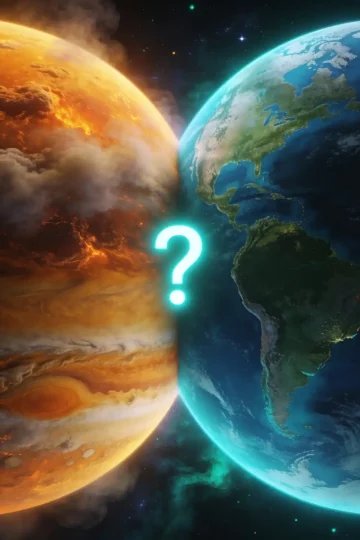
Now for the part that surprises a lot of people. A planet can be in the “just right” zone and still be a terrible place to live.
The best example is right next door: Venus. Venus is almost the same size as Earth. It sits near the edge of the Sun’s habitable zone. So it should be nice, right? Nope. The surface of Venus is about 460 degrees Celsius. That’s hotter than an oven. It could melt a metal spoon.
Why is Venus so hot? Because of its air. Venus is wrapped in a thick, heavy blanket of gas. The blanket traps heat and won’t let it escape, like a car with the windows rolled up on a sunny day. So the zone is only the first thing to check. A planet’s air matters just as much.
What else does a planet need?
To be a real home, a planet needs more than just the right spot. It also needs:
- Solid ground. The planet has to be rocky, like Earth. Some planets are giant balls of gas with no ground at all. You can explore which planets are rocky in our Mass–Radius tool.
- The right air. Not too thin, not too thick — just enough to keep it warm and protect it.
- A calm star. A star that doesn’t blast it with too much dangerous energy.
- Lots of time. Life on Earth took billions of years to grow. A good home needs to stay safe for a very long time.
The tricky part? We can’t measure most of these things yet for planets that are so far away. So when you hear a planet is “maybe habitable,” it usually just means it’s about Earth’s size and in the zone. That’s a good reason to look closer. It is not proof that anything lives there.
Which planets are the most like Earth?
Scientists made a score to help. It compares a planet’s size and temperature to Earth. Earth gets a perfect score of 1. The closer a planet is to 1, the more it looks like Earth.
But be careful with that word “like.” A planet can look like Earth and still not be alive. Remember Venus? It would get a pretty high score too! You can see the planets that look the most like home on our Most Earth-like Worlds list.
How do we even see these planets?
Here’s a fun secret: we almost never see the planets at all. They are too far and too dim. Instead, we watch the star.
When a planet passes in front of its star, it blocks a tiny bit of light. The star looks a little dimmer for a moment. That tells us the planet’s size. The planet’s gravity also gives the star a little tug, making it wobble. That tells us how heavy the planet is. From these tiny clues, scientists figure out the rest. You can try both tricks yourself in our How We Find Them simulator.
So, have we found another Earth?
Scientists have found more than 6,000 planets around other stars. A few of them are about Earth’s size and sit in the habitable zone. That is amazing!
But here is the honest answer: we have not found another Earth. Not yet. What we have is a map that shows us the best places to look. The search is just getting started.
Want to explore for yourself? Browse all the planets in our Atlas, test a world in the Habitable Zone tool, or check out the ones that look the most like home on the Earth-like list. And the next time you hear that scientists found a “habitable” planet, you’ll know the real question to ask: is it really, or is it just in the zone?